

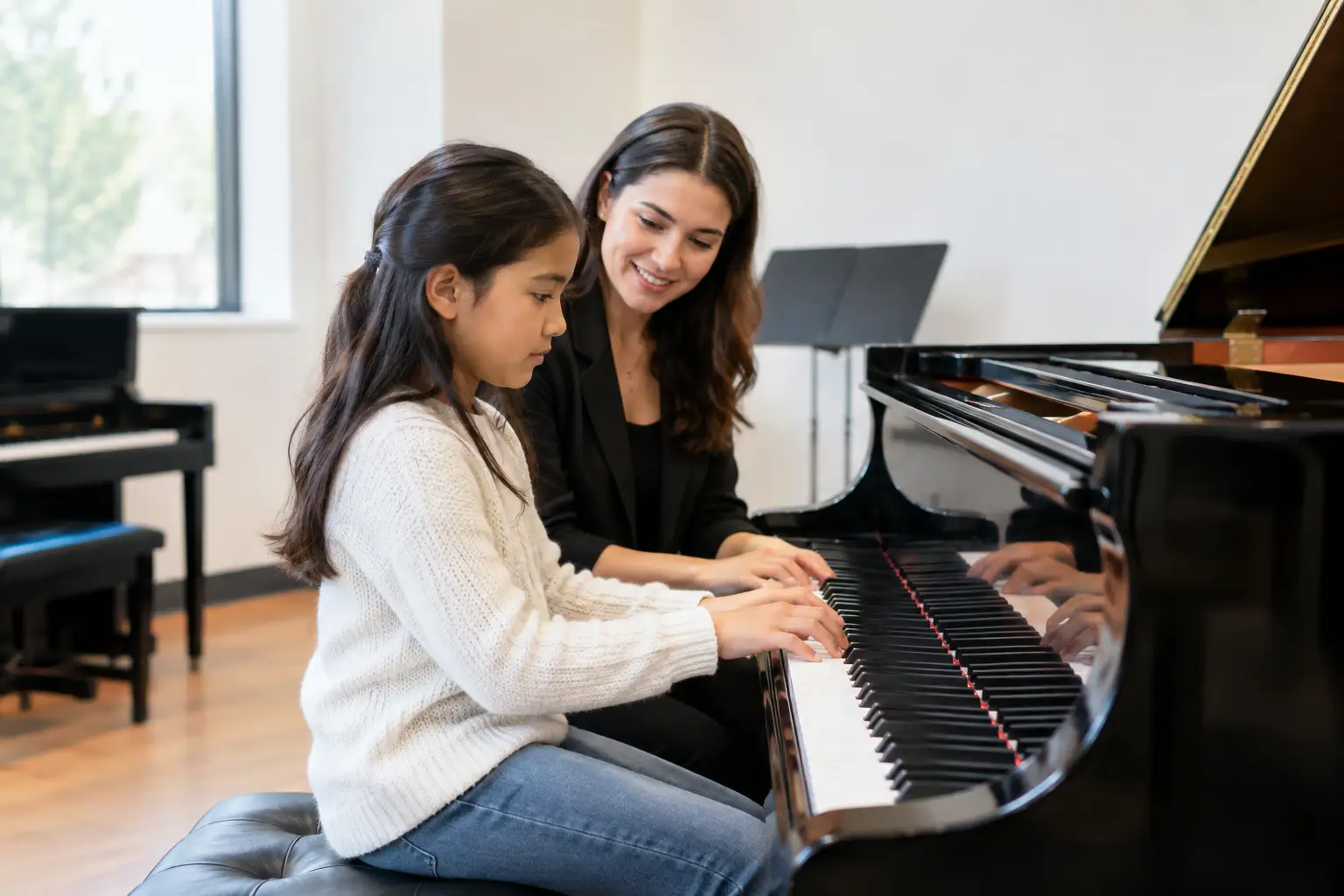
A school piano is asked to do far more than look impressive in a music room. It must hold up to daily student use, respond consistently under developing hands, support teachers across multiple levels, and remain musically rewarding after years of lessons, rehearsals, and performances. The best piano for music school programs is rarely just the largest instrument the budget will allow. It is the piano that fits the school’s rooms, curriculum, maintenance plan, and long-term standards.
For a small private studio, one exceptional upright may be the right foundation. For a growing school with group classes and recital needs, the better answer may be a carefully planned mix of upright, digital, and grand pianos. Choosing well begins with understanding how each instrument will actually be used.
Start With the School’s Daily Piano Needs
A piano for beginner instruction has different demands than one used for faculty performance or advanced repertoire. Before comparing brands and models, identify where the instrument will live and who will play it. A reception-area piano may need an attractive cabinet and a compact footprint. A teaching room needs a stable action and reliable tuning. A recital hall needs projection, tonal color, and a scale that can carry through the room without becoming harsh.
Student traffic matters as much as musical ambition. In a school where several instructors teach all day, a piano may receive more playing hours in one year than a typical home piano receives in several. That level of use favors proven construction, quality action parts, and an instrument that can be serviced without difficulty.
Also consider whether students will practice independently. A piano that feels noticeably different from the recital instrument can make technical development harder. Whenever possible, keep the touch and tone of practice pianos within a reasonably consistent standard, even if the sizes vary from room to room.
Best Piano for Music School: Upright or Grand?
The upright versus grand decision should be practical, not ideological. A well-prepared professional upright can be an excellent teaching piano. A grand piano is not automatically the best option if it leaves too little room for instruction, seating, or proper climate control.
Upright pianos for studios and classrooms
For many music schools, quality uprights provide the strongest value. Professional and studio uprights offer a larger soundboard, longer strings, and a more substantial action than entry-level console pianos. They are designed to deliver clearer tone and greater control while using far less floor space than a grand.
A Yamaha U3, for example, has long been a respected choice for serious teaching environments because of its dependable action, strong tonal presence, and ability to withstand regular use when properly maintained. Comparable professional uprights from other established makers can also serve schools beautifully, particularly when they have been carefully inspected, regulated, and voiced.
Uprights make particular sense for individual lesson rooms, theory classrooms, practice studios, and satellite locations. Their smaller footprint can allow a school to equip multiple rooms with acoustic instruments instead of concentrating its budget on one grand.
Grand pianos for performance and advanced study
A grand piano becomes especially valuable in a recital hall, larger teaching studio, audition space, or faculty room. Its horizontal action offers a level of repetition, control, and dynamic nuance that advanced pianists recognize immediately. The longer strings and larger soundboard also create more sustaining power and tonal depth.
Size should match the room. A 5-foot to 6-foot grand can be a superb choice for a teaching studio or intimate recital setting. Larger instruments, including 7-foot and concert grands, belong in rooms with enough volume to let the sound bloom. A grand that overwhelms the room is not a musical advantage. It can make ensemble work, spoken instruction, and student performances unnecessarily difficult.
Premium instruments from makers such as Steinway & Sons and Blüthner can be exceptional long-term assets for schools with demanding performance programs. They also require a realistic plan for climate stability, tuning, voicing, and technical service. The right instrument deserves the right care.
Do Not Compromise on Touch and Action
Students build technique through repetition. If a piano has uneven key weight, sluggish repetition, excessive friction, or inconsistent regulation, students can begin compensating for the instrument rather than learning efficient control. This is one reason a school should assess the action condition of any used or vintage piano as carefully as its exterior appearance.
A good school piano should feel even from the bass to the treble. Notes should repeat promptly, keys should return reliably, and the pedals should operate quietly and predictably. Teachers should test soft playing, repeated notes, scales, chords, and quick changes in dynamics. The piano does not need to feel identical to every other instrument in the building, but it should reward correct technique.
For acoustic instruments, regulation is not a one-time event. Normal use gradually changes how an action feels. A school that schedules regular tuning but ignores regulation for years will eventually notice a decline in playability. Ongoing technical care protects both the instrument and the quality of instruction offered on it.
Consider Digital Pianos as a Strategic Addition
Digital pianos can be useful in a music school, but they work best when selected for the right role. They are practical for keyboard labs, theory rooms, beginning group classes, and late-evening practice where headphones are needed. They also eliminate tuning concerns in rooms with unstable temperature or humidity.
The trade-off is that even high-quality digital actions and speaker systems do not fully replace the physical response and acoustic resonance of a fine acoustic piano. Students who study only on digital instruments may have difficulty adjusting to an acoustic piano’s pedals, tonal range, and key response.
A balanced program often uses digital pianos to expand access while preserving acoustic pianos for private lessons, serious practice, juries, and recitals. If choosing digitals, prioritize models with weighted keys, convincing pedal response, durable cabinetry, and controls that are simple for students and faculty to use.
New, Used, or Restored: Choose Condition Over Assumptions
New pianos offer predictable condition, current manufacturing standards, and warranty coverage. They can be an excellent fit for schools that want dependable instruments with a known service history from day one. However, a new piano is not the only responsible choice.
A quality used or restored piano can provide remarkable musical value when it has been evaluated by an experienced piano professional. The key question is not simply the instrument’s age. It is the condition of its soundboard, pinblock, strings, hammers, action components, structure, and finish, along with the quality of any previous restoration work.
Some vintage instruments have a level of material quality and character that newer pianos cannot easily replicate. Others may require significant rebuilding before they are suitable for institutional use. A school should avoid purchasing based on a famous name alone. The individual piano must be assessed on its present musical and mechanical condition.
Budget for the Ownership Experience
The purchase price is only one part of the school’s investment. Acoustic pianos need regular tuning, usually at least twice yearly and often more frequently in high-use settings. Schools should also plan for humidity management, periodic regulation, voicing, repairs, and professional moving whenever rooms are reconfigured.
Trying to save money through improper transportation can create costly damage to a piano’s cabinet, action, or internal structure. Professional piano movers use the equipment, wrapping methods, and trained handling required for instruments that may weigh several hundred pounds. This is especially important for stairs, tight corridors, and multi-room installations.
A realistic budget may also include bench replacement, protective covers, caster cups, room acoustics, and insurance. These details are not glamorous, but they help preserve the instrument and make daily use more comfortable for students and teachers.
Build a Piano Plan That Can Grow With the School
Rather than treating each piano purchase as an isolated decision, create a simple instrument plan. Place the strongest acoustic piano in the room where it will have the greatest educational impact. Use durable professional uprights in high-traffic teaching rooms. Add digital instruments where flexibility, headphones, or multiple student stations make sense. Then schedule maintenance before problems interrupt instruction.
At A440 Pianos, we help schools evaluate new, used, vintage, upright, grand, and electric piano options with the full ownership experience in mind, including delivery, tuning, repair, restoration, and future support. The goal is not to push every school toward the same instrument. It is to place the right piano in the right room for the musicians who will grow with it.
A well-chosen school piano becomes part of a student’s musical memory: the instrument on which first scales become confident phrases, a hesitant recital becomes a proud performance, and a young musician hears what careful playing can truly sound like.

0 Comments