


A digital piano versus acoustic piano decision rarely comes down to sound alone. It comes down to the room where the instrument will live, the player who will use it, the hours when music happens, and whether the piano is meant to be a practical learning tool, a serious performance instrument, or a lasting part of the home.
For some buyers, a quality digital piano is the smart answer: compact, flexible, and ready for private practice at any hour. For others, only an acoustic piano provides the physical response, tonal complexity, and visual presence they have been searching for. Both can be excellent instruments. The right choice depends on what you expect the piano to do over the next several years.
Digital Piano Versus Acoustic: The Essential Difference
An acoustic piano creates sound mechanically. When a key is pressed, a felt hammer strikes strings, and the soundboard amplifies the vibration. Every part of that chain affects the result: the action, hammers, strings, soundboard, cabinet, condition, regulation, and the player’s touch. It is a living mechanical instrument, which is why a fine grand or upright can feel deeply individual.
A digital piano creates sound electronically through recorded samples or modeled piano tones, delivered through speakers or headphones. Its keys may use weighted or graded hammer action to imitate an acoustic piano, but no strings or soundboard are involved. A well-designed digital instrument can be remarkably convincing, particularly for practice, casual playing, and many teaching environments.
The distinction matters because an acoustic piano does not simply reproduce a piano sound. It responds to the player in real time through its physical mechanism. That interaction is especially meaningful for advancing students, professional musicians, educators, and players who care about dynamic range, voicing, and tonal color.
Touch and Musical Expression
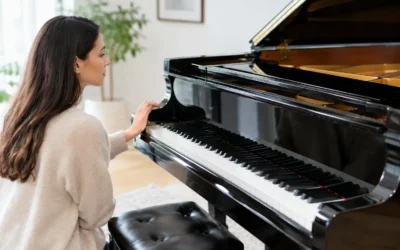
The action is often the deciding factor for serious players. Acoustic piano actions provide resistance, repetition, and weight that vary naturally from key to key. On a properly regulated instrument, a pianist can control a whisper-soft pianissimo, build a powerful crescendo, and repeat fast notes with confidence. The pedals also shape the sound in ways that are difficult to fully duplicate electronically.
Premium digital pianos have made major progress. Many feature fully weighted keys, escapement simulation, wooden-key components, and sophisticated pedal systems. For beginners and intermediate players, a quality digital action can support healthy technique far better than an inexpensive keyboard with light, springy keys.
Still, the experience is not identical. Digital actions are engineered to approximate a piano feel; acoustic actions are the piano feel. A serious student preparing for auditions, competitions, conservatory study, or regular performances will usually benefit from regular access to an acoustic instrument. That does not mean every beginner needs a grand piano. It means touch should be considered as carefully as budget and appearance.
Why Tone Changes the Experience
An acoustic piano produces layers of sound that shift with the player’s touch. The same note can have a bright attack, a warm singing quality, or a darker, more restrained character depending on how it is played and how the piano has been voiced. Notes resonate with one another, and the sound develops throughout the room rather than simply coming from a speaker.
That complexity is a major reason premium acoustic pianos remain desirable. A well-maintained Yamaha, Kawai, Baldwin, Steinway, or vintage European instrument can offer a musical personality that becomes part of a player’s identity.
Digital pianos offer consistency instead. The sound is predictable at low or high volume, and many models provide multiple voices, recording functions, metronomes, and accompaniment features. Those options can encourage practice and creativity. But if the goal is the depth and presence of an acoustic piano performance, electronics still have limitations.
Space, Volume, and Everyday Convenience
This is where digital pianos have a clear advantage. They are typically lighter, slimmer, and easier to place in an apartment, bedroom, office, or multipurpose room. Headphone capability is invaluable for households with sleeping children, nearby neighbors, or different schedules. A player can practice scales at midnight without filling the house with sound.
A digital piano also starts at a consistent pitch every time it is turned on. There is no seasonal tuning appointment, and moving it is generally less complex than moving an upright or grand piano.
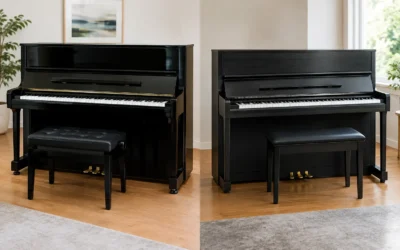
An acoustic piano asks more of its environment, but it gives more back in presence. Even a well-proportioned upright becomes a significant piece of furniture, while a grand piano can define an entire room. It needs a stable location away from direct sunlight, excessive humidity, heating vents, and frequent temperature changes. These considerations are manageable with professional guidance, but they should be part of the purchase decision.
For churches, studios, schools, and homes where the piano is central to gatherings and performances, an acoustic instrument often feels appropriate in a way that a digital piano may not. Its visual authority matters as much as its sound.
Maintenance and Ownership Costs
Acoustic pianos require routine care. Most need tuning about once or twice a year, depending on use and environmental conditions. Over time, they may need regulation, voicing, minor repairs, or restoration work. These services protect the instrument’s performance and help preserve its value.
Buyers should view this care as part of ownership, not as an unexpected burden. A premium piano is a complex instrument with thousands of moving parts. When it is maintained by experienced technicians, it can offer decades of musical service. Many vintage and pre-owned pianos remain exceptional precisely because they have been properly restored and cared for.
Digital pianos need less routine maintenance, but they are not maintenance-free forever. Speakers, circuit boards, key sensors, and connections can eventually fail. Technology also changes. A digital model purchased today may feel dated long before a well-built acoustic piano reaches the end of its useful life.
This creates an important value difference. An acoustic piano from a respected maker, selected carefully and kept in excellent condition, may retain meaningful value and can become an heirloom. Digital pianos generally depreciate more like other consumer electronics, even when they are high quality.
Choosing for the Player, Not Just the Price
A digital piano is often the right choice for a beginner who needs quiet practice, a family with limited space, a musician who travels or performs with electronic equipment, or a studio that needs flexible sounds and easy recording. It can remove practical barriers that might otherwise prevent someone from playing regularly.
An acoustic piano is often the stronger investment for a committed student, an experienced pianist, a teacher, a collector, or a buyer furnishing a home around music. It offers a more complete playing experience, lasting craftsmanship, and a level of beauty that a digital instrument cannot fully replace.
There is also a middle ground. Some families begin with a premium digital piano, then upgrade once a student shows sustained commitment. Others own both: a grand or upright for lessons and performance, plus a digital piano for silent practice. Neither path is wrong if it supports consistent playing.
What to Consider Before You Buy
Before making a final decision, play several instruments whenever possible. Listen beyond the first impressive sound. Test quiet playing, repeated notes, bass clarity, pedal response, and how the instrument feels after twenty minutes rather than two. If you are purchasing an acoustic piano, ask about its age, condition, service history, tuning stability, and any restoration work completed.
Delivery and support deserve equal attention. A piano purchase is not finished when the instrument leaves the showroom. Professional moving protects both the piano and the home, while ongoing tuning and repair support protect your investment. At A440 Pianos, buyers can evaluate premium acoustic and electronic options with the benefit of experienced guidance, delivery coordination, and long-term service.
The best piano is the one that invites you to sit down tomorrow, then keeps rewarding you years from now. Choose the instrument that fits your space and schedule, but do not underestimate the value of an instrument that makes every practice session feel worth your time.

0 Comments