

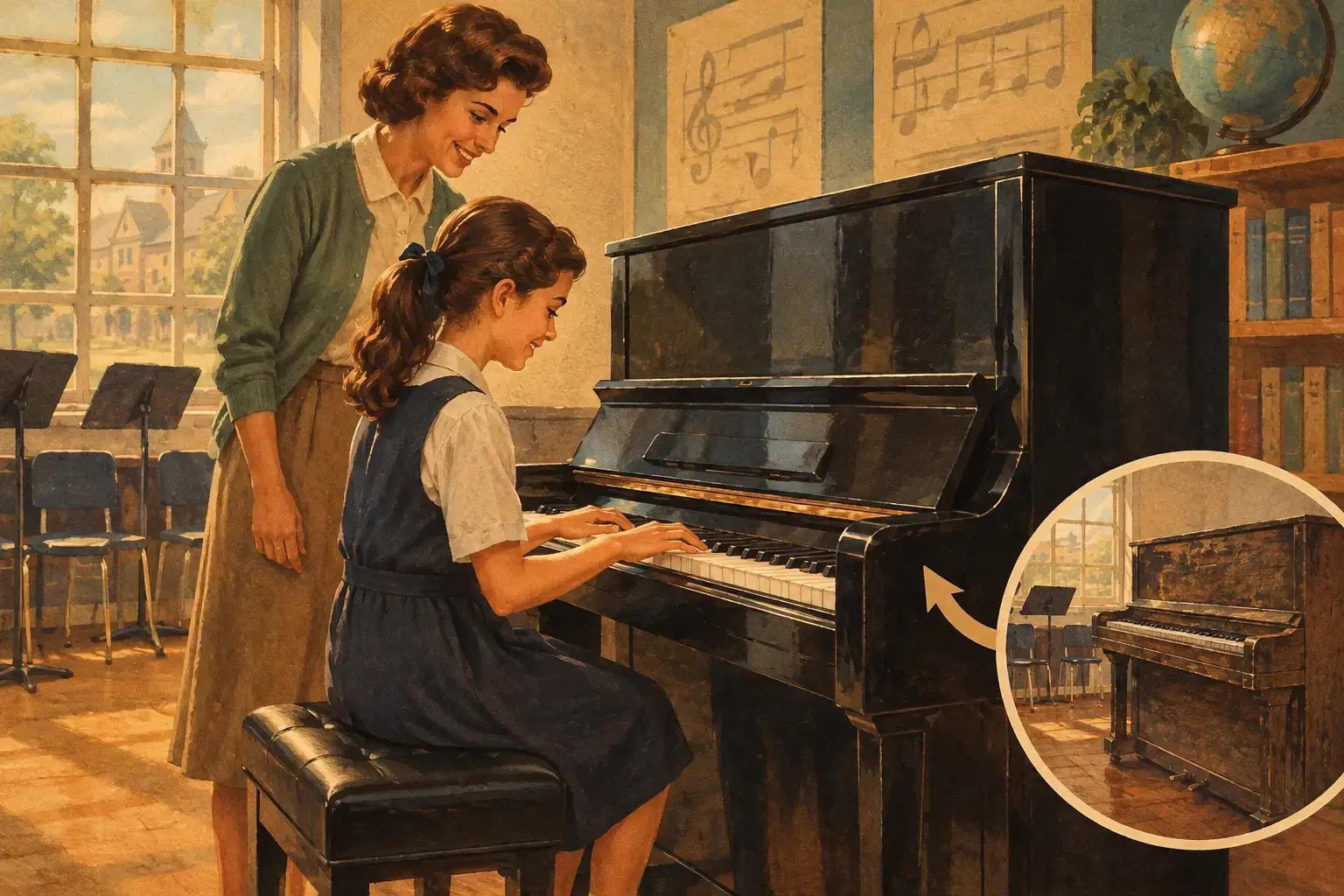
The auditorium piano had reached the point where every performance carried a risk. Several keys responded unevenly, the bass had lost clarity, and the instrument would not hold stable tuning through busy concert seasons. This school piano replacement case study follows a representative replacement project and the decisions that turned a recurring maintenance problem into a long-term musical investment.
The school was not looking for a decorative piano or the lowest possible price. It needed an instrument that could support beginning students in daily instruction, accompany choirs, serve faculty rehearsals, and sound credible in front of families at evening performances. Those are different demands from those of a private home, and they require a more deliberate purchase process.
The Starting Point: A Piano That Could No Longer Serve the Program
The existing upright had been in the building for decades. Its age alone was not the issue. Well-maintained vintage pianos can remain beautiful instruments for many years. The problem was cumulative wear combined with heavy institutional use, changing room conditions, and deferred repairs.
Teachers reported sticky keys, inconsistent repetition, and a tonal range that made it difficult to teach dynamics. The music director also faced an uncomfortable reality: tuning the piano before a concert improved it briefly, but did not correct underlying action and structural concerns. Continuing to spend money on short-term repairs would have preserved access to a piano, but not the standard of musical experience the school wanted to provide.
Before shopping, the school established three practical requirements. The replacement needed to be durable enough for frequent student use, musical enough for performances, and sized appropriately for a multipurpose rehearsal room. A concert grand would have been impressive, but it would have consumed too much floor space and budget. A small entry-level upright, while less expensive, risked repeating the same compromise within a few years.
School Piano Replacement Case Study: Setting the Right Criteria
The committee included the music director, an administrator, a facilities representative, and a parent volunteer with piano experience. That mix helped the school assess the purchase from several angles: musical quality, budget, building access, daily use, and future maintenance.
Rather than asking only, “What piano can we afford?” the committee asked, “What instrument will still meet our needs after years of student use?” That distinction changed the outcome.
The group prioritized a professional-quality upright piano from an established manufacturer. A larger upright offered the depth of tone and responsive action needed for instruction while remaining practical for the room. Its vertical design also made it easier to position safely against an interior wall without limiting rehearsal space.
Brand reputation mattered, but it was not treated as a substitute for inspection. A respected Yamaha, Kawai, Baldwin, Steinway, or comparable instrument can be an excellent school choice when its condition, service history, and musical character match the program. Each piano still needs to be evaluated individually. The best name on the fallboard cannot compensate for worn action parts, soundboard issues, or a poor fit for the room.
The school also recognized the difference between a used piano and an unknown piano. A premium pre-owned instrument can offer significant value when it has been properly assessed, prepared, and supported by a piano specialist. In contrast, an inexpensive piano from a general marketplace may arrive with hidden transportation damage, neglected maintenance, or repair needs that quickly erase the initial savings.
Why the School Chose a Professional Upright
After comparing several options, the committee selected a late-model professional upright with a full, clear tone and a responsive touch. The instrument had enough projection for choir rehearsals and small recitals without overwhelming the room. Its action gave advanced students meaningful control, while beginners could develop proper technique on a keyboard that responded consistently.
A grand piano remained appealing for formal performances. If the school had a dedicated recital hall, a grand would have deserved serious consideration. In this case, however, the room hosted classes, meetings, and rehearsals throughout the week. The upright delivered the strongest balance of musical return, space efficiency, and long-term practicality.
The decision also reflected a crucial point for education programs: students learn from the instrument under their hands. A piano with poor regulation, uneven voicing, or unreliable tuning can make basic technique unnecessarily frustrating. A well-prepared instrument gives teachers a dependable foundation for discussing articulation, balance, pedal control, and tone production.
Delivery Was Part of the Purchase, Not an Afterthought
The facilities representative raised a question that is often overlooked until too late: how would the piano reach the music room? The building had a narrow service entrance, a short exterior stair run, and a hallway with tight turning space. A standard furniture mover was not the right answer.
Professional piano delivery begins with an access assessment. The delivery team needs accurate measurements for doors, hallways, turns, stairways, elevators, and the final placement area. They also need to know whether the floor can support the instrument, where students circulate, and whether scheduling must avoid school arrival and dismissal periods.
For this project, the school selected a delivery window during a quiet campus period. The old piano was removed first, the path was protected, and the replacement was placed on a stable interior wall away from direct sunlight, exterior doors, and HVAC vents. Those details protect both the piano and the building.
The placement decision was especially valuable. Pianos respond to changes in temperature and humidity. Positioning one near an air vent or frequently opened exterior door can lead to faster tuning changes and more stress on the instrument over time. A piano should also be placed where teachers can hear it clearly and students can gather safely around it.
Building a Service Plan Around the School Calendar
A replacement piano is not a one-time transaction. It needs scheduled care, especially in an environment where many hands use it each week.
The school set up regular tuning appointments around the academic calendar, with additional attention before major concerts. For many school instruments, twice-yearly tuning is a sensible baseline. More frequent service may be appropriate for heavily used pianos, instruments in variable climates, or programs with demanding performance schedules.
Tuning alone is not the whole plan. Periodic regulation keeps the action even, so keys respond with consistent resistance and repetition. Voicing can refine a piano that becomes overly bright or harsh in a live room. Small repairs should be handled promptly before they become interruptions during rehearsals or performances.
The music department also assigned clear responsibility for the instrument. Staff members knew who could approve service, who would report issues, and how the piano should be secured when the room was unsupervised. This was not restrictive. It protected a major school asset while ensuring that teachers could rely on it every day.
The Results: Better Rehearsals and Greater Confidence
The change was immediate in the areas that mattered most. Teachers no longer had to work around unreliable notes or apologize for an instrument that did not reflect the quality of the program. Choir rehearsals became easier to lead because accompaniment carried with more clarity. Students practicing for auditions had a more consistent keyboard, and families heard a noticeable difference at performances.
The financial result was equally practical. The school spent more upfront than it would have on a basic consumer-grade piano, but it avoided buying an instrument likely to require early replacement or extensive correction. By choosing quality, professional delivery, and ongoing service together, the school gained a stronger total value proposition.
A440 Pianos helps schools evaluate premium used and specialty pianos with the delivery, tuning, repair, and restoration support that responsible institutional ownership requires.
What Other Schools Should Take From This Case Study
A school piano should be chosen for its role, not simply its price tag. Start by defining where it will be used, how often it will be played, who will play it, and what performances it must support. Then evaluate the instrument’s condition, musical response, size, access route, and service needs as one connected decision.
The right replacement may be a professional upright, a baby grand for a dedicated performance space, or a larger grand for a serious arts program. It depends on the room, the budget, and the ambition of the department. What should not be compromised is preparation: a piano must be inspected, delivered correctly, placed thoughtfully, and maintained with the same care the school expects from its students.
A dependable piano gives a music program more than accompaniment. It gives teachers a reliable teaching tool, students an instrument worthy of their effort, and every performance a stronger chance to be remembered for the music rather than the equipment.



0 Comments