


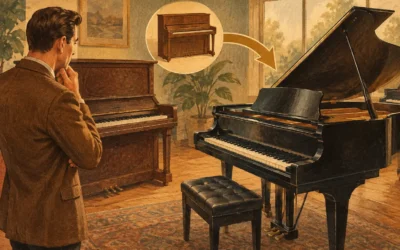
A beautiful old piano can stop a room cold. The cabinet has presence, the name on the fallboard carries history, and one chord can reveal a tone modern instruments rarely imitate. But age brings questions. A proper vintage piano restoration service is not just about making an old piano look better. It is about deciding whether the instrument deserves careful rebuilding, selective repair, or preservation in its current form.
For buyers, collectors, churches, studios, and serious families, that distinction matters. Some vintage pianos are excellent candidates for restoration and can deliver decades of musical performance. Others are better suited to limited repair or replacement. Knowing the difference protects both your investment and your musical expectations.
What a vintage piano restoration service actually includes
The phrase sounds broad because it is. Restoration can range from focused cosmetic work to a comprehensive rebuild of the piano’s structure, action, and finish. On a true vintage instrument, especially a premium grand or upright from a respected maker, the work usually begins with a full technical evaluation.
That inspection looks beyond appearance. A piano may have an elegant cabinet and a recognizable brand name, yet still have cracked bridges, worn hammer felt, loose tuning pins, or sluggish action parts. A serious restoration plan considers the soundboard, bridges, pinblock, strings, plate, action geometry, pedals, keyframe, keytops, cabinet finish, and structural integrity.
This is why restoration is never one flat-price service. Two pianos of the same model and age can need very different work. One may only need regulation, voicing, minor repair, and cabinet touch-up. Another may require restringing, action rebuilding, refinishing, and extensive structural correction before it can perform at a high level.
When restoration makes sense
Not every old piano should be restored, even if it comes from a famous maker. The right candidate usually has three things going for it: strong original quality, meaningful musical potential, and enough structural health to justify the cost.
Premium brands often respond especially well to expert restoration because the original scale design, materials, and craftsmanship were worth preserving in the first place. A vintage Steinway, Baldwin, Bluthner, Yamaha, or Kawai can be a compelling restoration project if the piano has not been compromised by severe neglect, water damage, or poorly executed prior repairs.
Sentimental value can also be a legitimate reason to restore. A family piano with deep personal meaning may justify investment even if the financial return is secondary. Still, the honest conversation should happen first. If a piano will never become a stable, satisfying musical instrument, a reputable technician should say so.
The difference between repair, rebuilding, and full restoration
This is where many buyers get misled. A piano can be advertised as restored when it has only received tuning, polishing, and a handful of replacement parts. That may improve presentation, but it is not the same as a full restoration.
Repair addresses specific problems. Replacing a broken hammer shank, fixing a pedal issue, or correcting a few sticking keys falls into this category. Rebuilding goes deeper and often focuses on major mechanical or structural systems such as the action, pinblock, bridges, or strings. Full restoration usually combines rebuilding with cosmetic renewal, detailed regulation, voicing, and finishing work so the instrument is both musically and visually elevated.
The right level depends on how you plan to use the piano. A decorative instrument in a formal living space may not need the same standard as a teaching studio piano or a serious performance grand. That is not cutting corners. It is matching the service to the purpose.
What to expect from the restoration process
A high-level vintage piano restoration service starts with diagnosis, not promises. The technician or restoration team should document the piano’s condition, explain what is original, identify what has failed or worn out, and recommend a realistic path forward.
From there, the work is usually staged. Structural issues come first because there is little value in refining touch and tone on an unstable foundation. If needed, the piano may be disassembled for plate removal, soundboard and bridge work, pinblock replacement, or restringing. Action rebuilding may involve new hammers, shanks, flanges, wippens, key bushings, backchecks, and felt components, followed by detailed regulation.
Voicing happens near the end, once the action is responsive and consistent. This is where a restored piano begins to show its personality. Tone can be bright, warm, clear, or more rounded depending on the instrument, the hammer choices, and the owner’s goals. Final cabinet work may include touch-up, satin or high-polish refinishing, hardware renewal, and case detail work.
Good restoration takes time. That is not a drawback. It is part of the value. Precision work on a vintage instrument should not be rushed, especially when long-term performance is the goal.
How restored tone and touch should feel
The best restorations do not erase a piano’s character. They reveal it. A vintage grand with a rich bass, singing treble, and complex midrange should still sound like itself after restoration, only cleaner, stronger, and more controllable. Likewise, the action should feel responsive and even, not generic.
This is one of the biggest trade-offs in restoration. Some owners want a piano to feel almost new. Others want to preserve as much original character as possible. Both are valid, but they lead to different decisions about parts, voicing, and finish. The right service provider will talk through those choices rather than forcing a one-size-fits-all result.
Cost, value, and the investment question
Restoration can be a smart investment, but it is not automatically the cheapest route to owning a premium piano. Cost depends on the instrument, the depth of work, parts selection, finish requirements, and transportation logistics. A modest repair plan is very different from a complete premium rebuild.
The financial question should be framed correctly. You are not simply asking what the restoration costs. You are asking what you will have when the work is complete. If the result is a musically strong, visually refined instrument with decades of life ahead, the value can be substantial. If the piano remains limited despite major spending, the numbers become harder to justify.
For many buyers, restored vintage pianos occupy a highly attractive middle ground. They offer brand heritage, tonal maturity, and visual distinction that can be difficult to find in newer instruments at the same overall price point.
Choosing the right vintage piano restoration service
This is not the moment to shop on price alone. Restoration quality depends on judgment, technical standards, parts quality, and after-service support. A premium service should be able to explain exactly what is being done and why.
Ask direct questions. Has the piano been restrung or only cleaned? Were the hammers replaced, reshaped, or merely voiced? Is the finish original, refreshed, or fully refinished? Was the action regulated to performance standard? Were tuning stability issues addressed at the structural level or just managed temporarily?
Photos matter, but playing evaluation matters more. If you are purchasing a restored piano rather than restoring your own, insist on understanding the scope of work. A polished cabinet can photograph beautifully while hiding major mechanical shortcomings.
For buyers who want a premium instrument and full-service support, working with a specialist such as A440 Pianos can simplify the process. The advantage is not just inventory. It is the combination of restoration knowledge, technical service, transport coordination, and a clearer path from selection to long-term ownership.
Vintage piano restoration service for different buyers
A family purchasing a legacy instrument for a serious student may prioritize touch consistency and tuning stability over historical purity. A collector may care more about period-correct details, original design integrity, and cabinet authenticity. Churches and schools often need durability and musical reliability first, with finish quality as a secondary concern.
That is why the best restoration plans are specific. A piano for home enjoyment does not need the same intervention as an instrument expected to handle heavy daily use. At the same time, under-restoring a premium piano can be expensive in its own way. Ongoing problems, uneven touch, and weak tuning stability tend to show up quickly when the instrument is played regularly.
A vintage piano is one of the few musical purchases that can carry artistic value, emotional significance, and interior presence all at once. When restoration is done well, you feel that in every note and every detail of the instrument. The right piano does not need to be made new. It needs to be made worthy of the years still ahead.
0 Comments