

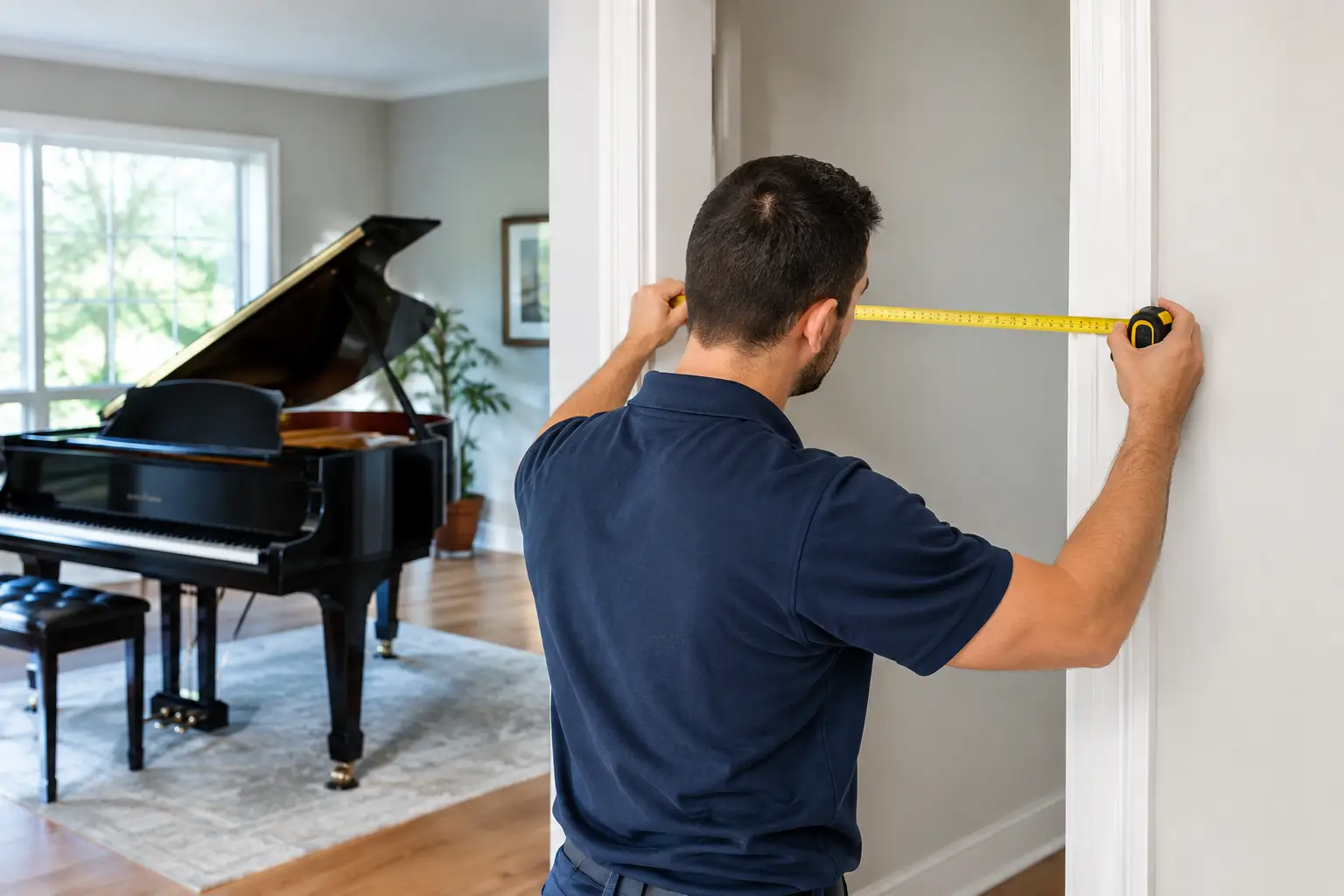
A piano may fit beautifully in your living room and still be unable to make it past the front hall. If you are searching for how to measure piano doorway clearance before delivery, the goal is not simply to find the width of one door. You need to account for the entire route, including door frames, turns, stairs, ceiling height, and the way the piano must be carried.
Careful measurements protect your home, your new instrument, and the people moving it. They also allow a professional piano mover to plan the right equipment, crew size, and delivery approach before the truck arrives.
How to Measure Piano Doorway Clearance
Start with the clear opening, which is the usable space between the inside edges of the door frame when the door is fully open. Do not measure the door slab itself or the decorative trim around it. A doorway that looks like a standard 36-inch entry can offer noticeably less usable width once hinges, weatherstripping, or a partially opening door are considered.
Use a metal tape measure and record the narrowest point. Measure the width at the floor, the middle, and near the top of the opening. Older homes can be slightly out of square, and a half-inch difference can matter when a piano is being maneuvered through a tight passage.
Next, measure the height from the finished floor to the lowest obstruction above the opening. Include door closers, low-hanging light fixtures, transoms, and decorative moldings. The measurement that matters is the smallest clear height, not the tallest point in the entryway.
A door can sometimes be removed to create a little more room, but the frame itself remains the limiting factor. Removing a door may help with swing clearance or a tight approach, yet it does not turn a narrow doorway into a wide one. Professional movers will determine whether removing a door is useful and whether it can be done safely.
Measure the Piano, but Consider Its Moving Position
Knowing the piano’s listed dimensions is helpful, but it is only the beginning. Upright pianos are generally moved upright, often with protective padding and a piano board. Grand pianos are normally prepared for transport with their legs and pedal lyre removed, then secured on a specialized skid or board. That means the dimension facing the doorway may be different from the instrument’s everyday footprint.
A console, studio, or upright piano may look manageable because it is narrow from front to back. Its height, depth, weight distribution, and the need for hand clearance can still make a confined entrance challenging. Larger uprights, especially tall professional models, deserve the same route planning as a grand piano.
For a grand piano, length alone does not tell the full story. A baby grand and a concert grand require different handling, but both need room for the moving board, padding, and controlled turns. The largest obstacle is often not the exterior door. It may be the 90-degree turn from the foyer into the music room.
Your mover should confirm the instrument’s exact make and model whenever possible. Dimensions can vary across brands and production eras, particularly with vintage instruments. A restored Steinway, Yamaha upright, or European-made grand may have details that affect the delivery plan.
Map Every Part of the Delivery Route
Measure from the curb or driveway all the way to the piano’s final location. A route assessment is most accurate when it follows the path movers will actually use, rather than the path that looks shortest on paper.
Record these details for each section of the route:
- Clear width and height of exterior doors, interior doors, gates, hallways, and elevator entrances.
- The depth and width of landings, foyers, hallways, and rooms where the piano must turn.
- Number of stairs, stair width, ceiling height above stairs, and the size of every landing.
- Outdoor conditions such as steps, steep walkways, gravel, narrow side yards, low branches, or overhead lines.
Hallway width is only one part of the equation. A long, straight hallway can be workable even when it is relatively narrow. A short hall that ends in a sharp turn may require more space because movers need room to change direction while maintaining control of the instrument.
Take special care with turns. Measure the hallway before and after the turn, then measure the open area at the corner. For an L-shaped hallway, a mover needs space not only to pass through each section but also to rotate the piano or moving board between them. Photos taken from both directions are often as valuable as the measurements.
Stairs, Elevators, and Multi-Level Homes
Stairs require a more detailed assessment than a flat entry. Measure the stairway’s narrowest width, the ceiling height above the steps, and the depth of any landing. If the staircase changes direction, document where that turn occurs and how much open space is available.
A straight stair run may be more straightforward than a curved or winding staircase, but it still requires trained movers, proper equipment, and a plan for weight distribution. Never assume a piano can be carried upstairs by a few strong friends. Pianos are extremely heavy, awkwardly balanced, and easily damaged by an uncontrolled bump or drop.
For elevators, measure the interior cab depth, width, height, door opening, and weight capacity. Freight elevators are often preferable, but not every building allows piano deliveries at all hours. Condominiums, apartments, and commercial buildings may require a certificate of insurance, reserved elevator time, loading-dock access, or advance approval from building management.
If the piano must be lifted over a balcony, through a large window, or to an elevated entry, that is a specialized delivery situation. It may be possible, but it requires an on-site evaluation and the appropriate lifting equipment. Do not make final assumptions based on a photograph or an estimated measurement.
Include Obstacles That Are Easy to Miss
The narrowest point is not always a doorway. Railings, furniture, radiators, kitchen islands, built-in shelving, wall art, light fixtures, and low ceilings can all reduce the usable route. Even a parked vehicle can limit how close the delivery truck can get to the entrance.
Before delivery day, clear rugs that could slip, remove breakable items from the route, and move furniture that narrows a turn. If a door is likely to need removal, do not remove it unless your moving team asks you to. They may prefer to inspect the frame and hardware first.
It is also wise to protect vulnerable surfaces. Hardwood floors, stair treads, freshly painted walls, and delicate trim deserve attention. Experienced piano movers use padding, floor protection, straps, dollies, and specialized boards to reduce risk, but a clear, prepared route gives them the best possible working conditions.
Send Measurements and Photos Before Scheduling
Written dimensions are useful, but clear photos make the plan more reliable. Photograph each doorway straight on, then step back to show the approach to it. Capture staircases from the top and bottom, turns in hallways, outdoor steps, and the proposed piano location.
Include a tape measure in photos of unusually tight openings when possible. Tell the mover whether doors can open fully, whether there is street parking, and whether the home has gates, stairs, or a long walk from the driveway. Small details can change the equipment or crew needed for a safe delivery.
At A440 Pianos, careful delivery planning is part of the complete piano ownership experience. A professional assessment may reveal that the route is simple, that a few preparations will solve a tight spot, or that a different entry is the better choice. The best time to learn that is before your piano is on the truck, ready to become part of your home and music.


0 Comments