


A piano can look immaculate, carry a celebrated name, and produce a beautiful first chord – yet still feel wrong under your hands. That feeling is not a minor preference. When learning how to evaluate piano touch, you are assessing the physical connection between player and instrument: how reliably it responds, how much control it gives you, and whether it encourages long, satisfying practice.
For a first-time buyer, touch affects comfort and technique. For an advancing student or accomplished pianist, it shapes articulation, speed, voicing, and musical confidence. A premium piano should not merely make sound when a key is pressed. It should allow the player to choose how that sound begins, grows, and releases.
What Piano Touch Actually Means
Piano touch describes the action of the keys and the mechanism behind them. On an acoustic piano, each key activates a complex assembly of levers, hammers, and dampers. The quality of that action determines the sense of weight, the depth of the key travel, the speed of repetition, and the consistency from one note to the next.
Players often describe touch with words such as light, heavy, crisp, deep, responsive, sluggish, or uneven. None of those words is automatically good or bad. A very light action may feel inviting to a beginner but offer less resistance than a serious player wants. A slightly firmer action can provide excellent control and support stronger technique, provided it is well regulated rather than stiff or tiring.
The goal is not to find a universally perfect touch. It is to find an action that works properly and suits the person who will play it most.
How to Evaluate Piano Touch at the Keyboard
Begin with a simple scale, played slowly from the lowest register to the highest. Use a comfortable dynamic, then repeat it softly. Pay attention to whether every key begins moving with a similar amount of effort. A well-maintained piano should feel consistent across the keyboard, even though the bass may naturally feel a little more substantial and the upper register a little quicker.
Do not judge touch from a single dramatic passage. Play scales, arpeggios, repeated notes, chords, and a portion of music you know well. Familiar music reveals more than a showroom performance because you already understand the response you expect from your hands.
Test the Weight, Not Just the Resistance
Key weight is the force required to depress a key. On a properly regulated acoustic piano, the action should feel purposeful but not resistant in a way that makes your forearms work excessively. Test this by playing a quiet five-finger pattern several times. If you cannot control a soft note without pushing through a noticeable barrier, the action may be too heavy, poorly regulated, or affected by friction.
Then play full chords at a moderate volume. If the keys bottom out with a harsh, abrupt sensation, that can indicate a problem with key bed felt, regulation, or overall maintenance. A clear end to the key stroke is normal. A jarring impact is not the standard a quality piano should deliver.
Players should also be wary of an action that feels unusually light. Lightness can be pleasant, but it should not feel loose, shallow, or disconnected. You should still sense a dependable point of control from the top of the key to the bottom.
Listen for Even Response
Touch and tone are inseparable. Press neighboring keys with the same motion and listen for a comparable response. If one note is noticeably louder, weaker, delayed, or harder to control than those around it, the issue may be regulation, hammer condition, voicing, or a combination of factors.
Soft playing is especially revealing. Try a short phrase at pianissimo, then repeat it a little louder. A good action lets you create a true soft sound without missed notes or sudden jumps in volume. This matters enormously for expressive playing. If a piano only feels satisfying when played loudly, it may limit a student long before their musical ambitions do.
Check Repetition and Fast Playing
A piano action must reset quickly after each note is played. This is called repetition, and it becomes more important as music demands faster repeated notes, trills, and delicate ornamentation.
Choose a middle-register key and repeat it rapidly with one finger, first at a moderate dynamic and then quietly. You are not trying to set a speed record. You are checking whether the key responds predictably before fully returning to its resting position. On a grand piano, a refined action should support fast repetition with impressive ease. A quality upright can also be highly responsive, though its action design differs and may not match the repetition speed of a comparable grand.
If notes fail to sound during normal repeated playing, feel sticky, or return slowly, do not assume the piano is simply “built that way.” A technician should inspect it. In a used or vintage instrument, the cause could range from ordinary regulation needs to humidity-related friction or worn action parts.
Play Across the Entire Keyboard
Many buyers spend most of their evaluation time in the center of the keyboard, where familiar melodies live. That is understandable, but incomplete. Play the lowest bass notes, the transition into the tenor range, the middle register, and the upper treble.
Look for keys that sit lower or higher than their neighbors, wobble sideways, click, scrape, or make a different mechanical sound. Minor mechanical noise is normal in an acoustic instrument. Distinct knocking, rubbing, or sticking is not something to dismiss on a premium purchase.
Also test black keys as carefully as white keys. They should feel secure and evenly positioned. Uneven key height or significant side-to-side movement can point to wear or adjustment needs.
Use Pedals to Confirm Control
Pedals are part of the playing experience, not an accessory to examine at the end. Depress the sustain pedal gradually and release it slowly while playing chords. It should engage smoothly, hold notes cleanly, and release the dampers without excessive noise or uneven clearing.
On grand pianos, test the soft pedal as well. Its effect varies by instrument and design, but it should operate smoothly and create a meaningful tonal change. If a piano has a middle sostenuto pedal, test it with a few selected notes. On many upright pianos, the middle pedal serves a practice function instead, so ask what it is designed to do.
A responsive action paired with poorly functioning pedals is still an incomplete musical experience. Both deserve professional attention before purchase.
Evaluate Touch Differently for Uprights, Grands, and Digitals
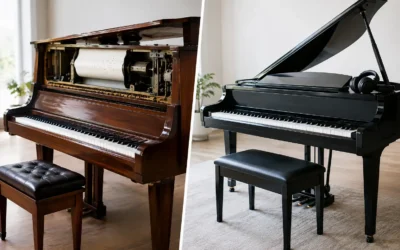
Grand pianos typically offer the most refined repetition and dynamic control because of their horizontal action design. That does not mean every grand feels better than every upright. A well-regulated premium upright can be a superb choice for a home, teaching studio, church, or space where a grand is impractical.
With uprights, pay close attention to evenness and repetition. A strong upright action should feel stable, clear, and capable of nuanced soft playing. It may feel somewhat different from a grand, but it should never feel compromised or unreliable.
For digital pianos, assess whether the weighted action has enough resistance and graded feel to support proper technique. Play quietly, test quick repetitions, and notice whether the key return feels natural. Digital actions do not duplicate every detail of an acoustic mechanism, but a serious player should still expect control, consistency, and a convincing range of dynamics.
Condition Matters More Than Age Alone
A vintage piano with a carefully restored and regulated action can feel more rewarding than a newer piano that has received little maintenance. Conversely, an attractive cabinet and a famous name cannot compensate for a neglected action.
Ask whether the piano has been tuned, regulated, repaired, or restored recently. Regulation adjusts the relationship of many action components so the keys respond evenly. It is a precision service, not a cosmetic upgrade. On a fine instrument, proper regulation can transform an action from merely acceptable to genuinely expressive.
Humidity history also matters. Seasonal changes can affect wooden action parts, felt, and key bushings. In Georgia and other humid climates, consistent climate control and professional care are especially valuable. A specialist should be able to explain the piano’s condition clearly and identify any work that has been completed or recommended.
Bring the Right Player Into the Decision
If the piano is for a child, let the child play it, but do not let a few favorite songs make the entire decision. Have their teacher, if possible, assess whether the action will support healthy technique as the student advances. For an experienced pianist, allow enough uninterrupted time to play demanding repertoire at different dynamics.
At A440 Pianos, buyers can compare a broad range of premium used, vintage, upright, grand, and specialty instruments in a setting designed for serious evaluation. The right piano is not simply the one that sounds impressive for thirty seconds. It is the one whose touch continues to invite you back to the bench, week after week, with more control and more music waiting in your hands.
0 Comments