


A grand piano can look perfect in a showroom and still be wrong for your room, your repertoire, or your long-term ownership costs. That is why a serious guide to buying grand pianos has to go beyond finish, brand name, and first impressions. The right instrument should satisfy your ear, fit your space, respond to your touch, and come with the kind of service support that protects the investment after delivery.
For many buyers, the challenge is not finding a beautiful grand piano. It is knowing which beauty is only surface-level and which one has real musical value underneath. A premium purchase deserves a clearer process.
What matters most in a guide to buying grand pianos
The first decision is not brand. It is purpose. A grand piano for a young student in a family living room is not judged by the same standards as a piano for a church sanctuary, teaching studio, or private collector.
If the piano will be used daily for lessons and practice, consistency and touch control may matter more than visual rarity. If the piano is being purchased for performance, projection, tonal color, and action precision move to the front. If it is going into a formal interior, cabinet style and finish may carry more weight, but they should never outrank the musical condition of the instrument.
This is where buyers often overspend in the wrong category. They pay for a nameplate when what they really need is a dependable scale design, healthy soundboard, responsive action, and a seller who can support moving, tuning, and ongoing care.
Start with size, but do not stop there
Grand pianos are often grouped by length, and for good reason. Size affects bass development, dynamic range, and the overall authority of the sound. In broad terms, baby grands usually begin around 4’11” to 5’6″, mid-sized grands fill the range from about 5’7″ to 6’3″, and larger performance grands and concert instruments extend well beyond that.
Bigger is not automatically better. In a smaller room, an overly powerful piano can feel harsh or crowded. In a large open space, a shorter grand may sound pleasant up close but fail to carry the richness a buyer expects. Ceiling height, flooring, rugs, windows, and furniture all shape how a piano is heard.
A practical way to think about size is to match the instrument to both the room and the player. A serious advancing student may gain more from a well-prepared 6-foot grand than from a decorative baby grand with limited tonal depth. At the same time, a carefully selected smaller grand can be an excellent fit for a refined home setting when tone, touch, and preparation are right.
New, used, or restored
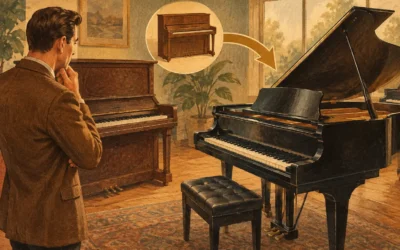
For many informed buyers, the best value in the market is not always a new piano. Premium used and restored grands can offer remarkable musical quality, stronger materials from earlier eras, and access to prestigious brands at a more attractive price point.
That said, condition is everything. A used grand piano should not be judged by polish alone. The structural and mechanical health of the instrument matters more than a glossy cabinet. Pinblock integrity, tuning stability, bridge condition, soundboard health, hammer wear, regulation, and action parts all affect how the piano performs now and how much it may cost later.
A restored piano can be especially compelling when the work was done correctly and documented clearly. Restoration, however, is not a magic word. Some instruments are beautifully rebuilt with long-term performance in mind. Others are cosmetically refreshed and marketed as more than they are. Buyers should want specifics, not vague assurances.
How to evaluate tone and touch
Tone is personal, but quality is not entirely subjective. A well-prepared grand should produce an even scale from bass to treble, with no notes that jump out aggressively or disappear. The bass should have body, the middle register should sing, and the upper register should remain clear without becoming brittle.
Touch is just as important. When you sit down to play, the action should feel controlled and predictable. Repetition should be clean. Soft playing should still produce a centered tone. Louder passages should open up without becoming thin or hard.
If you are buying for a household with multiple players, this is especially important. A beginner needs an action that encourages technique, not one that hides inconsistencies. An advanced pianist will notice regulation problems almost immediately. Churches, teachers, and studios should be even more demanding because the piano has to satisfy different hands throughout the week.
When possible, play slowly before you play loudly. Single notes, scales, repeated notes, and simple chords can reveal more than a dramatic piece. If you are shopping remotely, ask for detailed playing demonstrations across dynamic levels and registers, not just one polished performance clip.
Brand reputation matters, but only with context
Certain names carry deserved prestige. Steinway, Yamaha, Kawai, Baldwin, Bluthner, and other respected makers have earned strong reputations for different reasons, whether that is tonal character, action design, durability, or heritage.
Still, a great brand does not guarantee a great individual piano. Age, maintenance history, climate exposure, and preparation quality can make a major difference between two instruments with the same badge. One may be inspiring. The other may require significant work.
This is where a specialist retailer has a real advantage over a general marketplace listing. Curated inventory, technical inspection, and post-sale service matter. Buyers are not just purchasing wood, strings, and brand recognition. They are purchasing confidence.
Budget for ownership, not just the sale price
A grand piano purchase is never only about the initial number. Delivery, climate considerations, tuning, voicing, regulation, and occasional repair all belong in the real cost of ownership.
This does not mean ownership has to be complicated. It means buyers should be realistic. A piano that was inexpensive to buy but unstable to maintain can become costly and frustrating. A better-prepared instrument from a service-centered dealer may cost more upfront and still be the smarter financial decision.
Financing can also make sense for buyers who want to reach a higher level of instrument without compromising on quality. The key is to stay disciplined about value. Buy the best piano you can reasonably support over time, not just the one you can bring home fastest.
Questions every serious buyer should ask
Before committing to any grand piano, ask about age, serial number, maintenance history, and whether any restoration or replacement work has been performed. Ask when the piano was last tuned and regulated. Ask whether the seller can explain the condition of the soundboard, bridges, pinblock, and action in plain terms.
You should also ask about delivery logistics. Grand pianos are not ordinary household items. Safe transport, stair navigation, setup, and post-move tuning all require experience. For buyers in Atlanta and beyond, working with a full-service specialist such as A440 Pianos can simplify the process because sales, delivery, technical service, and support are all part of the same professional relationship.
Buying in person versus buying remotely
In-person shopping remains ideal because you can hear and feel the instrument directly. You can compare scale lengths, cabinet styles, and tonal personalities in one visit. For many buyers, that immediate side-by-side contrast makes the decision easier.
Remote purchasing can still work well when the seller is transparent and experienced. High-quality videos, detailed descriptions, clear condition disclosures, and coordinated delivery support make a significant difference. This is particularly relevant for buyers seeking specific premium used, vintage, or specialty grands that may not be available locally.
The standard should be the same either way. You should know what you are buying, what work has been done, what service is available, and what to expect once the piano reaches your home, school, studio, or sanctuary.
The right grand piano should feel complete
A successful purchase is not just a piano that impresses on day one. It is a piano that continues to reward playing, holds its musical value, and fits naturally into the way you live or work. The cabinet should please you. The tone should keep drawing you back. The touch should support progress rather than fight it.
That is the real measure in any guide to buying grand pianos. The best choice is rarely the flashiest or the cheapest. It is the instrument with lasting substance, prepared by people who understand that premium ownership starts before the sale and continues long after the bench is in place.
Take your time, ask better questions, and trust the piano that still feels right after the excitement settles.
0 Comments