

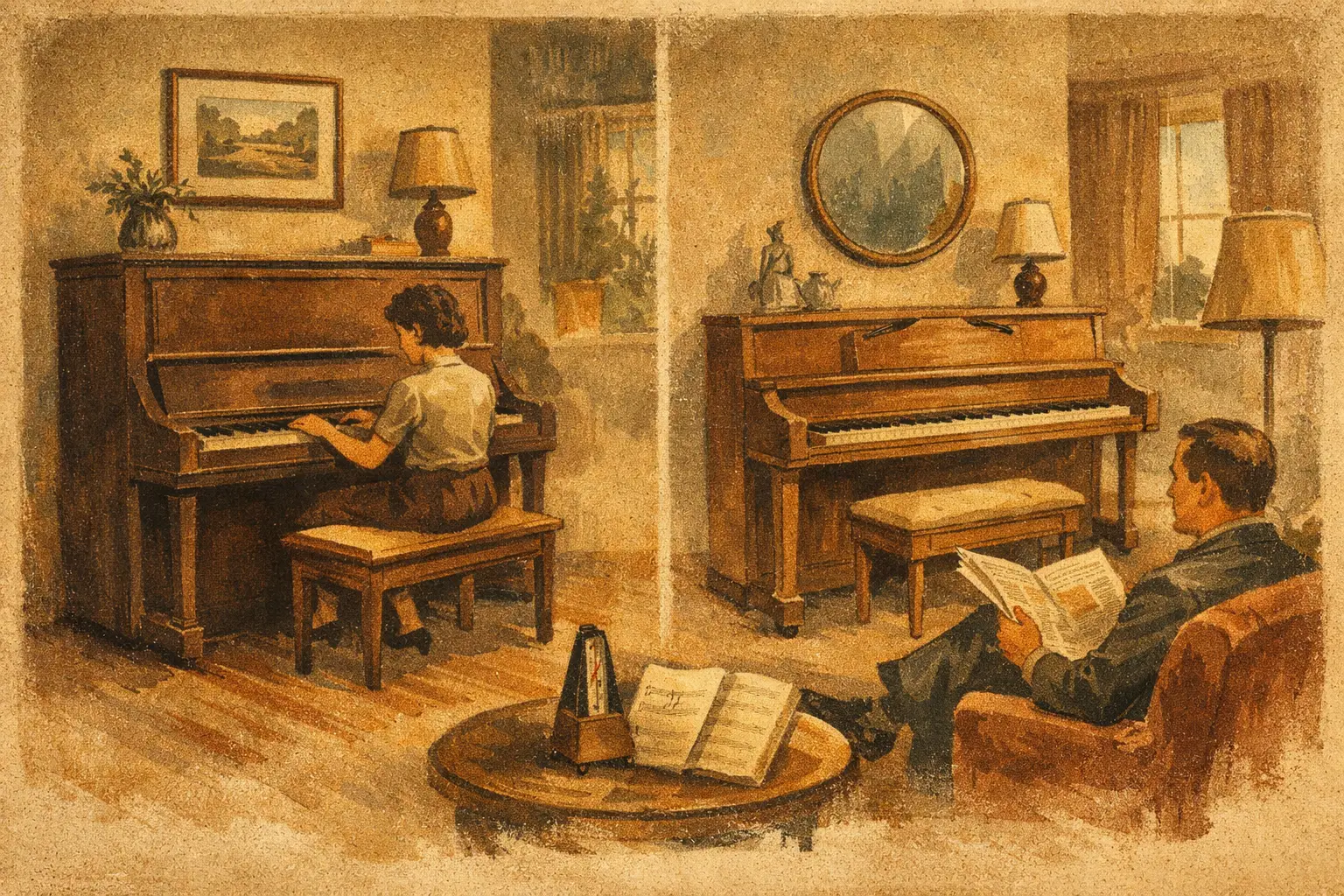
A piano can look perfectly proportioned in a showroom and feel entirely different once it becomes part of your living room, teaching studio, or music room. In the upright piano vs console piano decision, the real question is not simply which cabinet is smaller. It is whether the instrument has the musical response, presence, and long-term value your household needs.
For a casual beginner, a well-prepared console may be a beautiful and practical choice. For a developing student, a serious hobbyist, or a church accompanist, a taller upright often provides the extra tonal depth and control that keeps an instrument satisfying for years. The right choice depends on the individual piano, its condition, and how it will be played.
Upright Piano vs Console Piano: The Key Difference
A console piano is a type of vertical piano, but it is not the same thing as every upright piano. In everyday conversation, people often use “upright” to describe any piano that stands against a wall. Technically, the term covers several vertical sizes, including spinet, console, studio, and full-size upright models.
Console pianos generally stand about 40 to 44 inches tall. Their cabinets are designed for residential spaces, with a graceful furniture-style profile that can fit comfortably in a den, dining room, or bedroom. Many consoles have a decorative front, finished legs, and a smaller visual footprint than a studio or full upright.
When shoppers say “upright piano,” they often mean a taller studio or professional upright, usually around 45 to 52 inches high. The additional height makes room for longer strings and a larger soundboard. Those physical differences are central to the sound and playing experience, not merely the appearance.
There is no rule that says every tall upright will outperform every console. A premium, properly restored console from a respected maker can be more rewarding than a neglected tall piano. Still, when condition and build quality are comparable, the taller instrument usually has greater tonal potential.
Tone: Why Height Changes the Sound
The piano soundboard acts as the instrument’s acoustic engine. A taller upright generally has more soundboard area and longer bass strings, allowing it to create a fuller sound with greater resonance. The bass has more weight, the middle register has more color, and the treble can carry without becoming brittle.
This matters most in larger rooms, open-concept homes, churches, and teaching environments. A studio upright or full upright can fill the space with a more substantial voice while still offering the convenience of a vertical cabinet. Well-known models from Yamaha, Kawai, Baldwin, and Steinway-built vertical lines are especially sought after for this balance of size and musical authority.
A console piano produces a more intimate sound. That can be an advantage in a smaller home, condominium, or apartment where a powerful instrument might overwhelm the room. It is also a sensible choice for families who want music in the home without turning every practice session into a performance for the entire neighborhood.
Do not mistake “smaller” for “thin.” A high-quality console with healthy strings, soundboard, hammers, and tuning stability can offer a warm, clear voice. What it is less likely to deliver is the broad dynamic range and low-register depth of a taller upright. Players who enjoy classical repertoire, expressive accompaniment, jazz voicings, or advanced study often notice that difference over time.
Touch and Action Feel
The action is where a pianist feels the piano answer back. Console pianos commonly use a drop action, with part of the mechanism positioned below the keys. Studio and taller upright pianos typically use a direct-blow action, which places the action more directly behind the keys.
This design difference does not automatically make a console action poor. A skilled technician can regulate a quality console action to feel responsive and even. However, direct-blow actions are often easier to service and can offer a more immediate, consistent feel for demanding playing. They are a familiar choice in schools, studios, and churches because they are built to support regular use.
For a beginner, the priority is not chasing a technical label. The keys should move evenly, repeat reliably, and provide enough resistance to build proper control. A piano with sticky keys, uneven touch, worn hammers, or weak repetition will frustrate progress regardless of whether it is a console or a full upright.
For an advancing student, test soft playing as carefully as loud playing. Can the piano speak clearly at a gentle dynamic? Can you repeat notes without fighting the mechanism? Does the tone remain balanced from bass to treble? Those details reveal more than cabinet style ever will.
Space, Design, and Everyday Living
A console wins when visual scale is the deciding factor. Its lower height can sit comfortably beneath artwork or windows, and its furniture styling can complement traditional interiors. The difference of several inches may sound minor, but it changes how a piano occupies a room.
A taller upright is still remarkably space-efficient. Most vertical pianos have a similar width, generally close to five feet, and a comparable depth from the wall. The primary trade-off is height and visual mass, not floor space. If the room can accommodate a 48-inch upright, the musical benefits may be well worth the slightly larger profile.
Placement deserves serious consideration with either type. Avoid direct sunlight, exterior walls with extreme temperature swings, heating vents, fireplaces, and damp areas. A piano is made of wood, felt, metal, and tightly tensioned strings. Stable humidity and professional moving are part of protecting the investment, not optional afterthoughts.
Value: Purchase Price Is Only Part of the Decision
Console pianos often cost less than comparable studio uprights, particularly in the used market. That can make them attractive for first-time buyers. Yet the lowest purchase price is not always the best value if the instrument needs extensive work or is likely to be outgrown quickly.
A taller upright from a respected manufacturer may command more upfront, but it can offer a longer useful life for a serious student and stronger appeal when it is time to sell or trade. Brand reputation matters, though it should never replace an in-person evaluation of condition, maintenance history, and musical performance.
Vintage pianos require especially careful assessment. Some have exceptional craftsmanship, distinctive cabinetry, and a tonal character that modern instruments do not duplicate. Others may need major restoration. Before purchasing, confirm the condition of the pinblock, strings, bridges, soundboard, action components, pedals, and cabinet. A freshly polished exterior cannot tell you whether the piano is structurally ready for decades of service.
Professional preparation also has real value. Proper tuning, action regulation, voicing, repairs, delivery, and post-delivery care help a piano perform as intended. A440 Pianos evaluates instruments with the perspective of a full-service piano partner, which is particularly valuable when selecting a premium pre-owned or vintage vertical piano.
Which Piano Fits Your Needs?
Choose a console piano when you want a refined furniture piece for a modest room, an intimate sound level, and a dependable instrument for beginning or recreational playing. A strong console can be a far better choice than a compromised larger piano, especially when it has been maintained correctly.
Choose a studio or full upright when the player is committed to regular practice, the room can support a more substantial instrument, and tone and touch matter beyond the first stages of learning. It is often the more satisfying direction for advancing students, teachers, accompanists, and musicians who want the closest vertical alternative to a grand piano experience.
The best next step is to sit down and play several examples. Bring the person who will use the piano most, play familiar music at soft and full volume, and listen from across the room as well as from the bench. A well-chosen piano should not simply fit the wall. It should invite you to return to it tomorrow.

0 Comments