

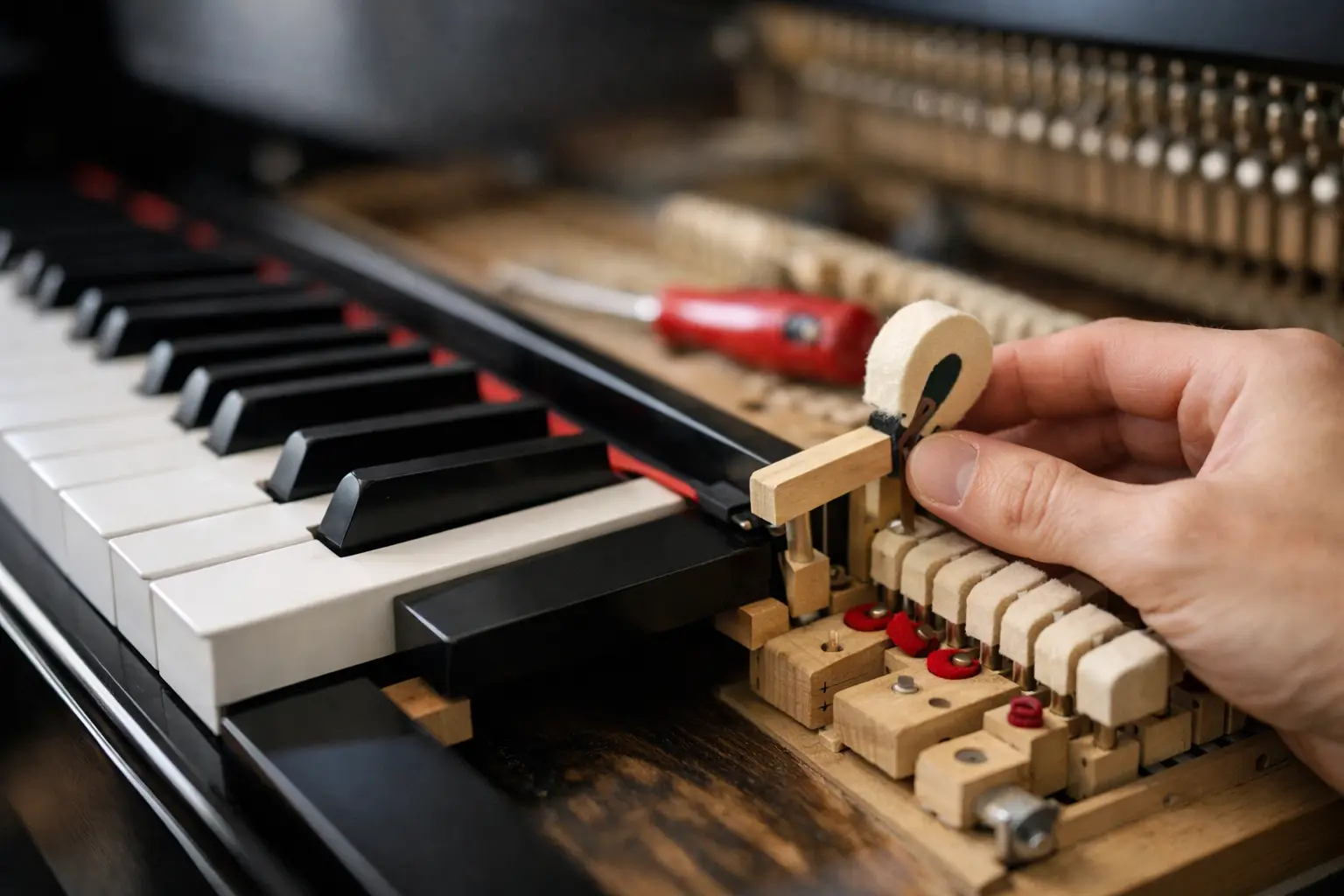
A piano key should feel responsive and sound musical, not distract you with a click, squeak, or knock before the note begins. So, what causes piano key noise? The answer depends on the kind of sound, where it occurs, and whether you are playing an acoustic piano or a digital model. Some light mechanical sound is part of normal piano operation. Repeated, loud, or changing noises deserve a closer look.
For a family with a first upright, a teacher maintaining a studio instrument, or a pianist evaluating a vintage grand, key noise is useful information. It can point to ordinary wear, a need for regulation, environmental changes, or a repair that is best handled before it affects playability.
What Causes Piano Key Noise in Acoustic Pianos?
An acoustic piano action contains thousands of moving parts. When you press a key, it activates levers, felt parts, a hammer, and dampers in a carefully timed sequence. These components are designed to work quietly, but they are not silent. A faint, even mechanical sound across the keyboard is often normal, especially in a room that is otherwise quiet.
The concern starts when one key is noticeably noisier than its neighbors, when the noise interrupts the note, or when the key begins to feel loose, sluggish, or uneven. The type of sound usually provides the first clue.
Clicking or tapping at the key
A click near the front of a key often comes from wear in the key bushings, the felt-lined areas that guide each key around its pins. As this felt compresses or dries, the key can develop side-to-side movement and make contact in a way it should not. Loose keytop material, an object caught between keys, or a small foreign item inside the keybed can also create a click.
Clicks may also come from an action adjustment issue farther inside the piano. A technician checks the key, action parts, and their alignment together rather than assuming the key itself is the only source. On a well-used piano, several small amounts of wear can combine into a surprisingly audible sound.
Squeaks and rubbing sounds
Squeaks are commonly associated with friction. Center pins in the action allow wood parts to pivot, and changes in humidity can make those parts tighter than intended. Felt can also become dry, compressed, or misplaced. The result may be a squeak on the way down, the way up, or both.
Atlanta’s seasonal humidity changes can be especially hard on pianos that are placed near exterior doors, air vents, sunny windows, or fireplaces. Wood and felt respond to moisture, even in a climate-controlled home. A piano that was quiet during one season may begin squeaking during another without anyone having played it improperly.
Thumps, knocks, and heavy impacts
A thump usually suggests that a moving component is reaching the end of its travel too abruptly. It may be related to a key bottoming out, a hammer return issue, a loose action part, or worn cushioning felt. On an upright piano, a louder thump may be heard when the key is released, because the damper and action are returning to rest.
Not every knock signals a major repair. A small adjustment or replacement of worn felt may resolve it. Still, a persistent thump should not be ignored. Continued impact can accelerate wear and make the piano less pleasant to play, particularly for students developing touch control.
Rattles, buzzing, and sounds that appear with certain notes
A rattle that seems tied to a particular pitch is not always a key problem. It may come from something vibrating elsewhere: a loose music desk screw, fallboard hardware, pedal rod, caster, cabinet panel, lamp, picture frame, or nearby object. Before assuming the action is at fault, remove items from the piano and listen again.
If the rattle remains, a technician can isolate whether it originates in the action, the piano case, the strings, or the room. This distinction matters. A buzz that appears only when a low note is played can be caused by sympathetic vibration, while a rattle heard every time one key moves is more likely mechanical.
Normal Piano Action Sound vs. a Service Need
Pianists sometimes worry that any sound from the keys means something is wrong. That is rarely the standard. In an acoustic piano, quiet action movement, a soft damper sound, and the gentle return of keys are expected. A grand piano may reveal more subtle action sound because its mechanism is exposed when the lid is open. An upright can have a slightly different character due to its vertical action design.
What matters is consistency. If the keyboard is generally quiet and one key suddenly clicks, sticks, squeaks, or produces a different resistance, schedule an inspection. The same applies when several keys are affected, the problem is getting worse, or the noise follows a move, a major temperature swing, or water exposure.
A useful at-home check is simple: play the key slowly, then play it normally, then release it slowly. Listen for when the sound occurs. Does it happen before the hammer strikes, at the bottom of the key stroke, or as the key returns? Note whether the issue occurs on one key, a section of the keyboard, or every key. Those observations help a qualified technician diagnose the issue efficiently.
Do not spray household lubricant into the keys or action. Oils, silicone sprays, and general-purpose lubricants can stain felt, attract dust, swell wood, and complicate a proper repair. Likewise, avoid pulling on keys, forcing a sluggish key, or removing action parts without training. Piano regulation involves precise relationships measured in very small increments.
Digital Piano Key Noise Has Different Causes
Digital and electric pianos use a weighted key mechanism, sensors, rubber contacts, and often springs or pivot assemblies rather than hammers striking strings. Their noises tend to be more distinctly plastic, metallic, or spring-like. A light clack can be normal, particularly on portable instruments with compact cabinetry, but a sharp clack from one key is not something to dismiss.
Common causes include worn key bushings or pads, a loose key pivot, debris beneath the keys, a broken support tab, or a damaged spring mechanism. A clicking key that still plays a note may eventually affect consistency. A key that makes noise and fails to trigger sound reliably can indicate a sensor or contact issue rather than a purely mechanical one.
Digital piano construction varies widely. Some repairs are straightforward for an experienced technician, while others require model-specific parts that may no longer be available. When considering service, the instrument’s age, value, action quality, and intended use all matter. A premium digital piano with a realistic action often justifies a targeted repair; an entry-level portable model may require a practical cost comparison.
Why Moving and Climate Changes Can Start a Noise Problem
Pianos are heavy, finely adjusted instruments. Even a careful household move can jar a cabinet, shift hardware, or expose the instrument to conditions that affect wood and felt. Professional piano moving reduces those risks through proper equipment, secure handling, and an understanding of where a piano can and cannot be safely supported.
After delivery, allow an acoustic piano to acclimate to its new room before scheduling routine tuning. If a new noise appears after the move, mention it when arranging service. The cause may be minor, but identifying it early can prevent an adjustment issue from becoming a larger repair.
Stable placement helps as well. Keep the piano away from direct sun, heating and cooling vents, radiators, damp exterior walls, and areas with frequent drafts. Consistent humidity benefits tuning stability, action regulation, and the long-term condition of felt, wood, glue joints, and the soundboard.
When a Noisy Key Should Be Repaired
Arrange professional attention promptly if a key sticks, repeats poorly, fails to return, feels much lighter or heavier than adjacent keys, or produces a loud knock. A technician should also inspect unexplained rattling, especially if it follows a move or is accompanied by a change in tone. These symptoms do not automatically mean expensive restoration, but they are not issues to solve by trial and error.
For used and vintage pianos, action noise is also part of a smart buying evaluation. A piano may have a beautiful cabinet and appealing tone while still needing regulation, new key bushings, hammer work, or other action service. Those needs can be completely manageable when identified honestly and priced appropriately. The goal is not to find an instrument with no history, but one whose condition, musical potential, and service needs fit your expectations.
At A440 Pianos, the same practical approach applies whether the instrument is a family upright, a concert-ready grand, or a cherished older piano. Careful assessment, proper repair, and regular tuning help preserve the touch and reliability that make a piano inviting to play.
A noisy key is often a small message from a complex instrument. Listen for the pattern, protect the piano from avoidable environmental stress, and let an experienced piano technician address anything that changes the feel of playing. A quiet, well-regulated action gives every player more room to focus on the music.

0 Comments