

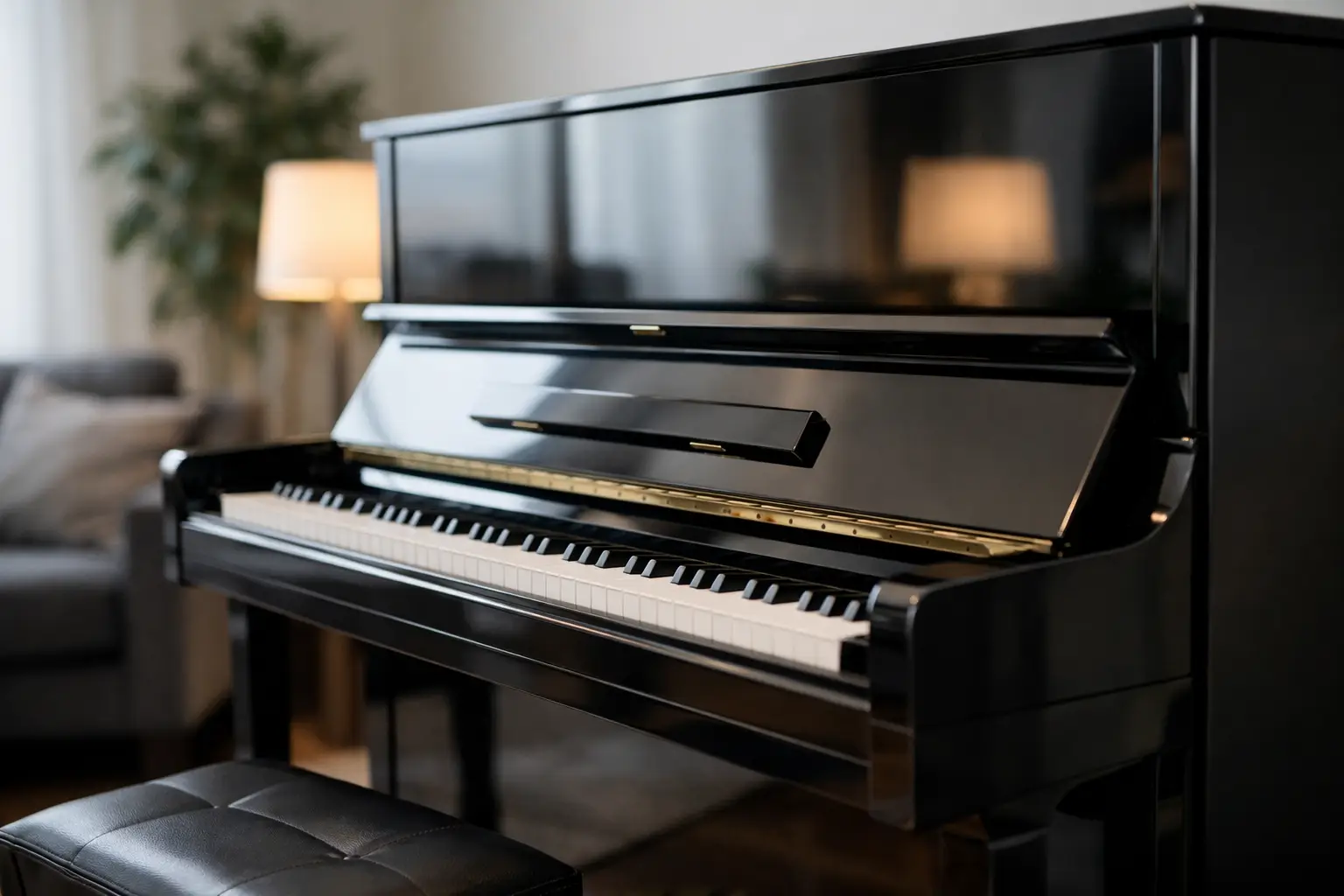
A Yamaha U1 is one of the few upright pianos that can follow a player from first lessons through advanced repertoire without feeling like a compromise. In this Yamaha U1 review, we look at why this 48-inch professional upright remains a favorite in homes, teaching studios, schools, and rehearsal rooms – and what a buyer should examine before making a decision.
The U1 has earned its reputation through consistency. It is not an exotic collector instrument, nor is it intended to imitate the sound of a grand piano. It is a well-designed, durable upright built to provide a responsive action, a clear musical voice, and dependable performance over many years of regular playing. For the right buyer, it can be one of the strongest values in the acoustic piano market.
What Makes the Yamaha U1 Different?
At approximately 48 inches tall, the Yamaha U1 sits in the professional upright category. That extra height matters. A taller cabinet allows for longer strings, a larger soundboard, and more room for the action and hammers to develop sound than a smaller studio or console piano can offer.
The result is a piano with more projection, greater tonal range, and a more satisfying bass response than most uprights under 45 inches. It is substantial enough for a serious musician, yet compact enough for many living rooms, apartments with appropriate access, music rooms, and private studios.
Yamaha has produced the U1 for decades, and the model has appeared in several generations and manufacturing locations. While details may vary by year, the core character has remained familiar: a clean, direct tone; a reliable action; and a cabinet designed for heavy everyday use. That consistency is a major reason it is common in educational settings, where an instrument must hold up to many different players.
Tone and Touch: What Does a U1 Feel Like to Play?
A well-prepared Yamaha U1 typically has a bright, focused sound with excellent clarity between notes. The treble tends to be articulate, which helps melodies project clearly. The middle register is balanced and useful for a wide range of styles, while the bass has more authority than buyers often expect from an upright.
That tonal clarity suits classical practice, jazz voicings, pop accompaniment, church music, and teaching. Players who like hearing every note defined within a chord often respond well to the U1. Its sound can be especially helpful for students developing control, since blurred or uneven playing is less easily hidden.
The trade-off is personal taste. Some pianists prefer a warmer, rounder, or more complex tone than a typical Yamaha U1 offers in its factory setup. Fortunately, tone is not fixed. A skilled technician can voice the hammers to reduce excessive brightness and create a more mellow sound. The results depend on the piano’s condition, its environment, and how far the hammers have already been hardened or worn.
The action is another U1 strength. Yamaha actions are widely respected for their consistency and responsiveness. A properly regulated U1 generally feels precise rather than heavy, allowing beginners to play comfortably while giving advanced players enough control for fast passages, repeated notes, dynamic contrast, and careful phrasing.
No two used U1s will feel identical. Regulation changes over time, and a piano that has spent years in a school practice room may need more action work than one kept in a carefully maintained home. Still, the underlying action design is one reason a quality U1 is worth restoring or servicing rather than simply replacing.
Yamaha U1 Review: Size, Space, and Practical Ownership
The Yamaha U1 is roughly 48 inches tall, 60 inches wide, and 24 inches deep. It is more imposing than a small upright, but it is still dramatically easier to place than a grand piano. Its vertical design makes it a practical choice for buyers who want a serious acoustic instrument without giving up the footprint required by a baby grand or larger grand.
Placement affects both sound and condition. Avoid putting the piano directly against a heating vent, exterior wall with major temperature swings, fireplace, or sunny window. A stable room environment helps protect the soundboard, pinblock, action parts, and finish. Even a highly durable Yamaha benefits from regular humidity control and professional tuning.
Like any acoustic piano, a U1 should be tuned at least once or twice a year, depending on use and environmental changes. Families with active students, teachers with a full schedule, and professional players may benefit from more frequent service. Occasional regulation and voicing keep the instrument feeling and sounding as it should.
Professional delivery is also essential. A U1 weighs hundreds of pounds, and moving one safely requires the correct equipment, trained personnel, and careful planning around stairs, turns, flooring, and doorways. The piano may be an upright, but it is not a casual furniture move.
Is a New or Used Yamaha U1 the Better Value?
A new Yamaha U1 offers current production specifications, a clean service history, and the appeal of being the first owner. For buyers who want a pristine finish, a manufacturer-backed purchase experience, and predictable condition, new can be the straightforward path.
A used U1 can be an excellent value, especially when it has been carefully selected and professionally prepared. Many older U1s were built to a high standard and still have decades of musical life ahead. However, the model name alone is not enough to determine value. Two pianos of the same age can differ greatly in wear, stability, tone, and required maintenance.
When considering a used Yamaha U1, look beyond the cabinet. The finish may show cosmetic wear, but the more meaningful questions involve the pinblock, tuning stability, soundboard condition, action wear, hammer wear, pedal function, and overall service history. A piano that looks beautiful but cannot hold a stable tuning is not a bargain.
Buyers should also be cautious with gray-market instruments. These are pianos originally manufactured for sale in another market and later imported into the United States. Some can be fine instruments, but their history, climate exposure, preparation quality, and warranty coverage should be clearly understood. Inspection by an experienced piano professional is particularly valuable in this category.
At A440 Pianos, we encourage buyers to compare instruments in person whenever possible. Play softly, then play with real dynamic range. Test the transition from bass to tenor, repeat notes, use both pedals, and listen for an even response across the keyboard. A piano should invite you to keep playing, not merely meet a specification sheet.
Who Should Buy a Yamaha U1?
The U1 is especially well suited to committed students, teaching studios, accompanists, musicians returning to piano, and families who want an acoustic instrument that will not be quickly outgrown. It offers a meaningful step up from entry-level uprights in both sound and action performance.
It is also a practical choice for professionals who need a dependable studio piano but do not have space for a grand. For a small church, school program, or rehearsal environment, its ability to project and withstand regular use can make it a sensible long-term investment.
There are cases where another piano may be a better fit. A buyer seeking a softer, more romantic tonal character may prefer to compare the U1 with select European uprights or a carefully voiced vintage instrument. Someone with a larger room and a budget for a grand should play several grand pianos before deciding that an upright is the final answer. And for a beginner with a strict budget, a professionally serviced smaller upright may be more appropriate than stretching too far for a U1.
The best Yamaha U1 is not simply the newest one or the least expensive one. It is the instrument whose condition, touch, tone, price, and preparation match the player and the home. When that combination is right, the U1 can become the piano a student grows with, a teacher depends on, and a family keeps for years of music.

0 Comments