


A Yamaha C7 is not a piano that disappears politely into a room. At 7’6″, it brings concert-grand scale, projection, and authority into a size that can still work beautifully in a serious home, teaching studio, recording space, or smaller performance venue. This Yamaha C7 review looks beyond the model name to help buyers decide whether its voice, action, footprint, and condition make sense for the way they actually play.
The C7 has earned its reputation for a reason. It is one of Yamaha’s best-known professional grand pianos: powerful enough for demanding repertoire and ensemble work, consistent enough for institutions, and versatile enough to serve musicians with very different musical tastes. That popularity also means buyers will encounter many used examples. The right C7 can be an exceptional long-term instrument. The wrong one, especially one with heavy institutional use or deferred maintenance, can require a much larger investment than its purchase price suggests.
Yamaha C7 Review: Sound and Musical Character
The Yamaha C7 is generally recognized for a clear, direct, and focused sound. Its treble has brilliance and definition, the middle register stays articulate through dense chords, and the bass has enough depth to support large Romantic works, jazz voicings, and collaborative playing. It has the reserve to fill a room without forcing the player to overwork the instrument.
For many pianists, that clarity is the C7’s greatest strength. Fast passagework can remain clean rather than becoming cloudy, and a melody often speaks readily over accompaniment. This makes the instrument especially appealing to advanced students, teachers, church musicians, recording artists, and players who need a piano that responds convincingly across a wide range of repertoire.
That said, no meaningful review of a C7 should suggest every example sounds identical. Age, environment, voicing history, regulation, string condition, and the individual piano’s preparation all matter. A well-maintained C7 can offer warmth and color alongside its signature clarity. A piano that has been voiced too brightly or played hard in a high-volume setting may sound more aggressive than a buyer wants for an intimate living room.
Players drawn to the darker, more complex, or more traditionally European character of certain Steinway or Blüthner instruments may find the Yamaha sound comparatively straightforward. That is not a flaw. It is a matter of musical preference. The C7 rewards a player who values precision, projection, and an honest connection between touch and tone.
How the C7 Action Feels
Yamaha grand actions are respected for reliability and consistency, and the C7 is often a pleasure for pianists who want a responsive, predictable keyboard. The touch is commonly described as moderately firm, quick, and controlled. Repetition is dependable, and the action can support both delicate pianissimo playing and forceful octaves without feeling unstable.
A properly regulated C7 gives the player a strong sense of command. You can shape a phrase, repeat notes quickly, and move from soft accompaniment to a full fortissimo climax with confidence. For teachers and studios, this consistency can be especially valuable because the piano gives developing players clear feedback rather than masking uneven technique.
Condition remains the key qualifier. Felt parts compress over time, action centers can tighten or loosen, and repeated use can affect key leveling, hammer travel, let-off, and repetition. A C7 that feels heavy, uneven, or difficult to control may not be a poor piano, but it likely needs skilled regulation or action work. Buyers should judge the action they are playing, not simply the reputation attached to the Yamaha name.
Size, Space, and Practical Fit
At 7’6″ long, the Yamaha C7 is a substantial instrument. It needs more than enough floor space to fit its outline. It needs room for the bench, space around the pianist, and enough acoustic breathing room that the sound does not feel overwhelming. In a compact room with reflective hard surfaces, even a beautifully prepared C7 can seem louder and brighter than expected.
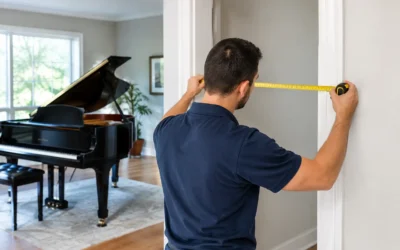
Before purchasing, measure the intended location carefully. Consider the path from the entrance to the piano room as well. Stairways, tight turns, elevators, and narrow hallways can influence moving plans and costs. A professional piano mover should assess access before delivery, particularly for an instrument of this size and weight.
The ideal setting varies, but the C7 often feels most at home in a generous living room, dedicated music room, recording studio, school, house of worship, or recital-focused environment. Rugs, curtains, upholstered furniture, and thoughtful acoustic treatment can help soften reflections without taking away the piano’s energy. If your main priority is a grand piano for a smaller family room, a Yamaha C3 or C5 may offer a more comfortable scale.
What to Inspect on a Used Yamaha C7
Because the C7 is common in universities, practice facilities, and performance spaces, many used instruments have experienced years of demanding service. That does not automatically make them poor choices. It does mean a thorough evaluation is essential.
Start with the serial number and manufacturing year, then ask where the piano has lived and how it has been used. A privately owned C7 maintained in a climate-controlled home may present very differently from one that served daily in an institution. Review the maintenance history when it is available, including tuning, regulation, voicing, restringing, pinblock work, and any action rebuilding.
A qualified technician should inspect the soundboard for cracks and separations, assess bridge condition, test tuning stability, and evaluate the strings, hammers, dampers, and action components. Hairline soundboard cracks are not always structurally serious, but their location, movement, and effect on tone matter. Likewise, worn hammers may be reshaped successfully, or they may be near the point where replacement is the better choice.
Pay attention to the musical evidence as you play. Do notes speak evenly from bass to treble? Does the sustain feel clear and controlled? Are there buzzing sounds, false beats, sluggish keys, or uneven repetition? Does the piano hold its tuning after being played? A clean cabinet and polished plate are pleasant, but the internal condition and musical performance deserve more weight.
Is a Yamaha C7 Right for Your Goals?
The C7 is an excellent candidate for an advanced pianist who wants a serious grand without moving to a full 9-foot concert instrument. It also makes sense for a teacher who needs a durable, expressive piano for lessons, a studio owner who records varied genres, or an organization that hosts frequent musical events. Its projection and consistency help it serve many roles well.
It may be more piano than some homes require. A buyer who mostly plays casually, has limited room, or prefers a mellower and more intimate tonal profile may find greater satisfaction in a smaller grand. The purchase budget should also account for delivery, climate placement, tuning after the move, regular maintenance, and any needed preparation. A lower-priced C7 that needs significant technical work is not always the better value.
When comparing individual instruments, play more than one if possible. A new Yamaha C7, a late-model used example, and a vintage C7 can each offer distinct value. Newer instruments may bring more predictable condition and modern factory consistency. Older examples can be wonderfully musical when cared for properly, but they require a closer look at their service history and remaining life in major components.
The Value of Professional Preparation
The best Yamaha C7 experience begins before it reaches your home. A piano should be evaluated, prepared, moved with the right equipment, acclimated, and tuned after delivery. Regulation and voicing can make a remarkable difference in how the instrument feels and sounds in its new environment.
At A440 Pianos, we encourage buyers to consider the complete ownership experience, not only the first impression on a showroom floor. A carefully selected C7 with knowledgeable preparation and ongoing service can become the center of a home’s musical life for decades. Take the time to play it, inspect it, and imagine the music it will support in your own space.

0 Comments