

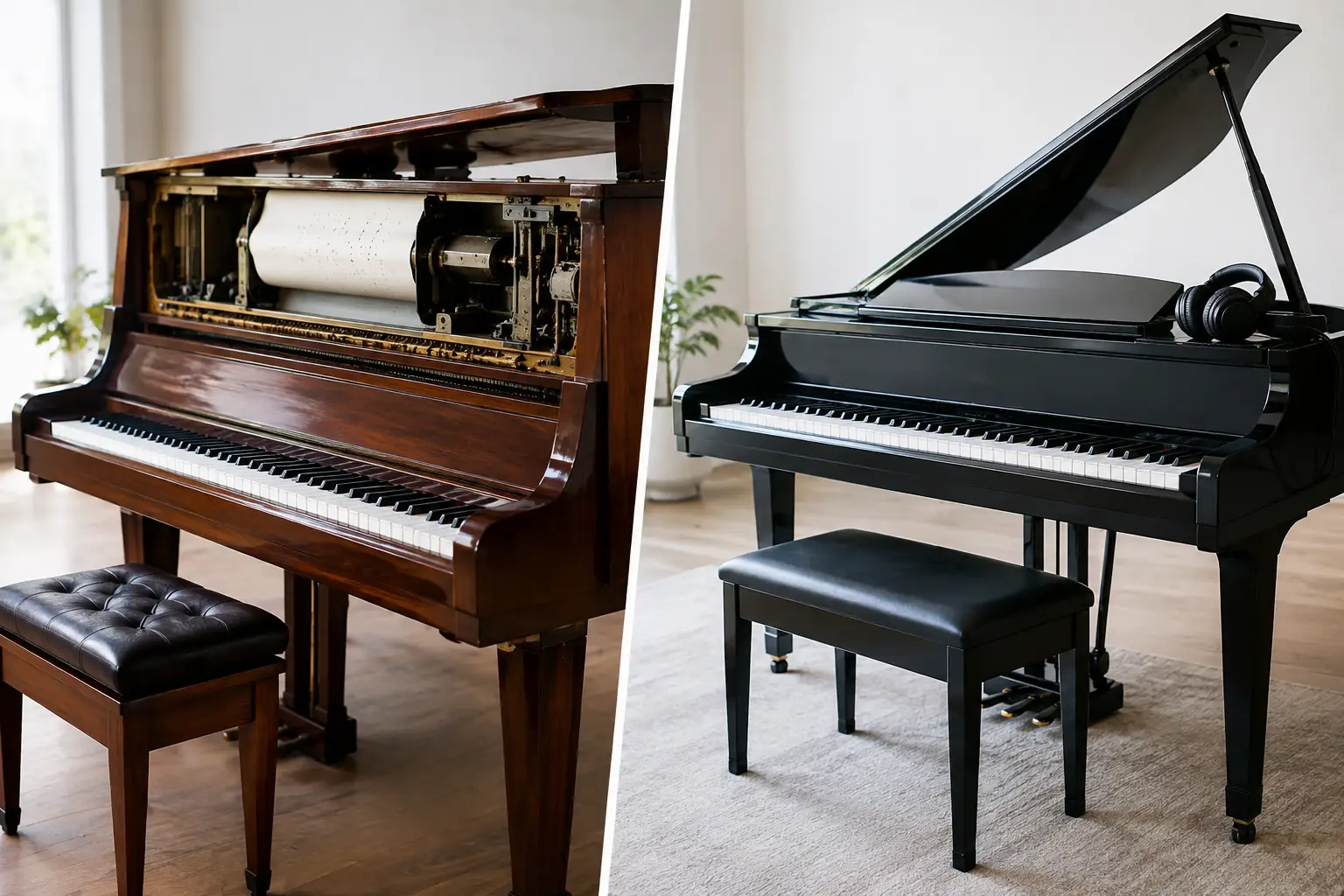
A piano can be the centerpiece of a home, but not every household can accommodate every piano moment. When comparing a player piano versus silent piano, the real question is whether you want the instrument to perform for you, let you practice privately, or do both. Each technology begins with an acoustic piano, yet each serves a very different musical life.
For a family choosing a first fine piano, a busy professional who practices after hours, or a host who wants live piano music without hiring a performer, understanding that distinction can prevent an expensive mismatch. The right choice depends less on which system sounds more impressive on paper and more on how the piano will live in your space.
What a Player Piano Does
A modern player piano is an acoustic piano fitted with a sophisticated playback system. It can reproduce a performance by moving the piano’s keys and pedals, often using high-resolution recordings made by professional artists. Unlike a speaker-based music system, the piano’s own hammers strike its own strings. You see the keys move and hear the sound of the actual instrument in the room.
This is a major part of the appeal. A well-prepared grand or upright already has its own tonal character, touch, and presence. A player system allows that piano to fill the room with music when no one is seated at the bench. Depending on the system, owners may control playlists from a phone or tablet, schedule performances, select different musical styles, and sometimes record their own playing for later playback.
Player pianos suit people who want their instrument to be played often, even when their own schedules are full. They are especially compelling in living rooms, entertaining spaces, restaurants, hospitality settings, and homes where one person plays while everyone else enjoys listening. A self-playing system can also be a source of inspiration for students, who can watch musical phrasing and pedaling unfold on the keys.
There is a trade-off. A player piano does not make the piano quiet. When it is performing acoustically, it produces the same room-filling sound expected from an acoustic instrument. Volume controls may be available through supplemental digital audio on certain systems, but acoustic playback itself still needs a setting where music can be heard.
What a Silent Piano Does
A silent piano is designed for private practice. When silent mode is engaged, a mechanism prevents the hammers from striking the strings. Sensors beneath the keys capture the player’s touch and send that information to a digital tone generator. The pianist then listens through headphones rather than through the acoustic soundboard.
The keys, action, pedals, cabinet, and physical presence remain those of a real acoustic piano. That is why silent systems appeal to serious students and experienced players who do not want to give up the feel of an acoustic action. You can practice scales at 11 p.m., work through difficult repertoire before the rest of the household wakes up, or prepare for a performance in a shared apartment without asking neighbors to tolerate every repeated passage.
Silent systems vary in sensor precision, headphone sound quality, recording features, and connectivity. Premium factory-installed systems generally integrate elegantly with the piano’s action and cabinet. In some cases, a qualified technician can install a compatible system in an existing piano, though suitability depends on the instrument’s condition, design, action regulation, and available space inside the cabinet.
Silent mode does involve a different listening experience. Even excellent sampled piano sounds are heard through headphones, not through a vibrating soundboard in an open room. The keyboard action remains authentic, but the physical resonance and air movement of a live acoustic piano are naturally reduced. For many owners, that is a small compromise for the freedom to practice whenever they wish.
Player Piano Versus Silent Piano: The Everyday Difference
The simplest distinction is this: a player piano plays music when you are not playing, while a silent piano lets you play without disturbing others. One is centered on enjoyment and performance in the room. The other is centered on flexibility, discipline, and privacy.
A player system is ideal if the piano will function as both instrument and entertainment. Imagine a dinner gathering where a jazz trio recording plays from the grand in the corner, or a Sunday morning when a favorite classical program brings a quiet house to life. The instrument becomes active more often, which can make piano ownership feel especially rewarding for non-players and occasional players alike.
A silent system is ideal if the biggest obstacle to playing is noise. A child can practice after sports practice without competing with television or bedtime. An adult beginner can repeat a lesson assignment without self-consciousness. A professional can maintain technique while traveling between demanding rehearsal and work schedules. In each case, the piano is available when motivation appears, rather than only when the room is empty.
For some buyers, the choice is not strictly either-or. Certain premium systems combine self-playing capability with silent practice features. These instruments can be exceptional solutions for households that want both private late-night practice and polished performances for guests. They also carry more technology, more complexity, and usually a higher initial investment, so it is worth deciding whether both functions will genuinely be used.
Sound, Touch, and Instrument Quality Still Come First
Technology should support the piano, not distract from its quality. Whether you choose a Yamaha upright with a silent system, a self-playing grand for a formal room, or a restored vintage instrument with carefully selected modern features, begin with the acoustic piano itself.
Listen for a tone you enjoy. Play the action and notice whether it feels responsive at soft and strong dynamics. Consider the scale of the instrument in relation to your room. A larger grand can provide greater tonal depth and musical range, but a well-built upright may be a more sensible fit for a smaller home, teaching studio, or condominium.
This matters because the acoustic personality of the instrument remains central when it is played normally. A remarkable playback system cannot make a neglected piano sound refined, and a silent feature cannot correct an action that needs regulation. Buyers should ask about the piano’s condition, service history, manufacturer, and future maintenance needs alongside its digital features.
Budget, Installation, and Long-Term Care
Both technologies add cost beyond that of a comparable traditional acoustic piano. Player systems are typically the larger investment because they incorporate playback hardware, software, control components, and precision mechanisms that operate the keys and pedals. Silent systems may be more attainable, particularly on select upright pianos, but prices vary considerably by brand, model, and whether the system is factory-installed or added later.
It is wise to budget for the complete ownership picture. A piano needs professional delivery, a climate-conscious location in the home, regular tuning, and periodic action service. Technology-equipped pianos also benefit from technicians who understand both acoustic regulation and the installed system. If the piano is moved, renovated around, or exposed to significant changes in temperature and humidity, its mechanical and electronic components deserve a careful check.
Placement is another practical consideration. A player grand needs room not only for the piano but also for listening. If the household expects to enjoy acoustic playback, avoid placing it where the sound will be immediately restricted by thin shared walls or a crowded layout. A silent upright can be more forgiving in an apartment or multipurpose room because headphones solve the volume challenge, though the piano still needs a stable environment away from direct sun, vents, and damp areas.
How to Choose the Right Technology
Think first about the moment you most want your piano to serve. If you picture guests arriving to beautiful music, family members listening together, or an elegant instrument that is active even when no one plays, a player piano deserves close consideration. If you picture yourself practicing after everyone is asleep, a student building confidence, or a home where sound limits have delayed piano lessons, silent functionality may have greater value.
Then consider who will use the piano. A non-playing household may receive more immediate enjoyment from a player system. A committed student or adult musician is likely to benefit daily from silent practice. A musical family with varied schedules may find that a combined system earns its higher price by solving two different needs at once.
At A440 Pianos, a thoughtful selection begins with the piano’s musical character, your room, and the way your household actually lives. Technology can make ownership more flexible, but the lasting pleasure still comes from sitting at an instrument that invites you to play. Choose the feature that removes the biggest barrier between your home and more music.

0 Comments