

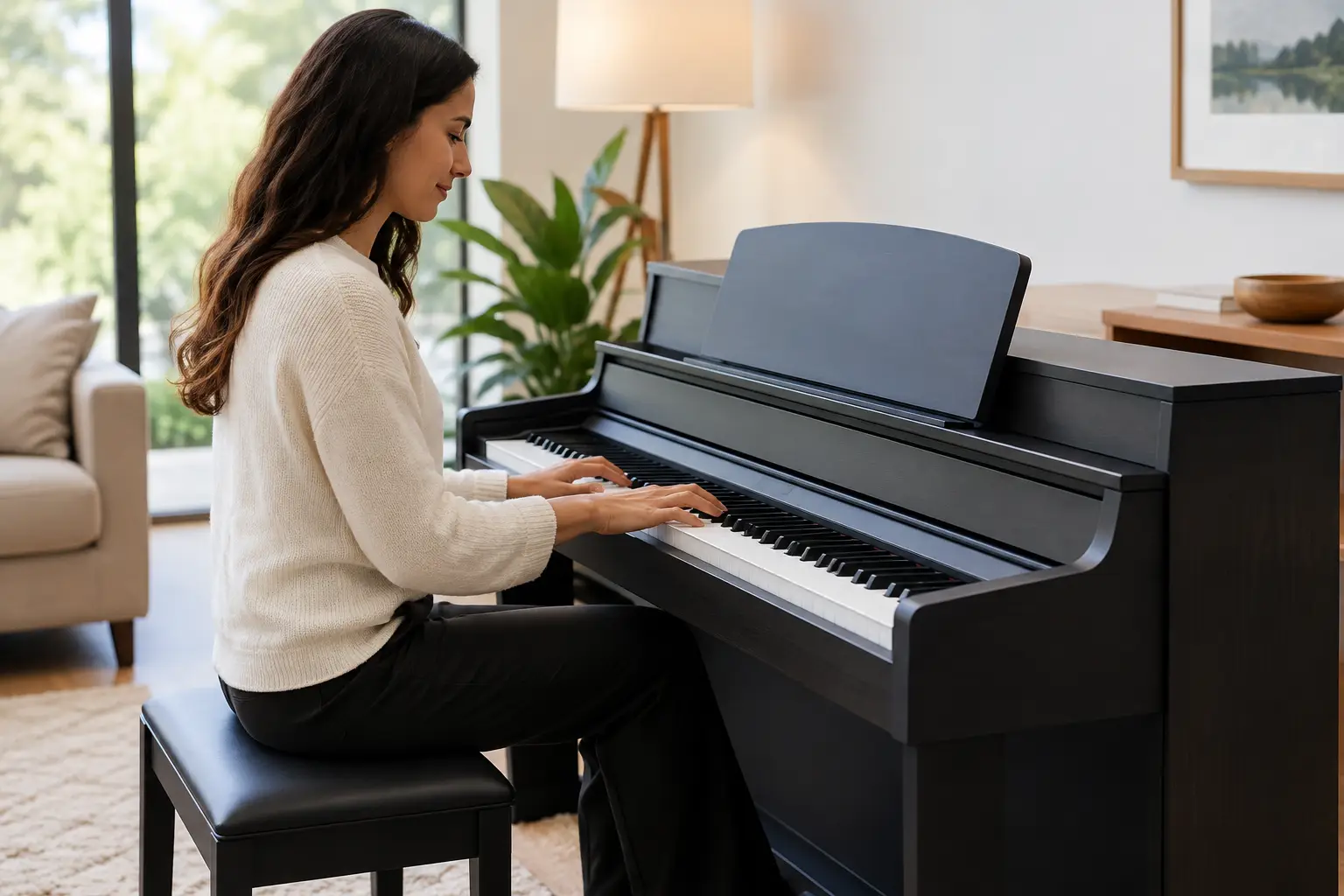
A digital piano earns its place in a home when it invites you to sit down and play, not when it simply fits in the corner. In this Yamaha CLP review, we look at the Clavinova CLP series from the perspective that matters most to buyers: how it feels under the hands, how it sounds in a real room, and whether it fits your musical life for years to come.
The Yamaha CLP line is designed for players who want a more piano-like experience than an entry-level keyboard can provide. It combines weighted keys, sampled concert-grand piano voices, onboard speakers, and modern practice tools in furniture-style cabinets that look appropriate in a living room, studio, or teaching space. It is not a replacement for every acoustic piano, but it can be an excellent choice when quiet practice, consistency, and compact ownership matter.
What a Yamaha CLP Is Designed to Do
Clavinova CLP instruments sit above Yamaha’s portable digital pianos and many basic home keyboards. Their purpose is straightforward: bring the touch, tonal character, and musical control of a piano into a digital instrument that does not require tuning and can be played with headphones.
That combination is particularly appealing for families, apartment residents, adult beginners, and experienced pianists with schedules that do not always allow for daytime practice. A student can work through scales at 10 p.m. without waking the house. A teacher can use recording and playback functions to assess progress. A returning pianist can enjoy a substantial keyboard without taking on the space and maintenance needs of a traditional upright.
The CLP series also gives buyers a wider range of cabinet styles, speaker systems, and key actions than Yamaha’s more portable models. As you move higher in the line, the improvements are not merely cosmetic. You generally gain a more expressive action, stronger sound projection, more detailed piano sampling, and a more convincing connection between your fingers and the sound.
Yamaha CLP Review: Touch Comes First
For most pianists, action is the deciding factor. Sound samples and Bluetooth features are useful, but a digital piano must respond naturally enough that you want to practice on it every day.
Yamaha uses graded hammer actions across the CLP range, meaning lower keys feel heavier and higher keys feel lighter, much like an acoustic piano. Entry and mid-level models offer a satisfying weighted response for beginning and intermediate players. Higher-level CLP models typically add more refined actions, longer key pivots, escapement simulation, and, on certain models, wooden key components. These details can make repeated notes, soft playing, quick passages, and dynamic control feel more convincing.
Still, no digital action feels exactly like every acoustic piano. An acoustic upright has its own mechanism, key depth, friction, and personality. A grand piano offers an even longer key lever and a different sense of rebound. Players accustomed to a well-regulated grand may notice the distinction immediately, especially at the lower end of the CLP range.
That is not necessarily a reason to rule out a CLP. It is a reason to play the specific model before purchasing when possible. For a young beginner, a quality weighted action is often more valuable than an elaborate speaker system. For an advanced pianist preparing demanding repertoire, the action and pedals deserve the greatest share of the budget.
The Sound: Impressive, but Room Matters
Yamaha CLP models are known for piano voices derived from respected concert grands, including Yamaha and Bösendorfer instruments on many versions of the line. The appeal is not just having several piano sounds. It is the ability to choose a tonal character that suits the piece, the player, and the room.
The Yamaha voice tends to offer clarity and directness, while the Bösendorfer-inspired voice often appeals to players seeking a warmer, darker color. Higher models generally provide greater detail as notes decay, respond to touch, and interact with the sustain pedal. Features such as string resonance, damper resonance, and key-off effects can add realism when used thoughtfully.
Speaker quality matters as much as the sampled sound. A CLP with a more powerful, multi-speaker system can feel fuller and more dimensional in a medium or large room. Lower models can still sound very good, but they may be best suited to smaller spaces or headphone-focused practice. Placing any digital piano tightly against a wall, in a corner, or on a thick rug can also change how the bass and projection are perceived.
Headphones are a major advantage, but choose them carefully. A good pair of comfortable, neutral over-ear headphones reveals detail and supports longer practice sessions. Very bass-heavy consumer headphones can make the instrument sound less natural than it really is.
Features That Help Musicians Practice
The strongest practical argument for a Yamaha CLP is not a menu of technology. It is the way technology removes barriers to regular playing. Most models provide dual headphone outputs, metronome functions, recording options, USB connectivity, and app integration for settings, notation, or lesson support. Depending on the model and year, Bluetooth audio and MIDI functions may also be available.
For families, dual headphone jacks can be especially useful. A parent or teacher can listen alongside a student without asking the student to perform through speakers. Recording gives learners a clear way to hear uneven rhythm, rushed phrases, or missed notes that may go unnoticed while playing.
These features should support musicianship rather than distract from it. Buyers who only want a dependable instrument for daily practice may never use every voice or accompaniment setting. That is perfectly reasonable. The core value remains the piano experience: responsive keys, a usable pedal system, and sound that encourages careful listening.
Choosing the Right CLP Model Level
The best CLP is not automatically the highest-priced one. It is the model that meets your current needs without leaving you dissatisfied after a year of progress.
A lower or mid-range CLP can be an excellent first serious piano for a beginner, casual adult player, or household where silent practice is the priority. Focus on a full 88-key weighted keyboard, a stable cabinet, three-pedal capability, and a sound system suitable for the room.
A mid-to-upper model often makes sense for advancing students, regular church musicians, teachers, and players returning to classical repertoire. Here, the more nuanced action and enhanced speakers can make practice more rewarding and support better control of voicing and dynamics.
The top end of the series is best considered by serious pianists who know they will appreciate the action refinements, deeper tonal modeling, and more substantial cabinet presence. At that point, it is wise to compare the CLP directly with a quality acoustic upright or a hybrid piano. The premium may be justified, but only if the player feels the benefit.
When a CLP Is Better Than an Acoustic Piano
A digital piano is not an acoustic piano, and buyers should not be told otherwise. An acoustic instrument has vibrating strings, a soundboard, and a physical response that remains uniquely compelling. It also needs regular tuning, proper humidity care, and professional service over time.
A Yamaha CLP can be the smarter choice when volume control is essential, when a move is likely, when room conditions are difficult for an acoustic piano, or when predictable touch and pitch are priorities. It is also easier to place in an upstairs room or condominium than a heavy acoustic upright, though it still deserves careful professional handling.
For some homes, the ideal answer is both: a digital piano for late-night practice and an acoustic piano for fuller musical expression. For others, a CLP is the instrument that makes consistent practice possible. That practical benefit should never be underestimated.
What to Check Before You Buy
Play slowly before playing loudly. Test very soft notes, repeated notes, scales across the keyboard, and gradual crescendos. Listen for whether the tone changes naturally with your touch. Use the sustain pedal and confirm that half-pedaling, pedal feel, and resonance satisfy you.
Consider the room, too. Measure the intended wall space, allow clearance for the bench, and think about where headphone cables, power outlets, and music books will go. If the piano is for a child, make sure the bench adjusts to a healthy playing height. If it is for a shared living area, cabinet finish and speaker volume may influence the decision as much as technical specifications.
At A440 Pianos, we encourage buyers to view a digital piano as part of a complete ownership decision. The right instrument should suit the player, the room, the budget, and the support you will need after delivery.
A Yamaha CLP is at its best when it becomes the piano people actually use – for a child’s first recital piece, an adult’s return to Chopin, or a quiet hour of music after the rest of the home has gone to sleep.


0 Comments