


A piano purchase often begins with a practical question: where will it live? A family may need quiet evening practice in a condo. A teacher may want a responsive instrument that reveals every detail of a student’s technique. A returning adult player may be drawn to the sound and presence of a real upright. When comparing acoustic vs digital pianos, the best choice is not simply the more expensive instrument or the one with the longest feature list. It is the piano that invites you to play consistently and fits the life around it.
Both types can support meaningful musical progress. The difference lies in how they create sound, how they respond under the hands, and what they ask of an owner over time.
Acoustic vs Digital Pianos: The Essential Difference
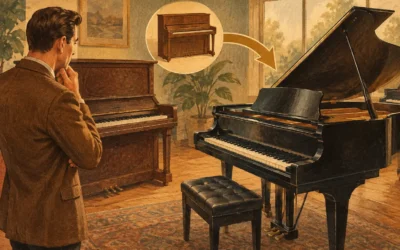
An acoustic piano creates sound mechanically. When a key is pressed, a complex action sends a felt hammer toward strings. The strings vibrate, the soundboard amplifies that vibration, and the player hears a living, physical sound shaped by touch, room acoustics, and the character of the instrument itself.
A digital piano uses sampled or modeled piano sound played through speakers or headphones. Its keys trigger sensors rather than hammers striking strings, although premium digital instruments use sophisticated weighted actions to closely reproduce the feel of an acoustic piano.
That distinction affects nearly every ownership decision. An acoustic piano offers depth, tonal variation, and a direct connection between a player’s technique and the instrument’s voice. A digital piano offers convenience, volume control, compact dimensions, and freedom from regular tuning.
Neither is automatically right for every musician. A serious beginner can thrive on a quality digital piano, while an experienced pianist may choose one for a second home, travel, or late-night practice. At the same time, a well-prepared acoustic upright can be a more inspiring daily instrument than a digital piano with impressive specifications but limited musical response.
Sound and Touch: Where the Playing Experience Changes
The biggest reason players choose an acoustic piano is the feeling of interaction. On an acoustic instrument, every note has a physical beginning, bloom, and decay. A soft note can be delicate without disappearing. A strong chord can expand through the room. Pedaling blends harmonies in a way that remains difficult to duplicate completely, even with excellent digital technology.
This matters most as a student develops control. Acoustic actions teach players to manage key weight, repetition, voicing, dynamics, and pedal technique. The action in a well-maintained Yamaha, Steinway & Sons, or Blüthner is not merely a mechanism. It is part of the musical conversation.
Digital pianos have made remarkable progress, particularly in the midrange and premium categories. Better models feature graded hammer actions, longer key pivots, escapement simulations, multi-speaker systems, and high-quality headphone sound. For many beginners and intermediate players, these instruments provide a satisfying and appropriate foundation for study.
Still, not all weighted keyboards feel alike. Some portable digital pianos have keys that are too light, short, or spring-like to build strong technique comfortably. If a digital piano is intended for classical study, look for 88 weighted keys and try the action in person whenever possible. The goal is not simply resistance under the fingers. It is control from the quietest pianissimo to a confident fortissimo.
Space, Volume, and Daily Life
For many homes, the digital piano wins on logistics. It can fit into a smaller room, often weighs far less than an acoustic upright, and allows headphone practice at any hour. A player with an unpredictable schedule, sleeping children, close neighbors, or shared walls may practice much more often when sound is not a concern.
Digital instruments also offer useful tools for learning and recording. A metronome, recording function, multiple sounds, Bluetooth connectivity, and adjustable volume can be genuinely helpful. These features should support practice rather than distract from it, but they can make a digital piano especially practical for modern households.
An acoustic piano requires more intention around placement. It should not sit directly beside a heat source, air vent, exterior door, or sunny window. Changes in temperature and humidity affect the wood, strings, and action. An upright occupies a meaningful footprint, while a grand piano needs sufficient room around it for both sound and access.
That said, an acoustic piano gives a home a presence that goes beyond its dimensions. It can become the center of a room, a gathering place, and an instrument that family members naturally approach. For buyers with the space and the desire for that experience, the commitment is often worthwhile.
Budget Is More Than the Purchase Price
Digital pianos generally have a lower entry cost, and their ownership expenses are predictable. They do not require tuning, and basic maintenance is limited to keeping the instrument clean, protecting it from moisture, and addressing any electronic or key-action issues if they arise. A quality digital piano can be an excellent value, particularly when portability and quiet practice are priorities.
An acoustic piano should be viewed as both an instrument and a long-term piece of craftsmanship. In addition to the purchase price, owners should plan for professional moving, tuning, periodic regulation, and occasional repairs. Most acoustic pianos benefit from tuning at least once or twice each year, depending on use and environmental conditions.
A used acoustic piano can offer exceptional value, but condition matters far more than age alone. A 40-year-old instrument that has been cared for, properly stored, and professionally serviced may be a far better choice than a newer piano that has been neglected. Before purchasing, ask about the piano’s tuning stability, pinblock condition, soundboard, action wear, pedal function, cabinet condition, and service history.
This is where expert guidance protects the buyer. At A440 Pianos Inc, the goal is to help each customer weigh the instrument’s musical potential alongside its condition, space requirements, and future care. A carefully selected used upright may provide a richer experience than a new entry-level instrument, while a digital piano may be the wiser purchase for a particular home.
When an Acoustic Piano Is the Better Choice
An acoustic piano is often the right fit for a committed student, serious hobbyist, teacher, performer, or family that wants a lasting centerpiece for music at home. It is also a strong choice for players preparing for recitals, auditions, and conservatory-level study, where regular time on an acoustic action is valuable.
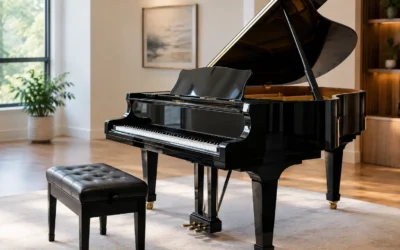
Choose acoustic when tone, touch, and long-term musical development are your highest priorities, and when you can provide a stable environment and appropriate maintenance. An upright can be an excellent fit for many homes, while a grand offers greater tonal range and action control for players with the room and budget to support it.
It is worth remembering that size affects more than appearance. A taller professional upright usually offers longer strings and greater soundboard area than a compact console. Likewise, a larger grand often provides more tonal color and control than a smaller baby grand. The best piano is not necessarily the largest one, but musical performance should be considered alongside furniture dimensions.
When a Digital Piano Makes More Sense
A digital piano may be the better choice when quiet practice is essential, space is limited, or the piano must be moved regularly. It is particularly practical for apartment living, dorms, multipurpose rooms, worship teams, rehearsal spaces, and musicians who need recording or amplification options.
For a beginner, a well-chosen digital piano can remove barriers to practice. Headphones make it possible to play early in the morning or late at night. A compact cabinet or portable design can keep a room functional. And the absence of tuning appointments can make the first years of ownership easier to manage.
Avoid treating every digital piano as interchangeable. A low-cost keyboard with 61 or 76 unweighted keys is useful for exploring music, but it is not the same as a piano for long-term study. If the player plans to take lessons, select an 88-key model with a convincing weighted action, a stable stand, and a proper pedal setup.
A Few Questions Before You Decide
Start with the player’s goals. Is this an introduction to lessons, a return to playing, professional work, or a lifelong passion? Then consider the household: Can the instrument be heard freely, or are headphones necessary? Think honestly about available space, delivery access, and the budget for care after the purchase.
Finally, play before deciding whenever possible. Listen for a sound that makes you want to sit down again. Feel whether the keys allow control rather than simply producing notes. The right piano should meet practical needs, but it should also make music feel close at hand. That is the instrument most likely to be played, cared for, and enjoyed for years.

0 Comments