

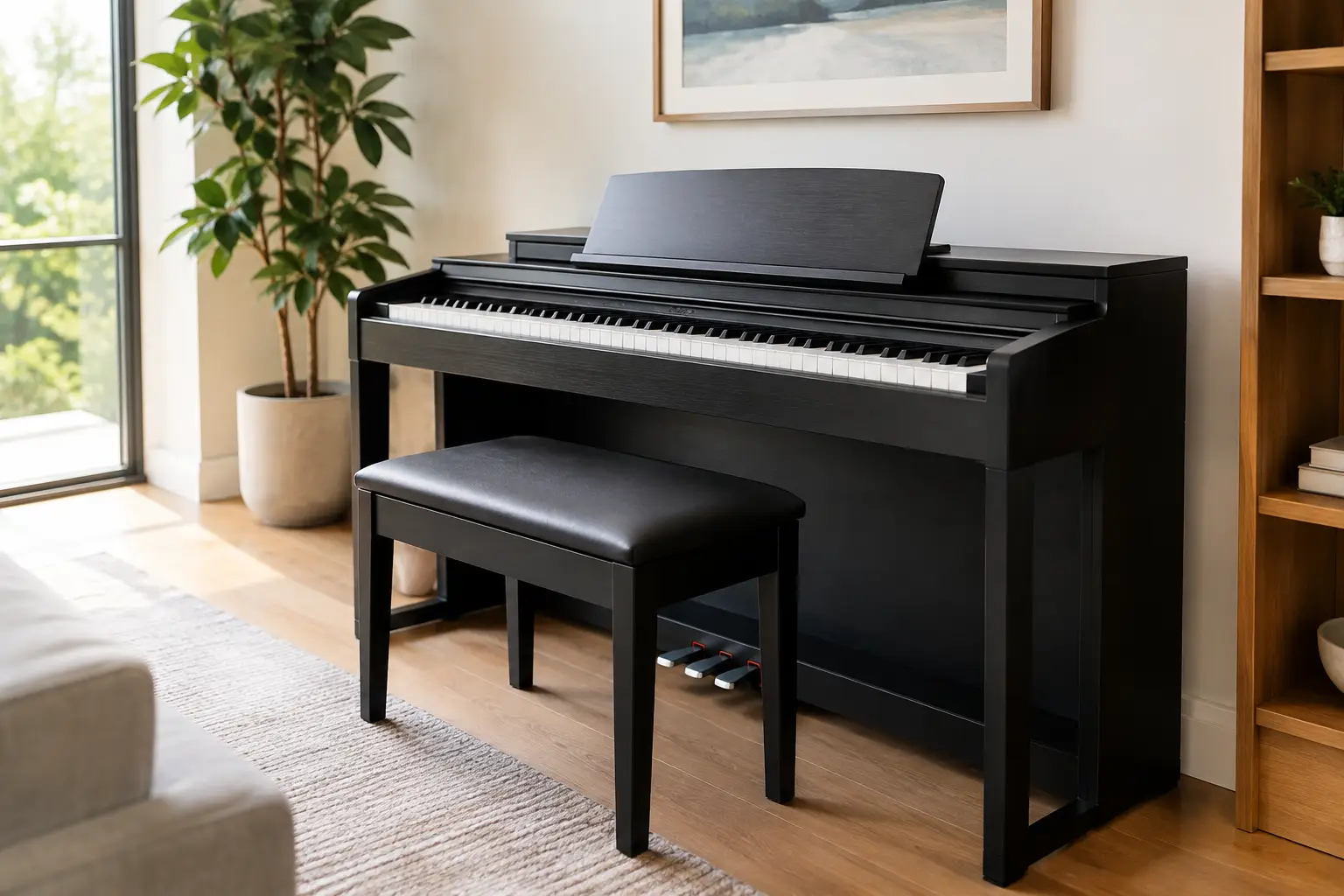
A piano has to earn its place in a home. It needs to invite practice on a busy Tuesday night, give a developing player enough musical feedback to improve, and still satisfy an experienced pianist who notices the difference between a pleasant sound and a convincing one. This Clavinova piano review looks at why Yamaha’s flagship-style digital piano line remains such a popular choice for families, teachers, and dedicated home players.
The short version is that Clavinova instruments are among the strongest digital piano options for buyers who want an acoustic-piano experience without the tuning schedule, weight, or room demands of an acoustic upright or grand. The more useful answer, however, depends on which Clavinova series you are considering and what you expect from the instrument over the next several years.
What a Clavinova Is Designed to Do
Clavinova is Yamaha’s premium digital piano family. Rather than functioning as a portable keyboard in furniture-style cabinetry, these instruments are designed to feel and behave more like pianos. They include a full 88-key keyboard, graded hammer action, pedals, substantial cabinetry, and piano sound samples intended to respond to dynamics and touch.
For a buyer comparing a Clavinova with an entry-level digital piano, the difference is usually apparent at the keyboard. A better action gives players more control over soft notes, accents, repeated notes, and phrasing. That matters to beginners learning proper technique, but it matters just as much to returning adults who do not want to outgrow their instrument after a year.
The Clavinova range generally includes three distinct approaches. CLP models focus most directly on the traditional piano-playing experience. CVP models add a broad selection of voices, accompaniment styles, and interactive features for players who enjoy arranging, composing, or playing popular music. CSP models emphasize guided learning and app-based song interaction. Each can be an excellent choice, but they serve different musical habits.
Clavinova Piano Review: Touch and Tone
A digital piano succeeds or fails at the point of contact between player and instrument. Yamaha has put considerable attention into Clavinova keyboard actions, and many models use graded weighting that feels heavier in the lower register and lighter as the notes rise, much like an acoustic piano.
Higher-tier models typically offer more refined actions, sometimes with wooden components or key surfaces designed to improve grip and comfort. The action will not feel identical to every acoustic piano. No digital mechanism can perfectly duplicate the shifting physical response of thousands of moving parts in a grand piano. Still, a well-matched Clavinova can provide a controlled, satisfying platform for scales, repertoire, sight-reading, and daily practice.
The sound is another clear strength. Clavinova pianos are known for detailed Yamaha grand piano voices, and many models also include alternate concert-grand character for players who prefer a different tonal color. Through the built-in speaker system, the better models produce a wide, room-filling sound with noticeably more body than a compact digital piano.
That said, speakers matter. A premium Clavinova may sound impressive in a modest living room, yet a serious player should also spend time with quality headphones. Headphones reveal the detail in the sample, the response of the action, and the realism of soft playing without room acoustics getting in the way. They also make evening practice possible without asking the rest of the household to join the lesson.
The Features That Matter in Daily Use
The greatest practical benefit of a digital piano is consistency. An acoustic piano needs a stable environment, regular tuning, and occasional regulation to perform at its best. A Clavinova is ready whenever you switch it on. For a family with changing schedules, that convenience can be the difference between an instrument that is played every day and one that sits quietly in the corner.
Volume control is equally valuable. A player can practice softly through speakers, use headphones, or connect external audio equipment where appropriate. Many Clavinova models also provide recording functions, metronomes, lesson tools, Bluetooth or audio connectivity, and USB capability. These features are helpful when they support a player’s goals rather than distract from them.
For example, a beginning student may benefit from recording a short piece and listening back for uneven rhythm. A teacher may appreciate simple accompaniment or playback tools. An adult player who enjoys standards, worship music, or contemporary songs may get real enjoyment from CVP accompaniment styles. On the other hand, a classically focused pianist may prefer a CLP model with fewer options and a more direct piano-first layout.
A polished control panel is not a substitute for a good keyboard action. Buyers should choose the musical foundation first, then decide how much technology they will genuinely use.
Where a Clavinova Fits Better Than an Acoustic Piano
For some homes, an acoustic upright remains the best answer. A well-prepared acoustic piano creates sound through strings, hammers, and a resonant soundboard, giving it a physical complexity that digital sampling cannot fully reproduce. Players preparing demanding classical repertoire, performing professionally, or simply drawn to the living presence of an acoustic instrument may ultimately be happiest with a quality upright or grand.
But a Clavinova solves real ownership concerns. It does not need annual tuning. It is less sensitive to seasonal humidity changes. It can be played privately with headphones, and it is generally easier to place than an acoustic piano. These advantages are especially meaningful in apartments, townhomes, shared households, media rooms, and spaces with limited climate control.
Cost can also favor the digital route. A quality acoustic piano is a long-term musical investment, but it requires delivery, tuning, and ongoing maintenance. A Clavinova may offer a more predictable ownership experience for a family that wants a high-level practice instrument now. It can also be an excellent second piano for a musician who owns an acoustic instrument but needs a quiet practice option.
The trade-off is longevity in a different sense. A properly maintained acoustic piano can serve a family for generations and may be restored when needed. Digital pianos are electronic products, so buyers should consider manufacturer support, condition, and whether the instrument’s features will remain useful to them as their playing develops.
Choosing Between CLP, CVP, and CSP Models
The right Clavinova begins with the way you play. The CLP line is often the best place to start for students, classical players, and anyone who wants a traditional piano cabinet with an emphasis on touch, tone, and pedals. It is the most natural fit for the buyer who wants to sit down and play without navigating menus.
CVP instruments are better suited to the player who wants more than a piano. Their additional sounds and accompaniment features can make solo playing feel like a small ensemble performance. They are particularly appealing for entertainers, songwriters, hobbyists, and families where several people will use the instrument in different ways.
CSP models can be compelling for learners who enjoy visual guidance and interactive song-based practice. This approach is not for everyone. Some students thrive with the extra structure, while others make faster progress with a teacher, printed music, and a straightforward piano interface. The best learning tools are the ones a player will use consistently.
Within each line, budget usually changes the quality of the action, speaker system, cabinet, piano samples, and pedal response. A lower-priced Clavinova can be a very capable home piano, while an upper-tier model may be worth the investment for a pianist who plays frequently and is especially sensitive to key feel and tonal detail.
What to Test Before You Buy
Specifications are useful, but they cannot replace playing the instrument. Begin with a familiar piece that includes quiet passages, chords across several registers, and dynamic contrast. Pay attention to whether you can control a soft tone without notes dropping out, whether repeated notes feel comfortable, and whether the bass has weight without becoming muddy.
Then test the pedals. Sustain should feel musical rather than like a simple on-and-off switch, and the instrument should respond naturally when you use partial pedal movement if that feature is available. Spend a few minutes playing at low volume and through headphones as well. A piano that sounds exciting at one loud showroom setting may feel very different in your home.
Cabinet style and dimensions deserve attention too. A Clavinova is more furniture-like than a portable keyboard, so measure the wall, doorway, and intended room before delivery. Consider where the bench will sit, whether the lid can open comfortably, and how the piano will relate to windows, heat sources, and foot traffic.
When comparing new, used, or display instruments, ask about the model year, cosmetic condition, keyboard response, pedals, speakers, power supply, and included bench. A knowledgeable piano specialist can help you weigh those details against the price and your long-term plans.
Is a Clavinova Worth It?
For the right buyer, yes. A Clavinova is worth considering when you want a serious digital piano with a credible action, strong piano sound, attractive cabinet, and useful home-friendly features. It is particularly compelling for families committed to lessons, adult players returning to music, teachers who need flexible volume control, and musicians who want reliable practice access at any hour.
It may be less suitable for a buyer whose first priority is the organic sound and tactile depth of an acoustic piano, or for someone who only needs a lightweight keyboard for occasional use. The key is to avoid paying for features you will not use while also avoiding an instrument that will feel limiting as your skills advance.
At A440 Pianos, we encourage buyers to play before deciding whenever possible. The best piano is not the one with the longest feature list. It is the one that fits your space, budget, hands, and musical ambitions well enough that you will want to return to it tomorrow.


0 Comments