


A beautiful piano can lose its appeal fast when it dominates the room, blocks traffic, or sounds too bright against hard apartment walls. Choosing an upright piano for small space living is not just about finding the shortest cabinet. It is about balancing footprint, touch, tone, design, and long-term satisfaction so the instrument fits your home and your standards.
For many buyers, the right answer is an upright, but not always the smallest one available. A compact piano may solve a floor plan problem while creating a musical compromise that becomes obvious within months. If the piano is for a serious student, a teaching studio, a church office, or a refined living area where appearance matters, the better choice is often a carefully selected console, studio upright, or professional upright with efficient dimensions and stronger musical value.
What makes an upright piano for small space work
Small-space buying starts with three measurements: width, depth, and room clearance. Most upright pianos are narrower in depth than many people expect, which is why they remain one of the most practical acoustic instruments for homes, condos, and multipurpose rooms. The issue is usually not whether the piano will physically fit against a wall. The real question is whether the room will still feel usable once the bench, player seating, and walking path are included.
A compact upright typically works best when the piano can sit on an interior wall with stable temperature and enough bench clearance for comfortable playing. If the piano ends up squeezed beside a doorway or heating vent, even a premium instrument becomes harder to enjoy and harder to maintain. Placement matters almost as much as piano size.
The good news is that upright pianos give buyers more flexibility than grand pianos without forcing them into a purely digital experience. For households that want the visual presence and tonal depth of a real acoustic instrument, an upright remains the strongest small-space solution.
The size ranges that matter most
Not all uprights serve the same buyer. In a smaller home, cabinet height directly affects tonal power, while depth and case design influence how easy the piano is to place.
Spinet and compact consoles
Older spinets and very small consoles appeal to buyers who want the lowest visual profile. They can fit tight spaces, but this is where trade-offs become serious. Many have lighter actions, less responsive touch, and more limited tonal color. Some older compact designs are also less attractive from a service standpoint because parts access and regulation can be more challenging.
For casual use, they may be enough. For a developing student or an experienced pianist, they often feel like a short-term solution.
Standard consoles
A quality console is often the sweet spot for an upright piano for small space buyers. It keeps a manageable footprint while offering a more satisfying action and fuller sound than the smallest uprights. In the right brand and condition, a console can perform beautifully in a family room, apartment, or lesson space.
This category is especially appealing for first-time acoustic buyers who want a piano that looks refined and plays with authority without consuming the room.
Studio and professional uprights
A studio upright or taller professional upright may sound like the wrong choice for a smaller home, but that is not always true. Many have only modestly larger footprints than shorter consoles. The added height improves string length and soundboard area, which usually means more tonal depth and better dynamic control.
If the room can visually handle a taller cabinet, this is often the smarter musical investment. You gain a more substantial instrument without stepping into grand piano territory.
Why the smallest piano is not always the best value
It is easy to shop by dimensions alone, especially online. But the most compact piano in the room can become the most expensive mistake if it disappoints musically or needs immediate service.
Used and vintage pianos deserve especially careful evaluation. Some compact uprights were built with impressive craftsmanship and remain excellent choices today. Others were entry-level instruments when new and have not improved with age. Brand reputation helps, but condition matters just as much as the decal on the fallboard.
This is where specialist guidance becomes valuable. A premium used upright from Yamaha, Kawai, Baldwin, Steinway, or another respected maker can offer far better touch and tone than a cheaper small piano sourced from a general marketplace. Buyers with limited floor space usually also have limited patience for trial and error. They want one good decision, not a temporary stopgap.
How room acoustics change the decision
Small rooms make pianos sound different. Hardwood floors, glass, painted walls, and low ceilings can make a bright piano sound sharper than it would in a larger setting. Soft furniture, rugs, and bookshelves can warm the room and make a more brilliant instrument feel balanced.
That means the ideal upright is not only about size. It is also about tonal character. A bright, highly projecting piano can feel overwhelming in a tight apartment. A warmer, rounder instrument may be easier to live with day to day. On the other hand, if the room is heavily carpeted and acoustically dry, a more lively piano may bring needed clarity.
This is one reason serious buyers should avoid making the decision from dimensions alone. The piano has to fit the ear as well as the wall.
What to look for if style matters as much as space
In many homes, the piano is not tucked away in a practice room. It sits in the living room, entryway, library, or open-plan space where guests see it immediately. For upscale buyers, cabinet style, finish, and visual scale matter.
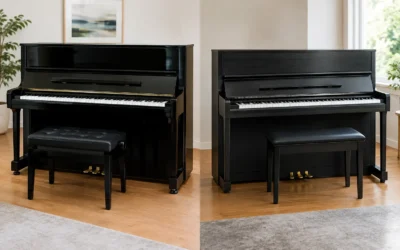
A polished ebony upright remains the most versatile choice because it complements both traditional and modern interiors. Satin ebony can feel more understated. Designer cabinetry, wood veneers, and vintage styling can create stronger visual character, but they should still suit the room rather than overpower it.
When space is limited, visual weight matters almost as much as physical size. A piano with clean lines and elegant proportions can make a room feel more finished, while a bulky cabinet can make the same room feel crowded.
Buying used is often the smartest move
A premium used upright often delivers the best combination of value, craftsmanship, and space efficiency. Many older uprights were built with materials and design standards that are difficult to match at lower modern price points. For buyers who care about musical quality but do not want to commit the space or budget required for a grand, this can be an ideal category.
The key is buying from a piano specialist who understands inspection, restoration, regulation, tuning stability, and delivery logistics. A beautiful used piano is only a good purchase if it arrives safely, performs reliably, and can be supported after the sale. That full-service approach matters even more in smaller homes, where placement challenges and climate conditions need practical planning.
At A440 Pianos, many buyers come in expecting to choose the smallest upright available and leave with a better-informed perspective. Sometimes the best fit is compact. Sometimes it is slightly taller, more refined, and far more rewarding to play for years.
Questions worth asking before you buy
Before choosing a model, think beyond the basic dimensions. Who will play the piano, and how seriously? Is this a first acoustic piano for a child, or an upgrade for an advancing pianist? Will the room support regular playing, or is the piano also serving as a design centerpiece in a formal area?
You should also consider access. Tight staircases, elevators, narrow hallways, and door clearances affect what can be delivered safely. A piano that fits the room on paper may still require careful professional handling to get there. Buyers often focus on the showroom dimensions and forget the path into the home.
Finally, ask what level of service comes with the purchase. Delivery, setup, tuning, future maintenance, and repair support are not extras. They are part of owning an acoustic piano properly.
The best small-space piano is the one you keep loving
A well-chosen upright should make the room feel richer, not smaller. It should invite practice, support musical growth, and look like it belongs there. When the size is right but the tone is thin, the action is disappointing, or the cabinet feels out of place, the piano becomes furniture with keys.
A better approach is to choose the finest instrument your space can comfortably support. In a compact home, that usually means an upright with efficient dimensions, proven musical quality, and professional support behind it. When those pieces align, even a smaller room can hold a piano with real presence.
If you are buying carefully, that is the goal – not just fitting a piano into the space, but fitting the right piano into your life.


0 Comments