

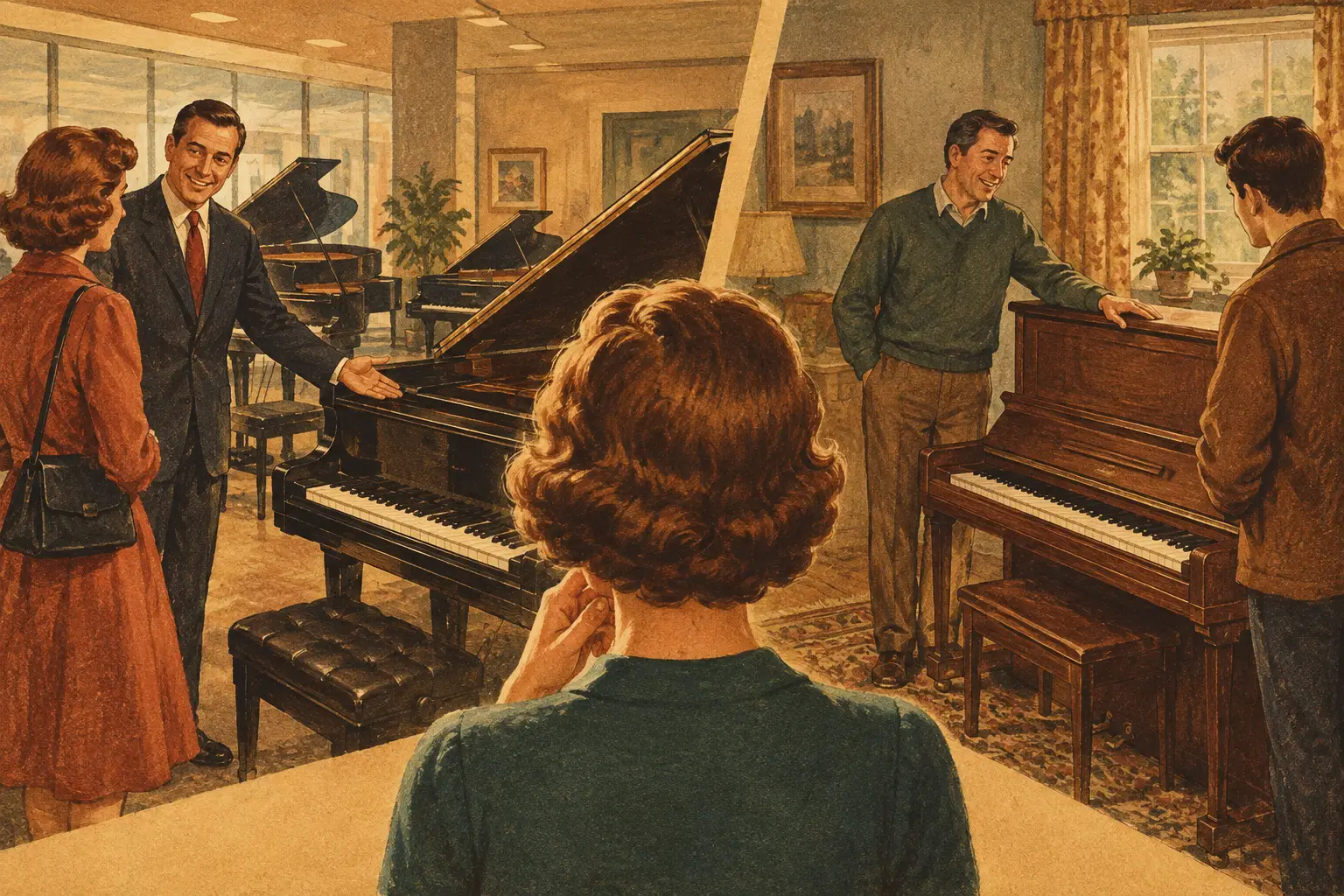
A beautiful used piano can look like a remarkable value until the first tuning reveals unstable pins, worn action parts, or a soundboard issue that was never visible in the listing photos. That is the real question behind a piano dealer versus private seller decision: not simply where the price is lower, but where the buyer carries the risk.
For a casual keyboard purchase, a private transaction may be straightforward. For an acoustic piano – especially a grand, a vintage instrument, or a piano intended for serious study and performance – the details matter. Condition, preparation, transport, and post-sale support all affect what the piano will cost and how it will feel to play over the years ahead.
Piano Dealer Versus Private Seller: The Core Difference
A private seller usually offers one specific piano in its current condition. They may be honest, knowledgeable, and genuinely attached to the instrument, but they are rarely equipped to evaluate every mechanical and structural concern, complete repairs, arrange specialized delivery, or stand behind the sale after the piano leaves their home.
A qualified piano dealer is selling more than an instrument. The dealer should evaluate condition, identify appropriate repairs, regulate and tune the piano as needed, and help the buyer understand its age, design, tone, and remaining useful life. That level of preparation is particularly valuable with premium used pianos, where a small difference in condition can create a major difference in value.
This does not mean every dealer piano is automatically superior or every private-sale piano is a poor choice. It means the buying experience should be judged by the quality of the inspection, preparation, documentation, and service behind it.
The Private Seller Advantage: Lower Asking Price
The strongest argument for buying privately is simple: the asking price can be lower. A homeowner may be moving, downsizing, settling an estate, or looking for a quick sale. In those cases, a buyer may find an excellent instrument for less than a comparable dealer-listed piano.
Private sellers can also offer unusual opportunities. A well-maintained family Steinway, Yamaha, Kawai, or Baldwin may have lived in a climate-controlled home and received consistent care. If its history is clear and an independent technician gives it a favorable inspection, buying directly can be sensible.
The challenge is that the advertised price is only the beginning. A piano that appears to be a bargain may still need professional moving, tuning after delivery, action work, replacement parts, humidity-related repairs, refinishing, or more extensive restoration. A free piano can become an expensive project quickly.
When considering a private sale, budget for an independent pre-purchase inspection before committing. The technician should assess tuning stability, pinblock condition, soundboard and bridge health, action wear, pedal function, key level, strings, hammers, dampers, and evidence of water, insect, or climate damage. A seller’s statement that the piano “just needs tuning” is not a condition report.
What You Pay for at a Piano Dealer
A reputable dealer’s price reflects curation, labor, facilities, and accountability. The piano has typically been selected from a larger market, evaluated by technicians, prepared for presentation, and priced according to condition, brand, model, age, and musical potential.
That preparation matters most when the buyer does not have the time or technical background to evaluate an acoustic piano. A dealer can explain why two similarly sized grand pianos may differ dramatically in touch, tonal color, and long-term value. They can also match the instrument to the player rather than simply selling the piano that happens to be available.
For a beginning student, that may mean a dependable upright with a responsive action and stable tuning. For an advanced pianist, it may mean comparing the warm complexity of a vintage European instrument against the clarity and consistency of a Japanese-built grand. For a collector, it may mean verifying originality, restoration quality, and the character that makes a rare piano worth pursuing.
At A440 Pianos, the advantage is a curated selection paired with technical and ownership services. Buyers can consider premium used, vintage, grand, upright, and specialty instruments while also having a clear path for delivery, tuning, repair, restoration, and financing.
Warranty and Accountability Change the Calculation
Pianos are complex machines made from wood, felt, steel, and thousands of moving parts. Even a carefully maintained piano can reveal issues after relocation, seasonal changes, or regular playing. The difference is how those issues are handled.
Most private sales are final. Once payment is exchanged, the buyer is responsible for every surprise. There may be no return option, no written condition standard, and no practical recourse if the piano performs differently than expected.
Dealer policies vary, so buyers should ask direct questions rather than assume coverage. Is there a warranty? What does it cover, and for how long? Has the piano been serviced before delivery? Is the piano tuned after it arrives? Who handles concerns if an issue appears shortly after installation?
Clear answers are a sign of a professional transaction. Vague promises are not. A premium purchase deserves written expectations, especially when the instrument will be used for daily practice, teaching, worship, recording, or performance.
Delivery Is Not a Side Detail
A piano is not furniture. Moving one incorrectly can damage the cabinet, action, pedals, finish, stairs, flooring, or the instrument’s internal structure. It can also create a serious safety risk.
Private sellers often expect buyers to arrange pickup. That may work if the buyer already has access to experienced piano movers, but it should never mean asking general household movers to handle a grand piano without the right equipment and training. The cost of proper transport should be part of the purchase comparison from the beginning.
A dealer is more likely to coordinate professional piano delivery, assess access challenges, and plan for stairs, turns, elevator requirements, and placement. This is particularly important for high-value grands, player systems, antique cabinets, and specialty instruments. After delivery, an acoustic piano should be allowed to acclimate before its first tuning.
How to Compare the True Cost of Each Option
Instead of comparing only two asking prices, compare the complete ownership cost. Include the piano’s condition, expected repairs, moving, tuning, warranty or service protection, bench and accessories, and the value of expert guidance.
A private piano priced at $3,000 is not necessarily less expensive than a dealer piano priced at $4,500. If the private piano requires $1,000 in repairs, $500 in moving, and several visits to address tuning and action concerns, the difference disappears. More importantly, the buyer may still own a piano with limitations that were not obvious at first.
On the other hand, a private seller with a well-documented instrument, fair pricing, and permission for a full technician inspection may offer genuine value. The right choice depends on the individual piano, not a label alone.
When a Private Seller Makes Sense
Buying from a private seller can be a good fit when the piano is modestly priced, the buyer is comfortable arranging an inspection, and the expected repair budget is realistic. It can also make sense for buyers with trusted piano technicians or for those seeking a restoration project with a specific musical or historical appeal.
Proceed carefully if the listing emphasizes appearance but provides little service history, if the piano has not been tuned for years, or if the seller discourages inspection. Warning signs include sticky keys, strong odors, rust, cracked ivory or plastic keytops, visible water staining, buzzing notes, or a piano that cannot hold pitch.
When a Dealer Is the Better Investment
A dealer is usually the stronger choice for first-time buyers, families investing in a student’s development, institutions, churches, studios, and anyone purchasing a premium piano with limited tolerance for surprises. It is also the more practical route when delivery, financing, restoration, and ongoing service need to be coordinated without managing multiple vendors.
The best dealer relationship should feel consultative, not pressured. You should be able to play several instruments, ask detailed questions, hear candid explanations of condition, and select a piano based on your space, budget, repertoire, and goals.
A piano should invite you to sit down again tomorrow. Whether you buy from a dealer or a private seller, choose the instrument only after its musical voice, mechanical health, delivery plan, and future care all make sense together.


0 Comments