

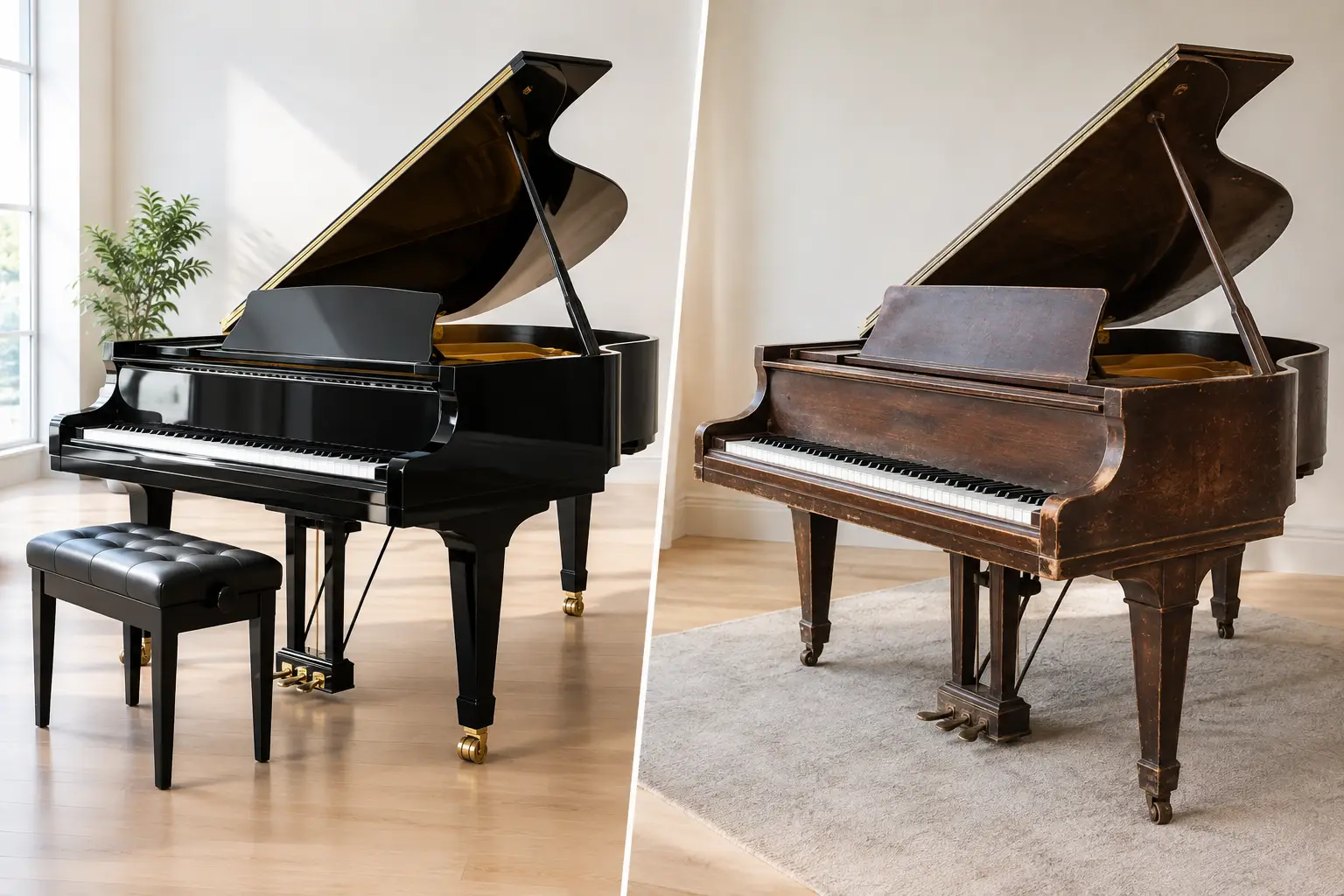
A piano can look beautiful across a showroom floor and still be the wrong piano for your hands, room, or musical plans. When comparing new versus restored pianos, the real question is not simply whether one is better. It is whether you want modern consistency, the character of a proven instrument, or a particular balance of both.
For a family buying its first piano, a newer upright with a warranty may bring welcome confidence. For a pianist who has always wanted the singing tone and scale of a classic grand, a properly restored instrument may offer exceptional musical value. The condition of the individual piano, the quality of the work completed, and the support available after delivery matter more than the label alone.
What “restored” should mean
The word restored can describe very different levels of work. A piano that has been cleaned, regulated, tuned, and polished is not necessarily rebuilt. Those services can improve playability, but they do not automatically address the components that determine a piano’s long-term performance.
A thorough restoration may include rebuilding the action, replacing worn hammers and shanks, restringing, repairing or refinishing the soundboard, restoring the cabinet, and addressing structural components such as the pinblock and bridges. The scope depends on the piano’s age, condition, make, and musical potential.
That distinction matters because a piano has more than 10,000 moving and tension-bearing parts. Fresh cabinet finish alone cannot make a weak pinblock hold a stable tuning or give worn action parts a precise touch. Before considering a restored piano, ask what was done, which parts were replaced, who performed the work, and how the instrument has been maintained since then.
A well-restored piano should not feel like an old piano that has been made presentable. It should feel responsive, stable, and musically alive. At the same time, restoration does not erase an instrument’s original design. A vintage Steinway, for example, retains the personality of its scale design and materials, while a restored Yamaha may preserve the clarity and directness players value in that brand.
New versus restored pianos: the practical differences
New and restored instruments can both be excellent choices, but they deliver different ownership experiences.
Tone and musical character
New pianos generally offer a predictable tonal profile. A new Yamaha upright may appeal to players seeking clarity, evenness, and reliable projection. New premium grands often provide a refined touch and a wide dynamic range from the start, although every acoustic piano still benefits from careful tuning and voicing as it settles into its new home.
Restored pianos can offer tonal complexity that is difficult to describe on a specification sheet. Some players are drawn to the warmth, depth, and color of a mature instrument from a respected maker. A restored grand may have a voice that feels especially personal for classical repertoire, jazz, accompanying, or intimate home playing.
Neither sound is universally superior. The best approach is to play several instruments at different dynamic levels. Listen to the bass, sustain a middle-register chord, and test how the treble responds when you play softly. A piano should invite you to stay at the bench.
Touch and control
A new piano gives buyers a known baseline. Its action components are new, its regulation is current, and its touch is designed to be consistent across the keyboard. This can be especially reassuring for beginners, teachers, and institutions that want a dependable instrument with straightforward service expectations.
A high-quality restoration can produce an equally satisfying action, sometimes with a level of nuance that experienced players love. But quality is essential. The action must be properly fitted, regulated, and voiced as a complete system. Replaced parts alone do not guarantee a fine touch.
For serious pianists, test repetition, soft playing, and rapid passages. Notice whether each key responds evenly and whether the piano gives you control without requiring excessive effort. If possible, bring a teacher, technician, or trusted pianist to a second appointment.
Value and price range
Restored pianos can place a distinguished brand or larger grand size within reach of a budget that would not accommodate a comparable new model. This is one reason a carefully selected restored piano can be such an appealing purchase. You may be investing in musical substance and craftsmanship rather than first-year depreciation.
However, a lower initial price is not automatically a better value. A lightly serviced older piano with major work still ahead can become expensive quickly. Conversely, a fully restored instrument with documented work, excellent tone, and stable structure may represent far more value than its age suggests.
New pianos tend to offer cleaner pricing and fewer unknowns. They may also include manufacturer warranty coverage, and financing may be easier to evaluate when the purchase is straightforward. Buyers should consider the full ownership picture: purchase price, delivery, tuning, regular maintenance, humidity control, and any future repairs.
Warranty and peace of mind
A new piano commonly comes with a manufacturer warranty, though terms vary by brand and retailer. This provides a valuable layer of protection for buyers who prefer predictable ownership, particularly when purchasing a first acoustic piano.
A restored piano may carry a dealer or restoration warranty rather than an original manufacturer warranty. The meaningful question is not only the warranty length, but what it covers and who will stand behind the piano if an issue arises. A knowledgeable piano specialist should be able to explain the instrument’s condition clearly and provide realistic guidance about its care.
When a new piano is the better choice
A new piano is often the right fit when reliability, modern features, and a clear warranty are your priorities. Families may appreciate starting with a new upright that gives a student a stable instrument for daily practice. Schools, churches, and studios may prefer the consistency of new instruments when several people will use the piano each week.
New can also be the stronger choice when a specific feature matters. Silent systems, self-playing technology, digital connectivity, and contemporary cabinet styles are generally easier to find in current production models. If your room has a defined visual style, a new piano may offer more finish options and a more uniform appearance.
This does not mean new is only for beginners. Many advanced pianists choose new premium instruments because they want the latest design refinements, factory specifications, and the opportunity to break in the piano themselves.
When a restored piano deserves serious consideration
A restored piano is compelling when the instrument has genuine musical pedigree and the restoration has been done with care. It can be an excellent choice for musicians who value a particular maker, period, tonal character, or cabinet design. It may also be the practical route to owning a larger grand piano with richer bass and greater expressive range.
The key is selectivity. Not every old piano is a restoration candidate, and not every restored piano has received the same level of craftsmanship. A respected brand name does not overcome poor structure, inadequate work, or years of neglect.
Ask for transparency about the piano’s history and restoration scope. Inspect the finish, but listen beyond it. Check tuning stability, pedal function, action consistency, and the condition of the soundboard and strings. A professional evaluation can protect your investment, especially when considering a vintage or collectible instrument.
Consider the home, not just the piano
The right piano must suit its future environment. An upright can be a superb musical center for an apartment, teaching studio, or family room, while a grand piano needs enough space for sound to develop without overwhelming the room. Measure carefully, including pathways, stairs, turns, and the final placement area.
Acoustic pianos also need a stable climate. Avoid exterior walls, direct sunlight, heating vents, fireplaces, and areas with frequent humidity swings. Whether new or restored, a piano will benefit from professional delivery, a tuning after it acclimates, and regular service thereafter.
At A440 Pianos, buyers can compare curated new, vintage, and restored instruments with practical guidance on space, budget, delivery, and ongoing care. That support matters because the purchase is only the beginning of a piano’s life in your home.
The best piano is the one that makes you want to play tomorrow. Spend time at the keyboard, ask direct questions about condition and service, and choose the instrument whose sound, touch, and story feel right for the music you hope to make.

0 Comments