

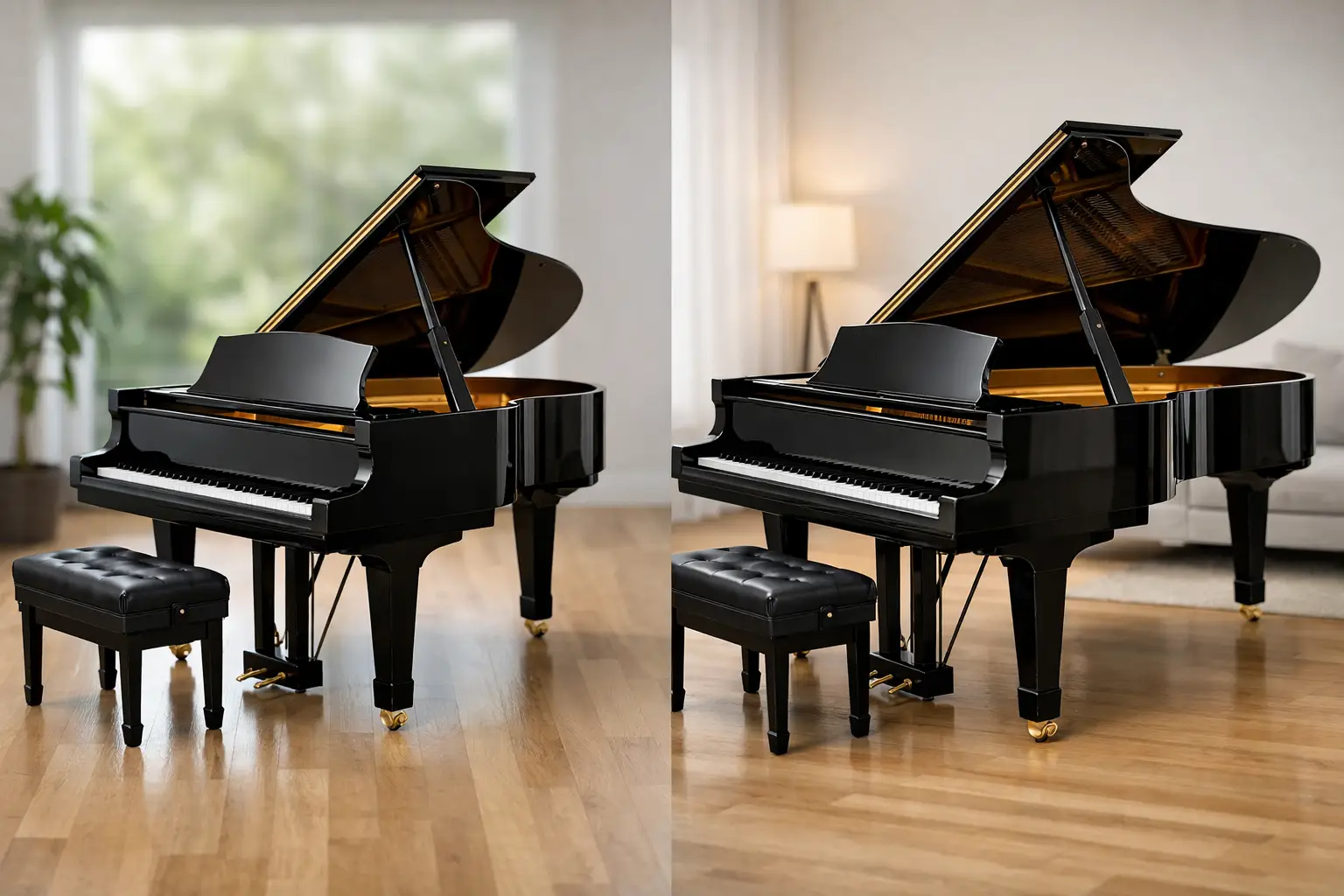
A few inches of piano length can change far more than the way an instrument looks in a living room. In the baby grand versus parlor grand decision, buyers are usually weighing room constraints against tonal depth, musical ambition, and long-term value. Both can be beautiful home instruments. The better choice is the one that gives the player enough musical range without overwhelming the space, budget, or household.
The first point worth knowing is that these labels are not perfectly standardized. One manufacturer’s baby grand may overlap in length with another maker’s small parlor grand. Rather than buying by category name alone, look at the piano’s actual length, condition, scale design, and voice.
Baby Grand Versus Parlor Grand at a Glance
A baby grand is commonly about 4 feet 11 inches to 5 feet 6 inches long. It is the compact grand piano most buyers picture for a home, condominium, teaching studio, or apartment with an appropriate room. It brings the horizontal action, elegant cabinet, and responsive touch people expect from a grand piano in a relatively manageable footprint.
A parlor grand generally begins around 5 feet 7 inches and may extend to roughly 6 feet 2 inches, depending on the brand and period in which it was built. These instruments are sometimes also called small grands or medium grands. That added length may appear modest on a tape measure, but it usually provides a longer bass string scale and a larger soundboard area.
The distinction matters because a grand piano produces sound through a carefully balanced relationship among strings, soundboard, bridges, rim, and action. Length alone does not determine quality, but it gives a skilled piano designer more room to develop tonal color and bass clarity.
What You Hear and Feel
A well-prepared baby grand can be an inspiring instrument. Its action is fast and expressive, and a quality example from Yamaha, Steinway & Sons, Blüthner, or another respected maker can offer years of satisfying playing. For beginners, families, and many intermediate to advanced players, a good baby grand is not a compromise in the usual sense. It is a serious musical instrument with a compact design.
Still, the lowest register is where a parlor grand often begins to pull ahead. Longer strings can produce a bass that is clearer, warmer, and less prone to a short, percussive quality. The middle register may feel more open as well, giving chords greater separation instead of blending into a single wash of sound. Players who spend time in Romantic repertoire, jazz, accompaniment, chamber music, or advanced classical literature often notice this added room in the tone.
A parlor grand may also offer a wider dynamic palette. Soft playing can retain more color, while a strong fortissimo can carry authority without becoming harsh. This is not a guarantee. An exceptional 5-foot-2 piano will often outperform a poorly designed or poorly maintained 5-foot-10 instrument. Brand, model, rebuilding quality, regulation, tuning stability, and voicing remain essential.
The right comparison is always piano against piano, not label against label. Sit at each instrument. Play a slow melody in the middle range, then test bass octaves, repeated notes, quiet chord voicings, and full-scale crescendos. Listen from the bench and ask someone else to play while you listen across the room.
Measure the Room Before Falling in Love
Grand piano dimensions can be deceptive. A baby grand may be only a half-foot shorter than a parlor grand, yet the added length affects walkways, furniture placement, and how naturally the room functions. Most grand pianos are close to 5 feet wide with the keyboard end included. A piano needs open space around it for bench movement, lid clearance, safe delivery access, and comfortable use.
For a baby grand, a room around 12 by 14 feet can sometimes work when the layout is simple and the piano is positioned thoughtfully. A parlor grand often feels more at home in a larger room, especially if the family also wants seating, a dining area, or regular entertaining space. Ceiling height, hard surfaces, large windows, rugs, and upholstered furniture will also shape the result.
A larger piano is not automatically too loud for a home. In fact, a finer parlor grand may produce a more refined tone at low volume than a smaller instrument. But its greater soundboard and projection deserve consideration. Area rugs, curtains, and fabric furnishings can soften reflections, while an overly bare room may make any grand piano feel brighter and louder than expected.
Before purchase, measure the intended location and every turn from the entry point to the room. Professional piano movers assess stairs, tight corners, elevators, door widths, and floor transitions as part of planning a safe delivery. This is especially valuable with vintage and premium instruments, where careful handling protects both the piano and the home.
Budget Beyond the Purchase Price
A baby grand often carries a lower purchase price than a comparable parlor grand from the same maker, simply because it uses less material and occupies a different market position. It can be an excellent way to bring a quality acoustic grand piano into the home while reserving budget for a proper bench, delivery, tuning, and future care.
A parlor grand may justify its additional cost for a committed player, teacher, or collector who values its fuller scale and larger musical presence. It can also be a particularly sensible choice when the room can comfortably accommodate it and the buyer plans to keep the piano for many years.
Condition can matter more than size, particularly in used and vintage pianos. A smaller grand with a sound structural foundation, healthy pinblock, well-maintained action, and thoughtful preparation is a much stronger investment than a larger piano needing extensive work. Older pianos should be assessed for more than their finish and brand name. The soundboard, bridges, strings, hammers, dampers, action parts, and tuning stability all deserve professional attention.
Plan for ongoing ownership as well. Acoustic pianos need regular tuning, usually at least once or twice a year depending on use and environmental stability. Humidity changes are especially hard on wood and can affect tuning and regulation. A complete ownership plan includes professional moving, climate-aware placement, tuning, repair support, and occasional voicing or regulation as the piano settles into use.
Who Should Choose a Baby Grand?
A baby grand makes excellent sense for a first grand piano, a family upgrading from an upright, a pianist with a compact music room, or a buyer who wants the visual presence and action of a grand without committing a large room to it. It is also a strong choice when the goal is primarily recreational playing, lessons, or daily enjoyment rather than performance-level repertoire.
The best baby grands do not sound “small” in a negative way. They tend to offer a direct, lively voice that can be ideal in intimate rooms. A carefully selected and prepared instrument can encourage practice every day because it feels inviting, responsive, and at home in the space.
When a Parlor Grand Is Worth It
Choose a parlor grand when tonal development is a high priority and the room genuinely supports it. The extra length is especially worthwhile for advanced students preparing demanding repertoire, working musicians, teachers who regularly demonstrate at the keyboard, and buyers who want a more substantial long-term instrument.
Parlor grands also suit homes where music is part of the room’s purpose rather than an occasional activity. If the piano will host recitals, lessons, ensemble rehearsals, or frequent playing, the richer bass and broader tonal range can remain rewarding long after the initial purchase.
There is no need to stretch for a larger piano simply because it is larger. A grand that fits the room, sounds balanced at the volume you use, and receives proper care will bring more satisfaction than an oversized instrument that feels crowded or goes underplayed.
At A440 Pianos, the most useful starting point is not a category label but a conversation about the player, the room, and the music ahead. Bring room measurements, photos of access points, and an honest sense of budget. Then spend time at the bench. The right piano should make you want to play one more piece before you leave.

0 Comments