

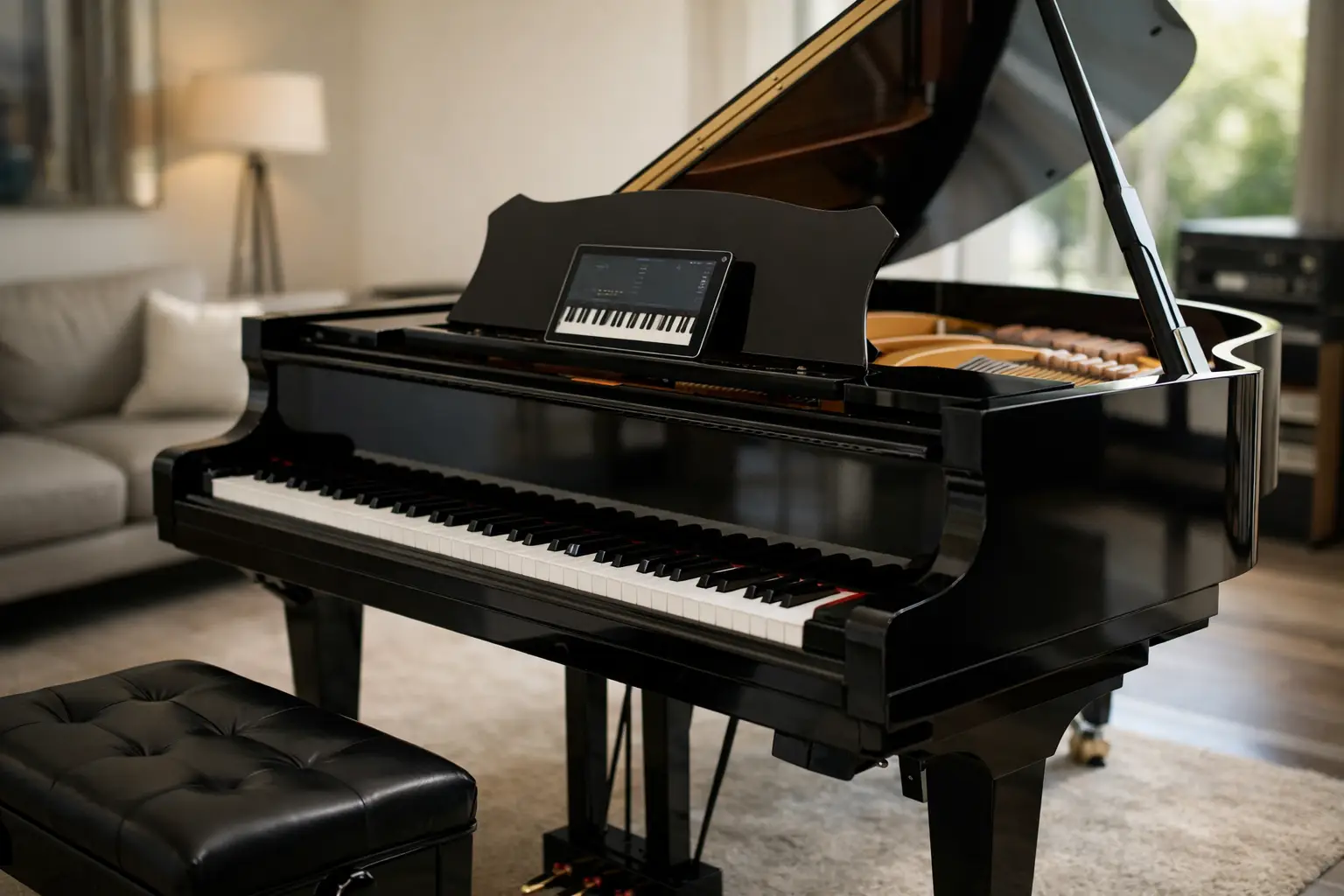
A piano can fill a room when someone is playing it. A Disklavier can do something more unusual: it can fill that same room with the sound and physical motion of a real acoustic piano when no one is seated at the bench. This Disklavier piano review looks beyond the novelty factor to help buyers decide whether Yamaha’s acclaimed self-playing system belongs in their home, teaching studio, venue, or collection.
For the right owner, a Disklavier is not simply a piano with speakers hidden inside. It is an acoustic Yamaha piano with an advanced recording and playback system that moves the keys and pedals, allowing music to be performed on the instrument itself. That distinction matters. The experience has far more presence than listening to a digital playback system, especially on a well-prepared grand piano.
What a Disklavier Actually Does
A Disklavier begins with a traditional acoustic piano action, strings, soundboard, and pedal system. Yamaha adds optical sensors, solenoids, and control technology that can capture a pianist’s performance and reproduce it with remarkable accuracy. During playback, the keys move, hammers strike the strings, and the dampers respond as they would under a musician’s hands.
Current and recent generations, including Disklavier ENSPIRE models, pair this mechanical playback with modern control options. Owners can select performances from built-in music libraries, use an app, stream compatible content, and in many configurations enjoy audio or video accompaniment. The system can also record performances, making it useful for composers, teachers, students, and performers who want to preserve a nuanced interpretation.
The core appeal is simple: the piano remains a piano first. When you sit down to play it manually, you are playing an acoustic instrument. When the system performs, you hear the instrument’s own strings and soundboard responding in the room.
Disklavier Piano Review: The Musical Experience
The strongest reason to buy a Disklavier is the quality of the playback experience. On a grand piano, especially, seeing the keys move while the sound comes directly from the instrument creates an effect that conventional audio systems cannot fully reproduce. The bass has physical weight, the treble projects naturally, and the sound changes with the room just as it does during live playing.
That said, not every Disklavier experience is identical. The underlying piano matters enormously. A Yamaha upright Disklavier can be an excellent choice where space and budget are limited, while a Yamaha grand Disklavier offers a larger soundboard, greater tonal range, and more dramatic visual presence. The condition, regulation, voicing, tuning, and placement of the piano also shape the result.
A buyer should resist the temptation to evaluate the technology separately from the instrument. A self-playing system cannot turn an underwhelming acoustic piano into a concert grand. Conversely, a properly maintained Yamaha grand with Disklavier capability can become both a serious player piano and a beautiful performance instrument for daily use.
There is also a level of expressiveness that separates Disklavier playback from simpler player-piano systems. The system is designed to reproduce subtle information such as touch and pedaling, so performances can retain their musical shape rather than sounding merely mechanical. It is still reproduction, not a living artist responding to the room in real time, but it can be remarkably convincing.
Who Gets the Most Value From a Disklavier?
Disklaviers make particular sense for owners who value both acoustic piano playing and access to music at any hour. Families often enjoy the ability to hear a polished performance in the home while still giving children a real piano to practice. For a beginner, that can make the instrument feel inviting rather than intimidating.
Teachers and studios may find the recording function especially useful. A teacher can demonstrate an assignment, record it, and let a student replay the example. Advanced students can listen back to their own playing with a level of detail that is difficult to absorb while performing. The system does not replace thoughtful instruction, but it can make practice and feedback more tangible.
For entertainers and hospitality settings, a Disklavier can provide an elegant alternative to background playlists. A restaurant, showroom, club, or private event space can enjoy genuine acoustic piano sound without requiring a pianist for every hour of operation. In those settings, the piano’s finish, scale, and room acoustics deserve as much attention as its technology.
Collectors and serious musicians may also appreciate a Disklavier as a second piano or a primary instrument in a home where music is central to daily life. If your goal is only silent practice through headphones, however, a quality silent piano or hybrid digital piano may be a more economical and practical solution.
The Trade-Offs to Consider Before Buying
A Disklavier is a premium purchase, and the price reflects both the acoustic piano and the specialized playback system. A buyer comparing a standard Yamaha grand to its Disklavier equivalent should consider whether playback, recording, and connected features will genuinely be used. If the system will sit idle after the first few weeks, putting the budget toward a larger or higher-tier acoustic piano may make more musical sense.
Technology also adds complexity. The piano still needs regular tuning and normal acoustic maintenance, but the electronic and mechanical components require informed service when an issue arises. Older Disklaviers can be excellent values, particularly when the piano itself has been well cared for, yet buyers should confirm the age of the system, its functional condition, available controls, and compatibility with current content or software.
Internet connectivity and app-based features are convenient, but they should not be the only reason to choose a specific model. Technology changes faster than piano construction. A well-built acoustic Yamaha can serve a family for decades; digital features may evolve along the way. The best purchase is one whose acoustic sound and touch you would still enjoy even if you never opened the app.
Volume deserves consideration, too. Because the strings are being played acoustically, a Disklavier can be as present as any other piano. It is ideal for gatherings and open living spaces, but apartment residents or households with sleeping children should ask about silent-play options and sound control before making a decision.
New Versus Pre-Owned Disklavier Pianos
A new Disklavier offers current technology, warranty coverage, and the assurance that the instrument has not experienced unknown environmental or moving conditions. It is often the best route for buyers who want the latest ENSPIRE features and a choice of size, finish, and configuration.
A pre-owned Disklavier can offer compelling value, particularly for someone who prioritizes the acoustic piano and wants player functionality without purchasing at the top of the range. However, it should be evaluated carefully. The piano’s strings, pinblock, soundboard, hammers, action, and cabinet all need inspection, as do the playback system, pedals, sensors, control unit, and included accessories.
Professional delivery is not optional with an instrument of this caliber. Disklaviers are heavy, finely calibrated pianos with additional electronic components. A careful move, correct placement, acclimation time, and post-delivery tuning help protect both the instrument and the investment.
What to Listen and Look for in Person
When possible, play the piano manually before you listen to a playback performance. Notice whether the key weight feels comfortable, whether the tone suits your ear, and whether the size fits the room. A beautiful feature list cannot compensate for an instrument you do not enjoy playing.
Then listen to the Disklavier in playback mode at more than one volume. Pay attention to tonal balance from bass to treble, pedal response, and whether the piano projects comfortably in the space. Ask to hear different musical styles. A delicate solo piece, jazz performance, and rhythmically energetic arrangement can reveal different aspects of the system.
For pre-owned models, ask for a clear demonstration of every feature that matters to you. Confirm what is included, whether the unit records properly, how it connects, and whether there are any service records. An experienced piano specialist can explain the practical differences between generations and help match the right model to your goals, space, and budget.
A440 Pianos works with buyers who want that broader perspective: not just choosing a self-playing piano, but planning for inspection, delivery, tuning, service, and long-term enjoyment.
A Disklavier is worth considering when you want an acoustic piano that can be both personally played and professionally performed in your home. Choose the piano with your ears and hands first, then choose the technology that will continue to bring music into your life long after the first impressive demonstration.

0 Comments