

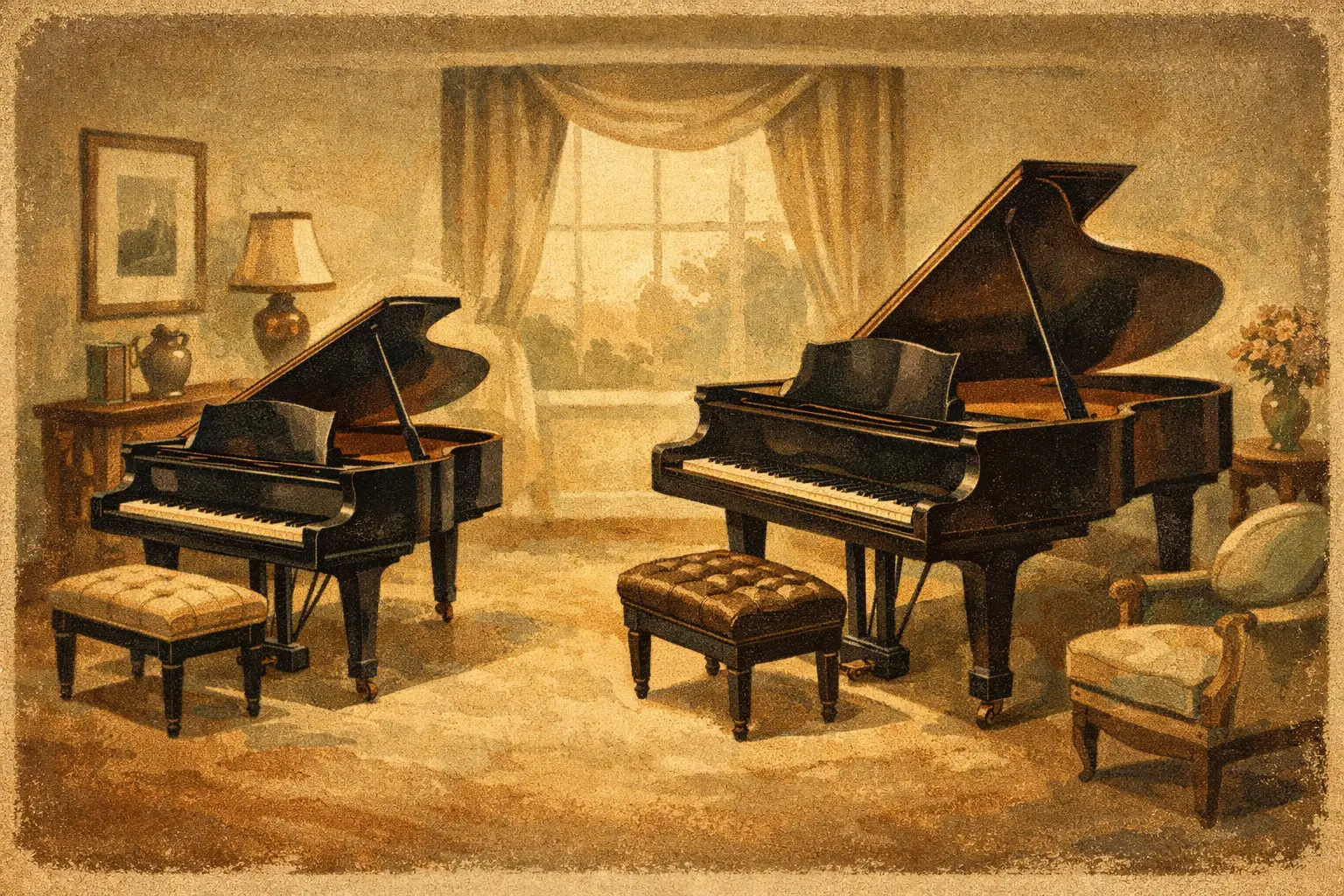
A grand piano can transform a room before anyone plays a note. Yet the decision between a baby grand vs parlor grand should go far beyond appearance. A few additional inches of piano can affect bass depth, projection, touch response, placement options, and the long-term satisfaction of everyone who plays it.
For a home, studio, church, or teaching space, both sizes can be exceptional. The right choice depends on the instrument itself, the room that will receive it, and the musical standard you expect from it over time.
Baby Grand vs Parlor Grand at a Glance
Piano size terminology is not completely standardized across every manufacturer. Generally, a baby grand measures about 4 feet 11 inches to 5 feet 6 inches long. A parlor grand, sometimes called a medium grand, often falls roughly between 5 feet 7 inches and 6 feet 1 inch.
That difference may sound modest. In a grand piano, however, length is not simply about cabinet size. More length usually allows for longer strings and a larger soundboard, particularly in the bass section. Those design changes can create a fuller, more sustained tone and greater dynamic range.
A baby grand is often the ideal luxury home piano: elegant, compact enough for many living rooms, and capable of serious musical performance when well built and properly maintained. A parlor grand begins to offer more of the scale, tonal color, and authority players associate with larger performance instruments, while still remaining practical for many residences and private venues.
What You Hear: Tone, Bass, and Projection
The central musical advantage of a parlor grand is usually its added scale. Longer bass strings can produce a clearer fundamental pitch with less of the short-string character sometimes heard in smaller grands. The result is often a bass register that feels more rounded and substantial rather than merely louder.
A larger soundboard also has more potential to move air. In an open-plan home, recital room, sanctuary, or teaching studio, a quality parlor grand may fill the space with greater ease. It can give advanced players more room to shape a phrase from a near-whisper to a commanding fortissimo without the sound becoming hard or compressed.
That does not make every parlor grand automatically superior to every baby grand. A premium 5-foot-2-inch Steinway, Yamaha, Kawai, Blüthner, or Baldwin with an excellent scale design, healthy soundboard, regulated action, and professional voicing can be a more rewarding piano than a poorly maintained 6-foot instrument. Brand, model, condition, restoration quality, and technician preparation matter as much as the measurement on the spec sheet.
Baby grands also have strengths that deserve respect. Their sound can be direct, warm, and intimate, which is especially appealing in a family room or a more acoustically live space. A smaller grand may provide all the power a room can comfortably support. In the wrong room, a bigger piano is not necessarily a better piano.
Room Size Is About More Than Square Footage
A piano needs physical clearance, but it also needs acoustic breathing room. Before choosing a baby grand or parlor grand, measure the piano’s length and width with the lid closed, then allow space for the bench, the player, traffic paths, and safe access around the instrument. A grand’s width is commonly close to 5 feet, while its length extends outward from the keyboard.
For many homes, a baby grand can work beautifully in a room around 12 by 14 feet or larger, assuming furniture and pathways are thoughtfully arranged. A parlor grand is often more comfortable in a room around 14 by 16 feet or larger. These are useful starting points, not rigid rules. Ceiling height, flooring, windows, rugs, upholstered furniture, and adjoining open spaces all influence how a piano sounds.
Placement matters as well. Avoid exterior walls when possible, direct sunlight, HVAC vents, fireplaces, and locations with frequent temperature swings. Keep the piano away from excessive dryness or humidity, and leave enough clearance so a technician can service it properly. A stable environment protects tuning, action regulation, finish, and the structural condition of a fine instrument.
Touch and Musical Control
The action mechanism in a grand piano differs from an upright and offers faster repetition when it is correctly regulated. Both baby grands and parlor grands can deliver the responsive touch serious students and accomplished players expect. Still, a parlor grand may feel more expansive under the hands because its tonal palette can reward a wider range of touch.
For an advancing student working on classical repertoire, a parlor grand can be a compelling long-term investment. It may better support the contrasts required in Romantic literature, the layered voicing of Debussy or Ravel, and the rhythmic power of jazz or contemporary styles. For a beginner, however, the quality and preparation of the action are far more valuable than buying extra length for its own sake.
An excellent piano encourages practice. Keys should feel even, repetition should be dependable, pedals should respond cleanly, and the tone should remain musical across the full keyboard. Those details shape daily playing more than a category label ever will.
Cost, Condition, and Long-Term Value
Within the same brand, age, and condition, a parlor grand generally costs more than a baby grand. It may also bring higher moving costs, require more careful placement planning, and need a larger climate-controlled space. The price difference is not only about size. Larger grands use more material and often occupy a more desirable position in a manufacturer’s product line.
For buyers considering vintage or pre-owned instruments, condition should lead the conversation. A piano’s age alone does not establish its value. Ask about the pinblock, strings, hammers, soundboard, bridges, action components, finish, previous restoration work, and recent service history. A properly restored vintage grand can offer extraordinary character and craftsmanship, but the restoration must be evaluated on its quality rather than its description.
Resale value also depends on brand recognition, musical condition, finish, size, and market demand. Well-regarded models from Steinway, Yamaha, Kawai, Baldwin, and other established makers tend to hold buyer interest when they have been responsibly maintained. A parlor grand may appeal to a broader group of advanced players, but a desirable baby grand in excellent condition can remain highly marketable because it fits more homes.
Who Should Choose a Baby Grand?
A baby grand is an excellent fit for buyers who want a genuine grand piano experience without allowing the instrument to dominate the room. It suits families investing in a first serious piano, homeowners furnishing a formal living area, and musicians who value refined tone at a manageable footprint.
It can also be the smarter choice when the room has hard surfaces and little sound absorption. In a bright, compact space, a carefully voiced baby grand may sound more balanced than a larger piano. If your priorities are elegant design, reliable performance, and a piano that works gracefully with everyday living, a premium baby grand deserves serious consideration.
When a Parlor Grand Is Worth the Extra Space
Choose a parlor grand when musical depth is a primary priority and the room can support it. Its additional length can be meaningful for an experienced pianist, a serious student approaching advanced repertoire, a teacher who wants to demonstrate with authority, or a church and studio that need more projection.
A parlor grand also makes a strong statement in a dedicated music room, executive residence, private performance setting, or collector’s space. The cabinet has more visual presence, but the real value is the potential for a broader tonal spectrum: a more resonant bass, richer middle register, and greater control at both soft and powerful dynamics.
If you are comparing two instruments in person, do not judge them only from the pianist’s bench. Have someone else play while you listen from different parts of the room. Play softly as well as loudly. Test repeated notes, pedal transitions, bass clarity, and the consistency of tone from one register to the next. The piano that sounds impressive for thirty seconds is not always the one that will remain inspiring after ten years of ownership.
Make the Decision With the Actual Piano in Mind
The best baby grand vs parlor grand decision is made by comparing specific instruments, not generic dimensions. A carefully selected and professionally prepared piano will deliver more value than a larger instrument chosen solely for its label. At A440 Pianos, that means looking closely at musical condition, design, finish, service needs, and the practical details of delivery and placement before the piano enters your home.
Choose the piano that invites you to sit down tomorrow morning, open the lid, and play longer than you planned.

0 Comments