


A piano can look exceptional in the showroom and still hide expensive mechanical problems under the fallboard. If you are shopping for a premium used upright or grand, learning how to inspect piano action is one of the smartest ways to separate a promising instrument from one that will need immediate service.
The action is the working mechanism between your fingers and the sound. Every touch, repetition, dynamic change, and tonal response depends on how well that system performs. Cabinet condition and brand name matter, but action condition tells you far more about how the piano will play in daily use.
What the piano action actually includes
Piano action refers to the assembly of moving parts that transfer motion from the key to the hammer. On an upright, that includes the keys, capstans, wippens, jacks, hammers, dampers, and springs arranged in a vertical design. On a grand, the same basic job is handled with a more complex horizontal action that allows faster repetition and finer control.
When buyers hear that a piano has been tuned, they sometimes assume the instrument is mechanically healthy. That is not the case. Tuning adjusts pitch. Action inspection looks at wear, alignment, friction, regulation, and how consistently the piano responds from note to note.
How to inspect piano action before you buy
Start with a simple idea: consistency matters more than one impressive note. A fine piano action should feel even, quiet, controlled, and predictable across the keyboard. If several keys behave differently, that usually points to deferred maintenance, wear, humidity issues, or incomplete repair work.
Begin with the keys
Play every key slowly, then more firmly. You are listening and feeling at the same time. Each key should travel smoothly, return promptly, and sit at a consistent height relative to its neighbors. If one key is lower, slower, looser, or noisier, the problem may be minor, but a pattern across sections of the keyboard often suggests broader regulation needs.
Pay attention to side-to-side wobble. A little movement is common in older pianos, but excessive looseness can indicate worn key bushings. Keys that stick, hesitate, or return sluggishly may reflect friction problems, swelling from humidity, or worn centers deeper in the action.
A buyer should also test key dip, which is simply how far the key travels when depressed. If key dip varies noticeably from note to note, the touch will feel uneven and control at soft dynamics will suffer.
Check hammer condition and alignment
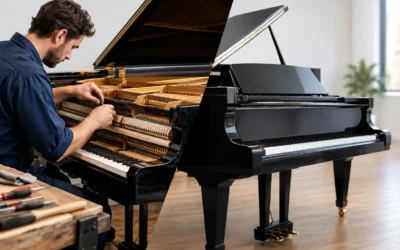
Open the piano enough to see the hammers clearly. On most uprights, the upper front panel can be removed. On a grand, the lid and fallboard area provide easier visual access. You are looking for wear, not just age.
Hammer felt should show use in a clean, even way. Deep grooves where the strings have cut into the felt usually mean significant wear. That does not always make the piano a poor purchase, especially on a quality instrument, but it does affect tone and often points toward future reshaping or replacement.
Look at alignment as well. Hammers should strike the strings squarely. If they appear twisted, shifted, or unevenly spaced, the piano may have regulation issues or evidence of prior repair that was not finished to a high standard.
Listen for action noise
A refined piano action is not completely silent, but it should be mechanically discreet. Clicks, knocks, rubbing sounds, or spring noise deserve attention. Some sounds come from a single loose flange screw or worn felt. Others suggest broader wear inside the action stack.
Play repeated notes in the middle register and in the bass. Then play very softly. Mechanical noise is often easier to hear at low volume. If the action is noticeably louder than the musical tone during soft playing, service is likely overdue.
Regulation tells you how professionally the piano has been maintained
Regulation is the precise adjustment of the action so each part moves at the correct time and distance. This is where many used pianos reveal the difference between casual upkeep and true technical care.
Look for even touch and let-off
In a grand piano, let-off is the point where the hammer escapes from the jack just before striking the string. If let-off is poorly regulated, the piano may feel weak, uneven, or hard to control in quiet playing. On an upright, the geometry differs, but the principle is the same: the action should release and reset properly without hesitation.
Play scales and repeated notes at different volumes. Some notes should not suddenly feel heavier, lighter, shallower, or harder to repeat than the surrounding ones. If they do, regulation is uneven.
Test repetition and return
A good action resets quickly. On a grand, play the same note repeatedly without letting the key come fully back up each time. A healthy action should repeat reliably. On an upright, repetition will naturally feel different, but keys should still return quickly and consistently.
Slow key return, double striking, blocking, or notes that fail under faster passages all suggest action work is needed. For a serious student, performer, or teaching studio, these are not small details. They directly affect technique and confidence.
Wear patterns that can become expensive
Used pianos often need some adjustment. That is normal. The goal is to distinguish normal service needs from signs of substantial rebuilding.
Worn hammer felt, tired key bushings, weak springs, deteriorated bridle straps on uprights, loose centers, and hardened felts all add up. None of these automatically disqualify a piano, especially if the instrument is a premium brand with strong structural value. But they should affect price, restoration planning, and your expectations for immediate performance.
If the action parts show patchwork repairs, mismatched components, or evidence of long-term neglect, proceed carefully. A beautiful cabinet and prestigious nameplate do not reduce the cost of detailed action work.
Upright and grand inspections are not identical
If you are learning how to inspect piano action, it helps to understand that upright and grand actions reveal problems differently.
On uprights
Upright actions are more compact and can be harder for a buyer to see without removing panels. They are also more affected by certain issues such as sluggish repetition or worn bridle tapes. When testing an upright, focus on consistency, return speed, pedal function, and action noise. A quality upright can deliver excellent value, but only if the mechanism has been maintained with care.
On grands
Grand actions are easier to evaluate visually and more revealing in repetition tests. Because buyers often choose grands for performance reasons, regulation standards should be higher. A grand with uneven let-off, poor repetition, or misaligned hammers may still have excellent potential, but it should be priced and serviced accordingly.
When a visual check is not enough
There is a limit to what any buyer can confirm in a brief appointment. A piano may pass a casual playing test and still need significant action regulation. That is why higher-value instruments deserve a professional evaluation, especially if you are buying vintage, shopping at a distance, or comparing multiple premium brands.
A reputable piano specialist can measure key dip, hammer blow distance, let-off, drop, aftertouch, friction, and wear at a level a general seller cannot. That kind of inspection matters even more when the instrument is being positioned as restored, rebuilt, or performance-ready.
For buyers who want confidence rather than guesswork, working with a service-centered piano company such as A440 Pianos can make the process far more efficient. The right partner will not just show you the finish and the logo. They will help you understand how the instrument actually performs where it counts.
What matters most in a buying decision
An imperfect action is not always a deal breaker. On a respected piano with excellent tone and structure, needed regulation may be a reasonable next step. On a lower-tier instrument, the same repair bill can quickly outweigh the piano’s value.
That is the trade-off. Brand, age, and appearance are only part of the equation. The real question is whether the action supports the level of control, reliability, and musical expression you expect from the instrument.
A fine piano should respond with confidence under the hands. If the action feels uneven, noisy, or uncertain, trust that impression. The best purchases are not just attractive on the floor. They are mechanically prepared to deliver years of dependable performance.
0 Comments