


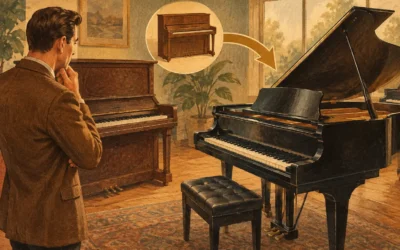
A piano can look perfect in photos and still feel completely wrong once it is in the room. That is why the grand piano versus upright question is not really about which one is better in the abstract. It is about which instrument matches your space, your playing level, your sound expectations, and the way you plan to live with it for years.
For some buyers, the answer is obvious the moment they sit down and play. For others, the decision takes more thought because both options offer real advantages. A well-chosen upright can outperform a mediocre grand, and a quality grand can transform the playing experience in a way an upright simply cannot. The smart choice comes from understanding the trade-offs clearly.
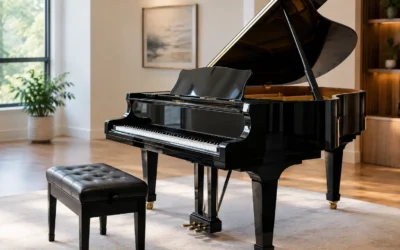
Grand piano versus upright: the real difference
The most visible difference is shape, but the more meaningful difference is how the piano works. In a grand piano, the strings lie horizontally and the action uses gravity to return the hammers to rest. In an upright, the strings stand vertically and the action relies on springs and a more compact mechanism.
That design changes the playing experience. Grand pianos typically offer faster repetition, more control at softer dynamics, and a broader tonal palette. Uprights are built to make serious music in a smaller footprint, and the best ones can be remarkably responsive, but they usually do not match a grand in action refinement and sound projection.
This is where many buyers get stuck. They assume grand means professional and upright means entry-level. That is too simplistic. There are high-performance uprights from respected makers that serve advanced students, teaching studios, churches, and discerning homeowners extremely well. There are also older or poorly maintained grands that deliver less musical value than a premium upright.
Tone and projection
If tone is your top priority, a grand usually has the advantage. The longer strings, larger soundboard, and open lid design create more depth, sustain, and color. Notes tend to bloom more naturally, and the instrument can fill a room with less effort. That matters in performance spaces, larger homes, and for players who care about tonal shading.
A grand also disperses sound differently. Instead of sending tone directly from the front panel area, it projects across the body of the instrument and into the room. The result often feels richer and more dimensional.
An upright can still sound excellent, especially a tall professional model. Height matters because taller uprights generally have longer strings and larger soundboards than compact consoles or spinets. A full-size upright can produce a strong, satisfying tone with impressive musical character. In a home setting, that may be more than enough.
The key is not to compare all grands against all uprights. Compare quality against quality, condition against condition, and intended use against intended use.
Touch and playing control
For serious pianists, this is often the deciding factor. Grand actions are prized because they allow better repetition and finer control. If you play advanced classical literature, work on nuanced phrasing, or need an instrument that responds consistently under demanding technique, a grand tends to feel more capable.
That does not mean every player needs one. Many families, teachers, and adult hobbyists are happiest with an upright that has a well-regulated action and a satisfying touch. For beginners, consistency and condition are often more important than the instrument category. A dependable upright with proper service support is a far better choice than a grand that needs extensive work.
Players moving into intermediate and advanced repertoire may start to notice the limitations of smaller uprights, particularly in repetition speed and tonal control. That is usually the point when the conversation shifts from owning a piano to owning the right piano.
Space, design, and daily living
This is where the upright wins many practical decisions. Uprights take up less floor space, fit more naturally into family rooms and studios, and are often easier to place without dominating the room. If you want acoustic performance but do not want your piano to become the entire floor plan, an upright is often the cleaner solution.
A grand needs more than square footage. It needs the right layout. You need clearance for the bench, room around the curve and tail, and a space where the instrument can breathe acoustically. In the right room, a grand becomes a centerpiece. In the wrong room, it can feel oversized and underused.
There is also a visual decision. A grand communicates presence, prestige, and performance. For some buyers, that matters because the piano is part musical instrument and part heirloom furniture. An upright can be elegant and refined, especially in premium cabinetry, but it makes a quieter visual statement.
Cost beyond the purchase price
When buyers compare a grand piano versus upright, price often enters the conversation early, and for good reason. In general, grands cost more to buy, more to move, and often more to restore or rebuild. Premium brands, vintage pedigree, cabinet style, and condition can shift that dramatically, but the broad pattern holds.
Uprights usually provide a lower entry point into acoustic piano ownership. That makes them attractive for first-time buyers, growing families, schools, and churches managing budget carefully without wanting to compromise on quality.
Still, price should be measured against long-term satisfaction. Buying an upright because it is cheaper can be shortsighted if the player is already pushing past what that instrument can offer. On the other hand, buying a grand only for appearance can be equally unwise if the room, budget, and playing needs do not support it.
A premium used piano often changes this equation in a favorable way. Buyers can step into a better brand, better build quality, and stronger musical performance than they might expect from new entry-level instruments at a similar price point.
Maintenance, moving, and ownership experience
Both types of acoustic pianos need tuning, climate awareness, and professional service over time. Neither is maintenance-free. The real difference is usually logistics.
Grand pianos are more complex to move and require more planning. They also demand greater care in placement because room conditions affect tuning stability and overall performance. Uprights are simpler to position and often easier to integrate into everyday household life.
That said, buyers should not let logistics alone decide the purchase. Proper delivery, setup, and ongoing service can remove most of the friction from ownership. Working with a specialist matters here. A company that understands moving, tuning, repair, and restoration does more than sell a piano. It protects the investment after the sale.
Which piano is right for your setting?
For a beginner or casual home player, a quality upright is often the most practical and rewarding choice. It offers authentic acoustic sound, saves space, and can serve a student well for many years if selected carefully.
For serious students preparing advanced repertoire, teachers who need better action response, and players who value tonal nuance, a grand often makes more sense if the room and budget allow it. The difference is not just status. It is function.
For churches, studios, and schools, the right answer depends on how the piano will be used. A sanctuary or recital setting may justify a grand for projection and presence. A rehearsal room, classroom, or teaching space may be better served by a high-performance upright that offers reliability and strong musical return on the footprint.
For collectors and luxury buyers, the decision may include cabinet style, maker history, investment value, and statement appeal as much as pure utility. In that world, the piano is both instrument and centerpiece.
How to make the final call
Play both if possible. Not just one of each category, but several examples across brands and sizes. Listen for clarity in the bass, warmth in the midrange, and how easily you can shape soft passages. Pay attention to whether the action feels cooperative or resistant. If the instrument makes you want to stay at the keyboard, that matters.
Ask practical questions too. How large is the room? Who will be playing most often? Is this a stepping-stone piano or a long-term purchase? Do you care more about compact function, or do you want the experience and visual presence of a grand?
A440 Pianos works with buyers facing exactly these decisions, and the right outcome is rarely one-size-fits-all. The best piano is the one that fits your musical goals with confidence, not the one that simply sounds more impressive on paper.
If you are choosing between a grand and an upright, trust your ears, your hands, and the reality of your space. The right piano should elevate the room, support the player, and still feel like the correct decision long after delivery day.

0 Comments