

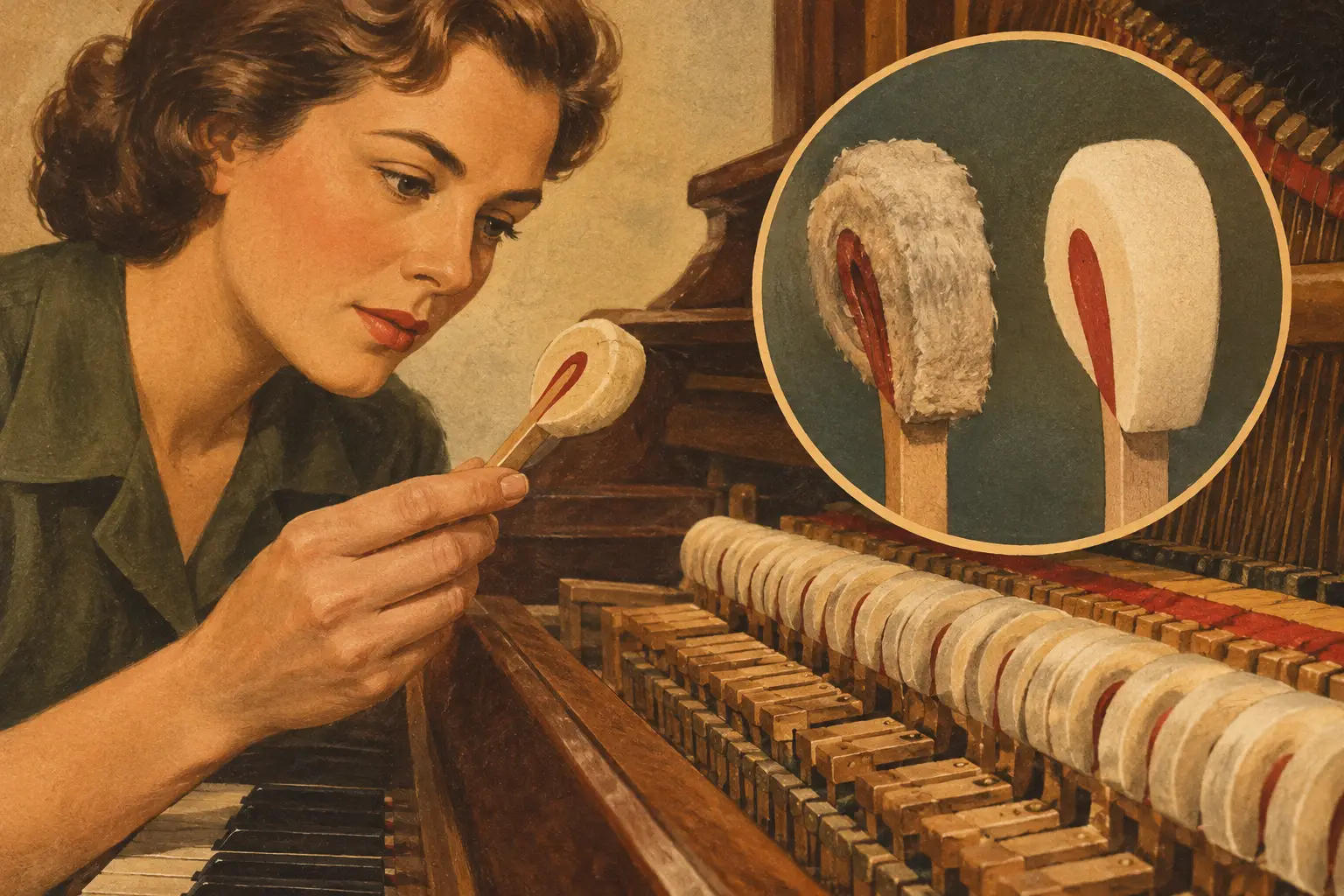
A piano can be tuned precisely and still sound disappointing. When to replace worn piano hammers is often the question behind a tone that has become brittle, overly bright, uneven, or strangely lifeless – especially on an instrument that has seen years of regular playing. The answer is not based on age alone. It depends on the condition of the hammer felt, prior repairs, the quality of the piano, and whether careful voicing and reshaping can still bring the instrument back.
For a premium piano, hammers deserve a measured evaluation rather than a quick replacement decision. A skilled technician can often preserve original parts when that protects the piano’s character and value. In other cases, a new, properly fitted hammer set is the difference between an instrument that merely functions and one that truly performs.
What Piano Hammers Do to Your Sound
Each time a key is played, its hammer strikes the strings and immediately rebounds. The hammer’s compressed wool felt determines much of the piano’s attack, color, projection, and dynamic range. Softer, correctly voiced felt can produce a warm singing tone. Hard, compacted, or deeply worn felt can make the same piano sound sharp, thin, or percussive.
Hammers do not wear evenly. Notes played most often – commonly the middle register, octave passages, and popular chord positions – develop grooves faster than surrounding notes. This can leave a piano with noticeable tonal changes from one section of the keyboard to another.
A hammer also has to meet its strings correctly. On a grand piano, each hammer may strike two or three strings at once. If the striking surface is distorted, or if the action is out of regulation, the hammer may not contact those strings evenly. The result can be a weak note, an unpleasant edge, or a sound that seems to split apart rather than bloom.
Signs It May Be Time to Replace Worn Piano Hammers
Deep string grooves are the most visible clue. Moderate grooves are normal and can frequently be removed through careful filing. But once the hammer has been filed repeatedly, there may not be enough felt left to retain the proper shape and resilience. A hammer that has become narrow, misshapen, or severely flattened has less material available for future service.
Tone is the second major indicator. A bright piano is not automatically a worn piano. Many Yamaha, Steinway, Baldwin, and other performance instruments are designed to offer clarity and projection. The concern is a tone that stays harsh even after expert voicing, or one that turns brittle when played with moderate force. If needling and shaping no longer produce a musical, controllable sound, replacement becomes more reasonable.
Unevenness across the keyboard is equally telling. Perhaps the center section is piercing while the bass is muted, or certain notes bark out regardless of touch. Some unevenness can be corrected through regulation, mating, and voicing. Persistent inconsistency may point to hammers with different degrees of wear, prior poor-quality filing, or felt that has hardened beyond useful recovery.
Look for physical warning signs as well. Loose hammer coverings, moth damage, excessive thinning, cracks in wooden hammer moldings, poorly glued replacements, and hammers that sit at visibly inconsistent angles all warrant professional inspection. These are not cosmetic details. They affect reliability, touch, and tonal control.
When Reshaping and Voicing Are the Better Choice
Replacement is not the automatic premium option. On a valuable vintage piano, original hammers can sometimes be retained with thoughtful restoration. If there is sufficient felt remaining, a technician may reshape the striking surface, remove shallow grooves, align each hammer to the strings, and voice the felt for a more refined tonal palette.
This route is often appropriate when the piano has a fundamentally good sound but has become uneven or overly bright through years of use. It is also less invasive and generally less costly than installing a new set. The trade-off is that reshaping has limits. Every filing removes material, and a hammer that has already been filed several times cannot be restored indefinitely.
Voicing alone can be highly effective when the hammers are structurally sound but compacted. Through selective needling and treatment, an experienced technician can reduce excessive brilliance and improve the transition from soft playing to full volume. It is delicate work. Over-needling can make a piano dull or unstable, while aggressive chemical treatment may create short-lived results or compromise the felt.
The right question is not simply, “Can these hammers be improved?” It is, “Will this repair deliver a lasting musical result that suits this piano and the way it is played?”
When Hammer Replacement Is Worth the Investment
New hammers are often the right choice when the existing set is too thin to shape properly, badly hardened, uneven from past work, damaged by insects or moisture, or incapable of holding a consistent voice. Replacement can also make sense during a larger restoration, particularly when a piano is receiving new strings, action rebuilding, or extensive regulation.
A new set gives the technician a stable foundation for tone and touch. However, the result depends on the quality of the hammers selected and the precision of installation. Hammers are not interchangeable accessories. Their weight, density, bore angle, tail length, and felt character must suit the specific action and scale design of the piano.
This is especially relevant for distinguished instruments. Installing a generic hammer set on a fine grand without proper fitting may change the action’s geometry, increase touch weight, or produce a tone that does not reflect the piano’s intended voice. A well-executed replacement includes boring, hanging, spacing, mating to the strings, shaping, regulation, and multiple stages of voicing. It is skilled restoration work, not a simple parts swap.
For a frequently used school, church, studio, or family piano, replacement may offer better long-term value than repeated temporary corrections. For a lightly used home piano, careful reshaping and voicing may be all that is needed. Usage matters as much as appearance.
The Relationship Between Hammers, Regulation, and Strings
A hammer diagnosis should never happen in isolation. The action must be regulated so each hammer travels correctly, escapes at the proper point, checks reliably, and returns quickly. A piano with worn key bushings, loose center pins, tired dampers, or inconsistent action parts can feel and sound poor even if the hammers are in decent condition.
The strings matter, too. Old strings can lose elasticity and develop a false or uneven tone. Replacing hammers on severely corroded or fatigued strings may not produce the transformation an owner expects. Conversely, installing new strings without addressing deeply worn hammers can leave the instrument sounding unnecessarily aggressive.
This is why a complete assessment is valuable before approving major work. The technician should evaluate hammer wear, string condition, pinblock stability, action regulation, soundboard condition, and the owner’s musical goals. A concert-level tonal restoration calls for a different plan than preparing a dependable upright for a beginning student.
Choosing the Right Time for Service
Do not wait until the piano becomes unpleasant to play. If you notice growing brightness, uneven notes, visible grooves, or a loss of control at soft dynamics, schedule an evaluation during routine tuning service. Early attention may allow for reshaping rather than replacement, preserving both the original parts and the restoration budget.
If you are considering a premium used or vintage piano, inspect the hammers before purchase. A piano can have an attractive cabinet, a respected name, and a recent tuning while still needing substantial action work. Clear information about hammer condition helps buyers compare instruments honestly and plan for ownership costs with confidence.
At A440 Pianos, a proper evaluation considers the whole instrument, from tonal potential to restoration needs and long-term service. That level of care matters because a piano should not only look exceptional in a home, studio, church, or performance space. It should reward the player every time the keys are touched.
The best time to act is when your piano is still telling you what it needs: a tone that has changed, a touch that no longer feels predictable, or hammers that have reached the end of useful service. Addressed with expert judgment, those signs can become the beginning of a more expressive instrument.


0 Comments