


A piano can look exceptional on the showroom floor, carry a respected name, and still not be the instrument you want to play every day. Learning how to compare piano tone gives you a more meaningful way to choose. It moves the decision beyond finish, size, and price toward the sound that will fill your home, studio, church, or performance space for years.
Tone is personal, but it is not mysterious. With a consistent listening process, you can hear whether one piano offers the warmth, clarity, depth, power, or refinement you value most. The goal is not to find the single “best” tone. It is to find an instrument whose voice suits your musical goals and your room.
What Piano Tone Really Means
Piano tone is the character of the sound produced when a hammer strikes a string. Two pianos can play the same note at the same volume, yet sound distinctly different. One may be warm and rounded, another bright and immediate. One may have a rich, singing treble, while another offers a darker bass with tremendous weight.
This character comes from many details working together: scale design, soundboard condition, hammer density, stringing, cabinet construction, regulation, voicing, and the piano’s overall maintenance history. On a quality used or vintage piano, age alone does not determine tone. A well-restored instrument can have remarkable depth and maturity, while an improperly maintained piano may sound thin, harsh, or uneven regardless of its brand.
When comparing pianos, listen for five core qualities: warmth, clarity, sustain, balance, and dynamic range. These categories give you useful language for a response that otherwise can feel purely emotional.
How to Compare Piano Tone in a Showroom
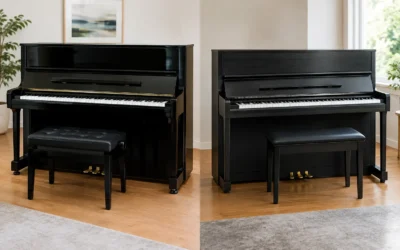
The most reliable comparison is a direct one. Play two or three pianos in the same room, ideally within a short period, and repeat the same musical material on each. This limits the effect of memory, which can be surprisingly unreliable after you have heard several instruments.
Start with a few single notes in the low, middle, and high registers. Let each note ring until it fades. Then play slow chords, scales at several dynamics, and a short piece you know well. A familiar passage reveals more than a technically difficult piece you have to think through.
Use the same bench position and similar touch on every piano. If you play only softly on one piano and forcefully on another, you are comparing your approach rather than the instruments. Ask a knowledgeable piano specialist to play while you stand several feet away as well. The player hears the piano from the bench; your audience hears it from the room.
Listen for warmth and brightness
Warmth is usually heard as a rounded, full sound with less metallic edge. It can be especially appealing in a living room, teaching studio, or smaller space where a bright piano might feel overly assertive. Many players enjoy warmth for lyrical repertoire, accompaniment, and long practice sessions.
Brightness brings definition and projection. A brighter piano can make fast passagework articulate and help the melody rise above accompaniment. It may suit contemporary music, ensemble work, or a larger room. The trade-off is that excessive brightness can become tiring, particularly at louder dynamics or in rooms with hard floors and expansive glass.
Neither quality is automatically superior. A Steinway, Yamaha, Kawai, Baldwin, or Blüthner can vary significantly from one individual piano to the next. The model, condition, preparation, and voicing matter as much as the name on the fallboard.
Check whether the tone is even
A premium piano should feel like one complete instrument from bass to treble. Play chromatic scales slowly from the lowest keys to the highest and listen for abrupt changes in color or volume. Some natural variation is part of a piano’s personality. The bass should not sound disconnected from the middle register, and the treble should not suddenly turn brittle, weak, or glassy.
Then play chords that span wide intervals. Listen to whether the voices blend. On a balanced piano, the bass provides foundation without covering the middle range, and the treble adds color without sounding detached. This is particularly important for advanced students, recording work, and players who perform repertoire with dense textures.
Test sustain, not just the first attack
Many shoppers focus on the opening sound of a note. The attack matters, but sustain often tells you more about the piano’s musical potential. Play a middle-register note at medium volume, release the key, and listen as the sound decays. Repeat with bass notes and high treble notes.
A strong sustain allows melodic lines to sing and gives chords a more spacious, resonant quality. On grand pianos, the longer strings and larger soundboard often create greater sustain and tonal complexity. That does not mean an upright cannot be satisfying. A high-quality upright can offer remarkable clarity, color, and control when space or budget makes a grand impractical.
Use the sustain pedal while playing slow harmonies. You want resonance, not blur. If every harmony becomes muddy, the piano may be too dark for your taste, the room may be overly reflective, or the instrument may need technical attention. A specialist can help separate room acoustics from the piano’s true character.
Explore the full dynamic range
A piano should respond beautifully when you whisper and when you ask it to speak with authority. Play the same phrase very softly, at a moderate level, and then with a full sound. Notice whether the tone stays attractive as volume increases.
Some pianos sound lovely at mezzo piano but become sharp when played loudly. Others have impressive power but feel unresponsive at softer dynamics. A refined instrument offers control across the range. You should be able to shape a phrase rather than feel limited to one volume or color.
For serious students and experienced pianists, this response is often more important than a first impression of power. For a church, school, or performance setting, projection may carry more weight. Context should guide your decision.
Consider the Room Where the Piano Will Live
The same piano can sound dramatically different after delivery. A showroom may have carpet, high ceilings, other instruments, and acoustic treatment that changes what you hear. At home, hardwood floors, windows, rugs, bookshelves, and ceiling height all influence brightness and resonance.
A lively room usually makes a piano sound brighter and more powerful. A heavily furnished room absorbs sound and can make the same instrument seem warmer or quieter. If your room is small and reflective, a naturally bright piano may need thoughtful voicing or additional soft surfaces. If your space is large and open, a piano with more projection and sustain may be the better match.
Share room dimensions, flooring, and intended placement with your piano professional before purchasing. This is not a minor delivery detail. It is part of selecting the right instrument.
Separate Tone Preferences From Mechanical Condition
A piano that sounds too bright, too mellow, or slightly uneven may not be a poor piano. Voicing can often refine tonal character by adjusting the hammers. Regulation can improve control and consistency. Tuning corrects pitch, but it does not by itself transform the piano’s tonal voice.
Ask which concerns are normal characteristics, which can be improved through service, and which may indicate deeper issues with the soundboard, bridges, strings, hammers, or action. This distinction is essential when considering vintage and pre-owned instruments. The right restoration and preparation can preserve a piano’s heritage while making it dependable for modern use.
At A440 Pianos, buyers can compare a broad selection of premium used, vintage, grand, upright, and specialty instruments with guidance that considers both musical character and long-term ownership. That expertise matters when two pianos initially seem similar but respond very differently under the hands.
Bring Your Ears, Your Music, and Your Patience
Do not rush a tonal decision after one dramatic chord. First impressions are valuable, but the right piano should continue to reward you after twenty minutes of playing. Bring a few contrasting pieces: something lyrical, something rhythmically active, and something that uses the bass and treble freely. If you are purchasing for a child or student, have them play too. The piano must inspire the person who will spend the most time at the keyboard.
If possible, return for a second listening session. Your ears adjust quickly, and a brief break can clarify which instrument stayed with you. Recordings can help you remember, though phone microphones rarely capture the full depth of a piano and should never replace listening in person.
The finest choice is often the one that makes you want to sit down again. When its tone supports your touch, your repertoire, and your space, the piano stops being an object to evaluate and becomes a musical voice you will be glad to live with.

0 Comments