


A piano does not need a grand foyer to feel at home. The right piano size for a small room comes down to more than the instrument’s footprint: you need enough clearance to play comfortably, control the sound, protect the piano from its environment, and leave the room feeling like a living space rather than a storage space. A carefully chosen upright, compact grand, or quality digital piano can bring genuine musical presence to an apartment, townhome, studio, or smaller family room.
Start With the Space You Can Actually Use
Many buyers begin by measuring one open wall, then choose a piano that is exactly that width. That approach often creates problems. A piano needs space around it for the bench, the player’s movement, ventilation, safe delivery, and future tuning or service work.
Before shopping, measure the room’s length and width, then mark doors, windows, floor vents, radiators, baseboards, and furniture that must stay. Measure the path from the entrance to the final location as well. A piano may fit beautifully in a room but still require careful planning to move through a narrow hall, stairway, or tight turn.
As a practical starting point, allow at least 24 to 36 inches behind the bench. This gives the pianist room to sit, stand, and adjust posture without feeling pressed against a wall or sofa. Leave several inches between the piano and the wall, particularly for an acoustic upright. That small gap helps with airflow and makes it easier for a technician to access the instrument when needed.
Room size also affects how a piano sounds. Hard surfaces such as tile, large windows, and bare walls can make even a modest upright seem overly bright or loud. Rugs, curtains, upholstered furniture, and bookcases soften reflections without taking away the piano’s character.
Piano Size for a Small Room: What Fits Best?
There is no single correct piano size for every compact room. The best choice depends on your available floor area, how often the piano will be played, the player’s goals, and whether acoustic tone or quiet practice is the priority.
Console and studio uprights
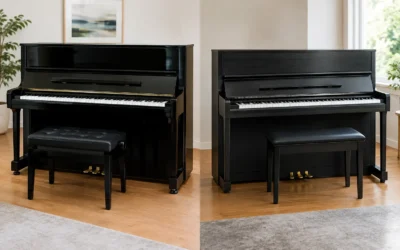
For many homes, an upright piano offers the strongest balance of musical quality and efficient use of space. Most uprights are roughly 57 to 60 inches wide and about 24 inches deep. Heights vary considerably, and that difference matters.
A console upright typically stands around 40 to 44 inches tall. It is a good option for a smaller room where a traditional acoustic piano is desired, especially for beginner and intermediate players. Its shorter cabinet makes it visually lighter than a taller model, while still offering the touch and resonance that digital instruments cannot fully duplicate.
Studio uprights generally measure about 45 to 48 inches tall. They use longer strings and a larger soundboard than consoles, often producing a fuller, more sustained sound. A studio upright can be an excellent choice for a committed student, teacher, or experienced player, provided the room can accommodate its stronger projection.
Full-size professional uprights, including models similar in scale to a Yamaha U3, can stand 52 inches or taller. They do not take much more floor space than a console, but they are visually and sonically more substantial. In a very small, reflective room, their power may be more than the setting calls for. In a well-furnished room or dedicated teaching studio, however, they can be a rewarding long-term instrument.
Spinet pianos and why condition matters
Older spinet pianos are compact, often about 36 to 39 inches tall, and may appeal to buyers focused only on space. Their smaller size can work in a limited room, but condition should lead the decision. Many spinets use an action design that is more complex to service, and their tonal range is generally less satisfying than a well-maintained console or studio upright.
A smaller piano is not automatically the better value. A carefully selected used upright in good structural and musical condition can provide years of enjoyment, while an inexpensive but worn instrument may require more service than it is worth. This is where professional evaluation makes a meaningful difference.
Baby grands and petite grands
A grand piano can work in a smaller room, but only if the room layout supports it. Petite and baby grand pianos commonly range from about 4 feet 5 inches to 5 feet 7 inches long, with a width near 58 inches. Their shape occupies more visual and functional space than an upright, because the tail extends into the room and the lid needs thoughtful placement.
For a compact living room, a grand under 5 feet may fit physically but still leave little room for seating or traffic flow. Plan for open space around the curved side and tail rather than squeezing the piano into a corner. The keyboard side should remain accessible, and the lid should not open directly toward delicate artwork, electronics, or a close wall.
The trade-off is musical. Even a small grand can offer a responsive action, horizontal string design, and expressive tonal color that many advanced players value. If a petite grand is your dream instrument, it may be worth simplifying the room around it rather than settling for a piano that does not inspire you to play.
Digital and hybrid pianos
A quality digital piano is often the most practical answer for an apartment, condominium, or multipurpose room. Many cabinet-style digital pianos are around 54 to 58 inches wide and 16 to 20 inches deep, while portable models can take up even less room. Headphone capability makes late-night practice possible without asking the household or neighbors to share every scale and repetition.
The key is to choose an instrument with a properly weighted action, a stable stand or cabinet, and a pedal setup that supports good technique. For a young beginner, that foundation encourages healthy habits. For an experienced player, it makes the transition to an acoustic piano more natural.
Digital instruments offer convenience, but they do not replace an acoustic piano for every player. If touch, resonance, and long-term musical development are central to your goals, a good upright may be the better fit even in a modest room.
Place the Piano for Sound, Safety, and Care
Once you select the instrument, placement protects both the piano and your investment. Avoid putting an acoustic piano directly against an exterior wall if that wall experiences significant temperature swings. Keep it away from direct sunlight, fireplaces, heating vents, air conditioners, and areas with frequent moisture changes.
Consistency matters more than perfection. A stable indoor environment helps the soundboard, pinblock, action parts, and finish remain healthy. If the only practical location is near a window, use blinds or curtains and leave enough clearance so the piano is not exposed to intense sun or trapped heat.
For upright pianos, the back typically faces the wall. In a small room, placing the piano on an interior wall is often the simplest and safest arrangement. A rug beneath the piano and bench can reduce vibration and make the area feel intentional. Use proper piano caster cups or pads where appropriate to protect wood, tile, or other finished floors.
For grand pianos, think about the lid and the room’s natural acoustics. A fully open lid can overwhelm a compact space. Playing with the lid closed or on a shorter prop may create a more balanced sound while preserving the instrument’s warmth.
Do Not Forget the Delivery Plan
The best piano for your room must also reach that room safely. Professional piano movers assess entryways, stairs, turns, flooring, and the piano’s dimensions before delivery. This is not a job for general furniture movers or a group of friends with a pickup truck. Pianos are heavy, mechanically complex instruments that need specialized equipment and proven handling techniques.
At A440 Pianos, we help buyers consider both the instrument and the complete ownership experience, including delivery, setup, tuning, and future service. Discussing access early can prevent the disappointment of choosing a piano that cannot be brought into the home safely.
Make Room for the Music, Not Just the Piano
A small room does not require a small musical ambition. Choose an instrument that leaves enough physical and visual breathing room, then shape the surrounding space to support practice. A comfortable bench, useful lighting, a few music books within reach, and a room that invites you to sit down can matter as much as a few extra inches of cabinet height.
The right piano should fit your home, but it should also make you want to play tomorrow.


0 Comments