


A piano can look perfect on paper and still feel wrong the moment you sit down. That is exactly why the hybrid piano versus digital question matters so much. For some buyers, the deciding factor is key action. For others, it is tone, maintenance, recording features, or whether the instrument will still satisfy them five years from now.
If you are buying for a serious student, a private studio, a church, or your own home, this is not a small distinction. Hybrid and digital pianos can overlap in price and appearance, but they are built around different priorities. One is designed to get closer to the physical experience of an acoustic piano. The other is usually built around convenience, portability, and value.
Hybrid piano versus digital: the real difference
A digital piano produces sound electronically through sampled or modeled piano tones and plays through speakers or headphones. It is usually lighter, easier to place, and more accessible in price. Many excellent digital pianos offer convincing sound, weighted keys, recording tools, and practical features for everyday use.
A hybrid piano also uses digital sound generation, but its major distinction is the action. Most hybrid models are designed with a more sophisticated mechanical key system, often borrowing elements from true acoustic piano actions. The goal is not just to imitate piano weight, but to recreate the response, control, repetition, and subtlety that trained players expect.
That difference sounds technical until your hands are on the keyboard. A strong digital piano can feel very good. A well-designed hybrid often feels more serious, more stable under the fingers, and closer to the discipline of practicing on an acoustic instrument.
Why buyers compare hybrid piano versus digital so closely
The comparison is common because both categories promise a modern alternative to a traditional acoustic piano. Both can offer headphone practice, volume control, and freedom from regular tuning. Both can work beautifully in homes where space, climate, or noise levels make acoustic ownership less practical.
But they do not serve every player equally.
A beginner may be thrilled with a quality digital piano and never feel limited for years. A progressing student preparing for advanced repertoire may notice that a standard digital action does not fully support technique development. A teacher or experienced pianist may appreciate the convenience of digital features but still want the physical confidence that comes from a more advanced action.
That is where hybrids often justify their higher price.
Touch and action matter more than most specs
Shoppers often start with speaker wattage, number of voices, or cabinet style. Those details have value, but touch is what shapes your experience every day.
Digital pianos usually use weighted hammer action systems designed to simulate the resistance of an acoustic piano. Better models can be impressively refined. Still, many digital actions simplify the internal mechanics to keep cost, weight, and maintenance low.
Hybrid pianos are typically built for players who care about precision. The key travel can feel more natural. Repetition is often faster. Control in soft dynamics can be easier to manage. That matters for classical players, advancing students, and anyone sensitive to phrasing and articulation.
If your goal is casual playing, a strong digital piano may be more than enough. If your goal is to build technique that translates well to an acoustic grand or upright, a hybrid deserves serious attention.
Tone: not just sound quality, but sound behavior
Many buyers assume hybrids always sound better than digitals. That is not automatically true. Some premium digital pianos sound excellent, and some hybrids justify their price more through action than through a dramatic leap in speaker performance.
What often separates the experience is how the tone responds to your playing. Better instruments – whether digital or hybrid – offer more nuanced dynamic layers, smoother tonal transitions, and less of that compressed or artificial feeling that can make digital playing seem flat over time.
Hybrid models tend to be voiced for a more refined playing experience, especially in premium cabinets meant for serious home or studio use. The sound may bloom more naturally through the speakers, and the relationship between touch and tone can feel more believable.
Still, if you primarily use headphones, built-in speakers may matter less than the sound engine and the action. That is one of those areas where it depends entirely on how and where the instrument will be used.
Maintenance, placement, and day-to-day ownership
One reason buyers consider both categories is practicality. In that respect, digital and hybrid pianos share some major advantages over acoustic instruments. Neither requires routine tuning in the traditional sense. Both are generally less sensitive to seasonal humidity changes. Both can be excellent choices for condos, multipurpose spaces, and households where quiet practice is essential.
A standard digital piano is usually easier to move, easier to fit into tight spaces, and simpler as a plug-and-play solution. That is useful for families who may relocate, schools with flexible room setups, or studios where space changes often.
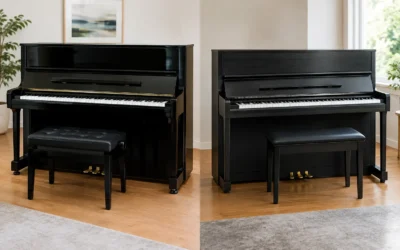
A hybrid piano is typically heavier, more substantial, and more furniture-like in its construction. It may occupy a room with greater visual presence, which many buyers see as a benefit rather than a drawback. It feels more permanent, more intentional, and in many cases more worthy of long-term ownership.
Price and value are not the same thing
This is where the decision gets more personal. Digital pianos usually offer the lowest cost of entry. For many households, that matters. You can buy a capable instrument with weighted keys and useful features for far less than the price of a premium hybrid.
Hybrid pianos sit higher in the market because they are trying to solve a more demanding problem. They are built for buyers who want modern convenience without giving up too much of the physical piano experience.
If you are comparing two instruments and wondering whether the hybrid is worth the premium, ask a more useful question: what kind of player is this piano meant to support?
If it is for a beginner testing the waters, value may point toward digital. If it is for a committed student, a teacher, or a pianist who already knows what a responsive action feels like, value may point toward hybrid even at the higher price.
A cheaper purchase can become expensive if it needs to be replaced quickly. A more advanced instrument can be the better long-term buy if it keeps the player engaged and growing.
Who should choose a digital piano?
A digital piano is often the right fit for first-time buyers, casual players, and families balancing budget with function. It also makes sense when portability matters, when the room is small, or when the player wants a broad set of features like rhythm tracks, USB recording, app connectivity, and multiple instrument sounds.
It is also a practical solution for secondary spaces. A church rehearsal room, lesson studio overflow room, or vacation property may not need the depth of a hybrid if convenience is the top priority.
The key is not to buy the cheapest option blindly. A better digital piano with a stronger action and cleaner sound is usually a smarter investment than an entry model loaded with extra features that do little for actual playing.
Who should choose a hybrid piano?
A hybrid piano makes the strongest case for serious students, advanced players, teachers, and buyers who want an instrument that feels premium every time they sit down. It is especially appealing for those who practice regularly but cannot maintain or place an acoustic piano in the space they have.
It is also a strong choice for buyers who care about furniture quality and presence. In a well-designed home, studio, or teaching environment, a hybrid can offer the clean practicality of digital ownership with a more substantial visual and musical identity.
For many of these clients, the decision is not about features. It is about confidence. They want a piano that supports discipline, nuance, and long-term satisfaction.
The smartest way to decide
Do not buy based on category alone. Some digital pianos outperform cheaper hybrids in meaningful ways, and some hybrids are worthwhile only if you truly value the action. Brand, model, cabinet design, speaker system, and intended use all matter.
Try to judge the instrument by three standards. First, how does the action respond when you play softly, quickly, and repeatedly? Second, does the tone remain pleasant over time, not just impressive for a few minutes? Third, does the instrument fit the player you are now and the player you expect to become?
At A440 Pianos, this is the kind of comparison that deserves an expert eye, not a quick online guess. The right instrument is rarely the one with the longest feature list. It is the one that makes you want to keep playing.
If you are torn between a hybrid and a digital, trust the piano that feels like it will still satisfy you after the excitement of the purchase wears off. That is usually the better investment.

0 Comments