


A Kawai RX piano review should begin with one practical point: this is not a single piano with a single personality. The RX series covered several grand piano sizes over many production years, and condition matters as much as the name on the fallboard. A well-maintained RX can be one of the most compelling premium used grand piano values available – especially for families, serious students, teachers, churches, and players who want a responsive Japanese-built instrument without entering the price range of a new luxury grand.
The best examples deliver a satisfying blend of power, clarity, and control. The less desirable examples usually reveal the risks of buying any used grand: neglected regulation, tired hammers, unstable tuning, or cosmetic wear that suggests a harder life than the asking price reflects. For a buyer willing to evaluate the individual instrument carefully, the Kawai RX deserves serious attention.
What the Kawai RX Series Was Built to Do
Kawai positioned the RX line as a professional-grade grand piano series, above many entry-level and institutional instruments and below its most exclusive concert offerings. These pianos were designed to perform in homes, teaching studios, recital settings, houses of worship, and smaller performance spaces where musical authority matters but a full concert grand is impractical.
The series included several sizes, commonly ranging from the compact RX-1 at about 5 feet 5 inches to larger instruments such as the RX-2, RX-3, RX-5, RX-6, and RX-7. The larger models offer more string length, soundboard area, bass presence, and dynamic headroom. That does not automatically make them the right choice. A refined RX-2 or RX-3 can be far more appropriate for a well-appointed living room than a 7-foot grand that overwhelms the room acoustically and visually.
Many later RX instruments incorporate Kawai’s Millennium III action components, which use ABS-carbon composite materials in key action parts. The purpose is consistency: the material is less affected by humidity changes than traditional wooden components. This can contribute to a stable, quick, and dependable action. However, specifications changed during the RX production run, so buyers should verify the action and build details on the particular piano rather than assuming every RX has identical features.
Kawai RX Piano Review: Tone and Musical Character
The RX tone is often described as clear, focused, and powerful, with a clean treble that projects well without becoming brittle when the piano is properly voiced. Its bass can be notably strong for its size, particularly in the RX-3 and larger models. There is a directness to the sound that rewards accurate playing and gives teachers, accompanists, and advanced students a useful level of definition.
Compared with a vintage American piano, an RX may sound more precise and controlled than lush or smoky. Compared with many Yamaha grands, it can offer a slightly rounder, darker foundation in the middle register, though every individual piano will vary. It does not generally aim for the broad, complex tonal bloom associated with a top-tier Steinway or a premium European grand. That distinction is not a criticism. It is part of why a good RX can be such a sensible purchase: it delivers an impressive, professional sound at a more attainable used-piano price.
Voicing has a major effect on this series. An RX that has been carefully voiced can sound warm, polished, and elegant. One with compacted hammers may seem overly bright, percussive, or thin in the upper register. This is why a short showroom audition is not enough. Play soft passages, repeated notes, wide dynamic changes, and sustained chords throughout the keyboard. Listen not only for volume, but for color and control at low dynamics.
The Right Tone Depends on the Room
A piano that sounds bold and exciting in a large showroom can feel too forward in a smaller room with hardwood floors and minimal upholstery. Conversely, a gentler RX-2 may not provide enough authority for a sanctuary, school hall, or active teaching studio. The room, the player’s repertoire, and the desired listening experience should guide the decision as much as the piano’s length.
Touch, Action, and Player Control
For many buyers, the action is where the Kawai RX makes its strongest case. When properly regulated, it offers a responsive and even touch that supports technical study and expressive playing. Fast repetitions, trills, and controlled soft playing can feel especially assured on a well-prepared example.
The touch is not identical to every other premium grand. Some pianists prefer the more traditional feel of an all-wood action, while others value the stability and crisp response associated with Kawai’s composite action designs. Neither preference is wrong. A pianist accustomed to a heavily worn vintage grand may find a regulated RX more immediate and precise. A player seeking a very deep, luxurious key feel may prefer another instrument after comparison.
The key phrase is “properly regulated.” Even an excellent piano can feel disappointing if the key dip, let-off, aftertouch, hammer alignment, or repetition adjustment has been neglected. A used RX with uneven touch is not necessarily a poor piano, but its purchase price should account for the technical work required to bring it back to its intended performance standard.
Which Kawai RX Size Makes Sense?
The RX-1 and RX-2 are strong choices for private homes, apartments with suitable floorplans, and players who want a genuine grand piano experience without committing to a large footprint. They can provide remarkable musical satisfaction when selected for condition rather than simply for size.
The RX-3, at roughly 6 feet 1 inch, is often a desirable middle ground. It has enough scale to offer stronger bass and a more spacious tonal palette while remaining practical for many homes, studios, and teaching environments. For serious students moving beyond an upright or small baby grand, this size can represent a meaningful long-term upgrade.
Larger RX-5, RX-6, and RX-7 models are better suited to buyers with the room, budget, and musical need to support them. These grands can bring more tonal depth and projection, but they also demand careful placement, professional moving, and regular service. Bigger is valuable only when the instrument has enough space to speak naturally.
What to Inspect Before Buying a Used RX
A premium used grand should be evaluated as an individual musical instrument, not as a brand badge. The cabinet finish matters, particularly in a formal home or luxury interior, but the structural and musical condition should come first.
Ask about the piano’s serial number, service history, climate exposure, and prior use. A lightly played home piano may have years of excellent life ahead of it. A piano that spent decades in a heavily used institution can still be worthwhile, but it may require more extensive action and hammer work.
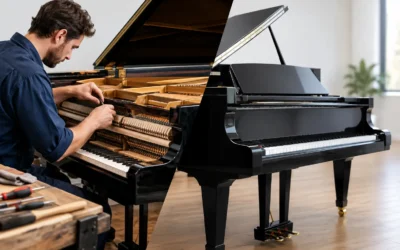
A qualified piano technician should inspect the tuning stability, pinblock, soundboard, bridges, strings, dampers, pedals, and action. Buyers should also look for cracked or excessively worn keytops, uneven hammer wear, sluggish keys, buzzing, false beats, and notes that do not repeat consistently. Cosmetic imperfections can often be addressed. Structural problems deserve much more caution.
There is also a difference between a piano that is merely playable and one that has been professionally prepared for sale. Preparation can include detailed cleaning, action regulation, voicing, tuning, minor repairs, and casework attention. That work has real value because it determines whether the piano feels premium from the first day in your home.
Value and Long-Term Ownership
The Kawai RX is often attractive because it occupies a valuable position in the used market. It offers recognized Japanese craftsmanship, substantial musical capability, and a professional appearance without demanding the price of many European or top American prestige grands. For buyers who prioritize performance per dollar, that equation is difficult to ignore.
Its resale value depends on size, age, finish, condition, service history, and local demand. A larger, well-maintained RX in a classic polished ebony finish will usually appeal to a broad audience. Still, a piano should not be bought as a short-term investment. It should be selected as an instrument you will be pleased to play, hear, and maintain for years.
Regular tuning, humidity management, and prompt attention to small mechanical issues will protect both the playing experience and the piano’s value. Professional delivery is equally essential. A grand piano is not furniture that should be handled casually; careful moving protects the cabinet, plate, action, and your home.
For buyers considering a premium used grand, an RX is most compelling when it has been inspected, prepared, and matched to the player rather than sold on its name alone. At A440 Pianos, that level of selection matters because the right instrument should feel like a confident musical decision long after delivery day.
0 Comments