

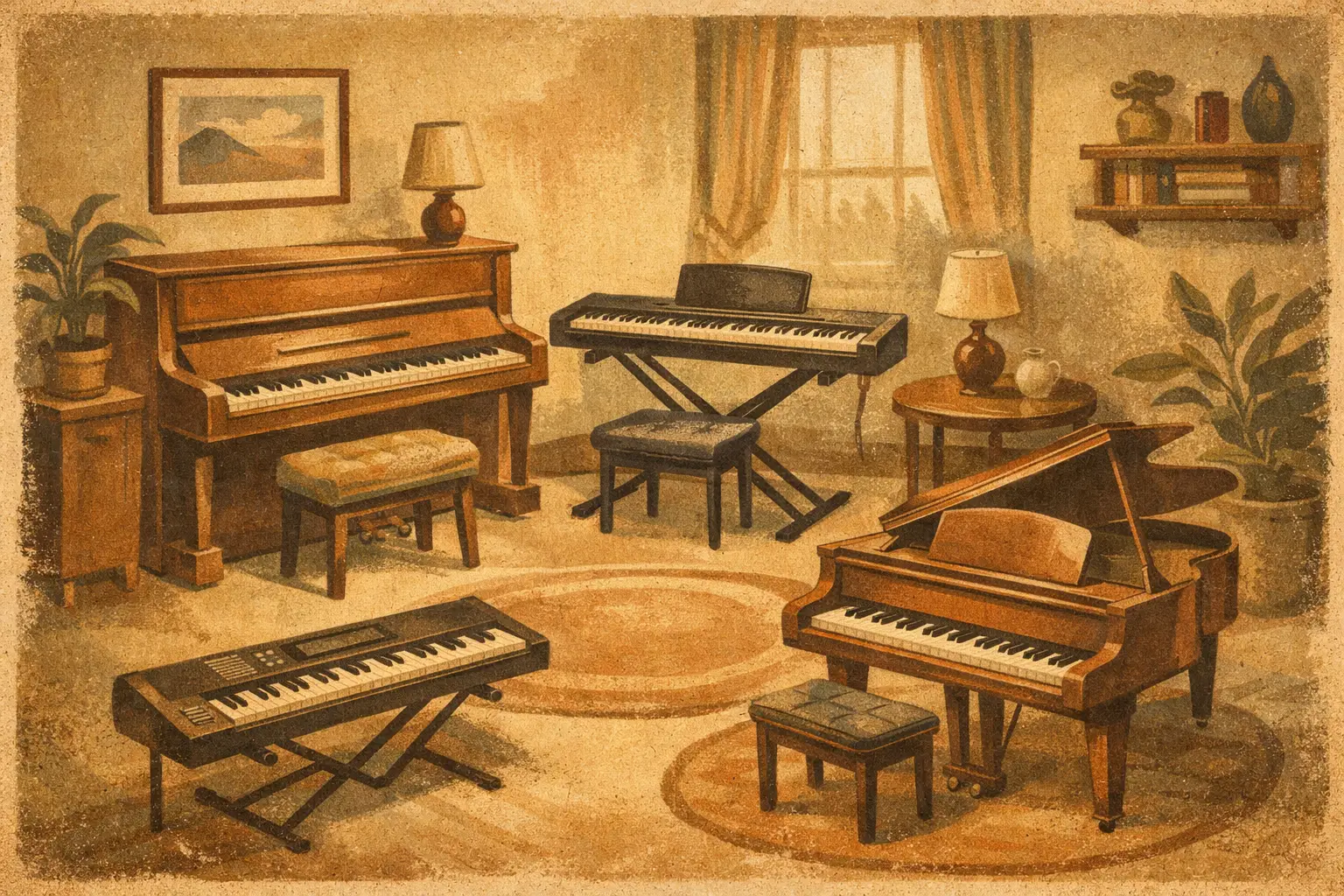
A piano does not need to dominate a room to become its center of gravity. The best pianos for small rooms balance musical authority with sensible proportions, giving a student, family, or experienced player a satisfying instrument without turning a living room, condo, studio, or apartment into a maze of furniture.
The right choice depends on more than floor space. Ceiling height, nearby walls, flooring, noise expectations, and the level of playing all affect which piano will feel at home. A compact instrument can still offer excellent touch, tonal depth, and lasting value when it is chosen with care.
What Makes a Piano Right for a Small Room?
Start with the space around the piano, not just the piano’s published dimensions. An instrument may technically fit against a wall yet leave too little room for a bench, a comfortable playing position, or proper access for tuning and service. Measure the intended location, including doorways, stairwells, elevators, and turns that a professional piano mover will need to navigate.
Acoustic pianos also interact with the room. A hard-floored room with bare walls can make even a modest upright sound bright and forceful. Rugs, curtains, upholstered furniture, and sound-absorbing wall treatments can soften reflections without muting the instrument’s natural character. In a tight apartment with shared walls, a digital piano or an acoustic piano equipped with a practice mute system may be the more considerate choice.
For many buyers, the most successful small-room piano is not the smallest available. It is the smallest instrument that still provides the touch, tone, and reliability the player needs. A serious student may outgrow a lightweight keyboard quickly, while a casual adult beginner may be better served by a premium digital piano than by an acoustic instrument with limited musical potential.
Best Pianos for Small Rooms by Type
1. Console uprights
Console pianos are among the strongest choices for rooms where an acoustic piano is desired but floor space is limited. Typically about 40 to 44 inches tall, they provide a more substantial soundboard and longer strings than compact spinets while remaining easy to place along a wall.
A well-built console from Yamaha, Kawai, Baldwin, or a respected vintage maker can offer a responsive action and a warm, well-proportioned sound for daily practice. They suit family rooms, smaller music studios, and homes where a piano should look as refined as it sounds. The trade-off is tonal scale: a console generally cannot produce the bass depth or dynamic reserve of a tall studio upright.
2. Studio uprights
A studio upright, usually 45 to 50 inches tall, is often the best acoustic value for a committed student in a small home. Its larger soundboard and longer bass strings create a noticeably fuller voice than a console, and its action is often more capable under advanced repertoire.
These instruments require only slightly more floor depth than a console, although their height makes them visually more present. In a room with an eight-foot ceiling, a studio upright can still feel elegant rather than oversized, especially in a traditional ebony, walnut, or mahogany cabinet. For music teachers, churches with limited rehearsal space, and families investing in long-term study, this is frequently the sweet spot.
3. High-quality digital pianos
A premium digital piano is the most space-efficient option when headphones, volume control, and low-maintenance ownership matter most. Many cabinet-style digital pianos have a footprint similar to a small desk, while portable models can be placed on a stand and moved when the room needs to serve another purpose.
The best examples use weighted, graded hammer actions and detailed piano sampling to create a convincing playing experience. They are especially practical for apartments, townhomes, and late-night practice. The essential compromise is that digital instruments do not produce sound through strings and a soundboard, so the physical resonance and tonal complexity differ from an acoustic piano.
For a beginner or recreational player, that difference may be less important than being able to practice at any hour. For an advanced classical student, it is worth spending time at the keyboard to determine whether the touch allows sufficient control of repetition, voicing, and soft playing.
4. Hybrid and silent pianos
Hybrid and silent piano systems serve buyers who want acoustic touch with more control over volume. A silent system allows an acoustic piano’s hammers to be stopped before striking the strings, while sensors transmit the player’s performance to headphones. Hybrid designs may combine acoustic-style actions with digital sound engines.
They cost more than a conventional upright or standard digital piano, but they solve a real small-room problem: practicing freely without filling the entire home with sound. This is an excellent category for serious players in condos, professionals with irregular practice hours, and parents who want a child to practice consistently without household conflict.
5. Baby grand pianos, chosen carefully
A baby grand can fit in a smaller room, but it should never be selected only because it looks impressive. Most baby grands range from roughly 4 feet 11 inches to 5 feet 6 inches long, and they need open space around the curve and keyboard. The bench, lid position, and traffic flow must all be considered.
When the room supports it, a quality baby grand can be a beautiful choice for an open-plan living area or a dedicated music room. Its horizontal stringing and grand action offer musical benefits that many pianists value. Yet a short, poorly built grand may be less satisfying than an excellent studio upright. Quality, condition, restoration history, and tonal character matter more than the silhouette.
6. Spinet pianos, with realistic expectations
Spinet pianos were designed for compact homes and are often inexpensive on the used market. Their low height can make them attractive where every inch matters. However, their drop-action mechanism is more difficult to regulate and repair, and many spinets lack the tonal power and touch response required for sustained study.
A spinet can make sense as a decorative, occasional-use instrument if it has been inspected and serviced properly. It is generally not the first recommendation for a family purchasing a piano for a progressing student. A compact console or a quality digital model will usually be a stronger long-term decision.
7. Custom-finished or visually distinctive compact pianos
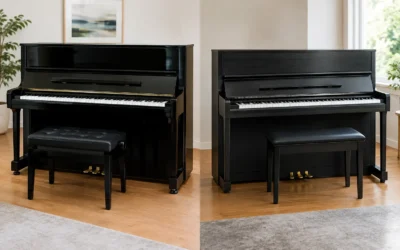
In a small room, the piano is highly visible. That makes cabinet design part of the decision. A polished ebony upright offers a formal, timeless presence; a satin walnut console can soften a traditional room; and a white or art-case piano can become a deliberate design statement.
Visual distinction should not come at the expense of musical condition. A beautiful cabinet cannot compensate for unstable tuning pins, worn action parts, or a compromised soundboard. The ideal instrument pairs a finish that belongs in the room with technical quality that supports years of playing.
How to Place an Acoustic Piano Without Overpowering the Room
Place an upright on an interior wall whenever possible, away from direct sunlight, exterior temperature swings, air vents, fireplaces, and kitchens. These conditions can create humidity changes that affect tuning stability, wood components, and the piano’s finish. Leave enough clearance for technicians to remove panels and perform service properly.
Avoid pushing a grand piano into a corner simply to save space. Its lid and soundboard need room to project, and a cramped placement can make the bass muddy or the overall sound uncomfortably loud. In a smaller room, keeping the lid closed or on its short stick is often more balanced than playing with it fully raised.
An area rug beneath the piano and bench can help control brightness and protect flooring. It should be large enough to support the bench in its normal playing position. If sound carries to adjacent rooms, consider acoustic treatments before assuming that the piano itself is too large.
The Used Piano Advantage for Smaller Spaces
A carefully selected used piano can provide a level of craftsmanship that may be difficult to find in a new instrument at the same budget. This is particularly true with premium uprights and vintage American or European pianos that have been properly maintained or restored. The key word is carefully. Age alone does not create value.
Before purchasing, evaluate tuning stability, action condition, pedal function, cabinet condition, structural integrity, and the quality of any restoration work. A piano that has been regulated, voiced, tuned, and inspected by qualified technicians gives a buyer much more confidence than an instrument sold without a service history.
At A440 Pianos, buyers can compare premium used, vintage, upright, grand, and electronic instruments while arranging professional delivery, tuning, restoration support, and financing through one specialized source. That service matters when the piano must arrive safely and perform properly in a room with little margin for error.
Choose for the Player, Then the Room
A small room should encourage music, not limit it. If the player needs the expressive range of an acoustic upright, a quality console or studio model may be the right fit. If quiet practice and flexibility take priority, a premium digital or silent piano may deliver more daily value. And if a grand is the dream, choose one only after confirming that the room can support both its dimensions and its sound.
The best piano is the one that invites the player to sit down again tomorrow – with enough musical depth to reward progress and enough practical sense to belong comfortably in the home.

0 Comments