


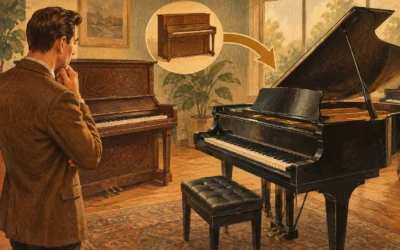
A piano trade in example can make the upgrade process feel much more concrete. Imagine that you own a well-maintained Yamaha U1 upright, purchased 12 years ago for a child beginning lessons. Your child is now an advanced player, the piano has been tuned regularly, and your family is considering a used baby grand. Rather than managing a private sale, arranging moving, and hoping the buyer follows through, you apply the value of the U1 toward the next instrument.
The trade-in allowance is not simply a number pulled from a price guide. It reflects the piano’s musical and cosmetic condition, its brand and model, its age, local demand, the work needed before resale, and the value of the piano you are purchasing. A professional evaluation gives you a realistic starting point and helps you decide whether a trade-in is the right path for your household.
A Piano Trade In Example With Real-World Variables
Consider a family trading in a 2012 Yamaha U1 upright. The piano has had annual tuning, plays evenly, and has no major cabinet damage. Its serial number confirms its age, and an inspection shows healthy hammers, soundboard, bridges, strings, action parts, and pedals. It is a desirable model with a strong reputation among teachers, homes, and smaller studios.
Suppose the family selects a pre-owned 5’7″ grand piano listed at $18,000. After the dealer evaluates the upright, accounts for its condition and anticipated preparation, and considers current demand, the trade-in allowance might be $5,000. The family applies that amount to the grand and pays the remaining $13,000, before any applicable delivery, taxes, or financing terms.
That $5,000 is not necessarily the same as what a private-party buyer might eventually pay for the U1. A dealer accepting the piano takes on transportation, inspection, tuning, cleaning, regulation, possible repairs, showroom time, warranty responsibility where offered, and the risk that the instrument may take time to sell. In return, the family receives a simpler transaction and a coordinated transition from one piano to the next.
The example would change if the U1 had missed years of service, showed humidity-related damage, or required significant action work. It could also change if the piano were a newer Yamaha U3, a desirable Steinway upright, or a well-restored vintage instrument with exceptional tone. Brand matters, but condition and marketability matter just as much.
What Determines a Piano Trade-In Value?
A piano is both a musical instrument and a complex mechanical system. Two pianos with the same brand, model, and age can have meaningfully different values because their ownership histories are different.
Brand, model, and market demand
Well-known models with dependable performance tend to be easier to place with the right next owner. Yamaha uprights, certain Kawai models, Steinway grands, and carefully selected European instruments often have established demand. That does not mean every piano from a respected maker automatically commands a premium. The specific model, scale design, manufacturing period, condition, and demand in your market all affect the offer.
Some older pianos deserve close attention rather than an automatic yes or no. A vintage grand may have a beautiful cabinet, a distinguished name, and deep sentimental value, but original strings, worn hammers, loose tuning pins, or a compromised soundboard can require substantial restoration. Conversely, a thoughtfully rebuilt instrument may offer remarkable musical value when the work has been completed to a high standard.
Musical and mechanical condition
An evaluator will listen and look beyond the finish. They may assess tuning stability, pinblock condition, soundboard and bridge integrity, string condition, key level, action response, hammer wear, pedal operation, dampers, and evidence of past repairs. Regular tuning is helpful, but it is only one part of the picture.
Climate exposure can be especially significant in Georgia. Pianos that have spent years near direct sunlight, exterior doors, HVAC vents, or inconsistent humidity may show effects that are not immediately obvious to a casual player. A professional assessment can identify whether those effects are routine service items or signs of more extensive work.
Age and service history
Age alone does not establish value. A 30-year-old piano maintained by a careful owner may be more desirable than a much newer instrument that has been neglected. Service records, restoration invoices, and a clear ownership history can help support an evaluation, particularly for premium and vintage pianos.
Still, honest documentation is better than guesswork. If you do not have records, that is common. Share what you know about the piano, including when it was last tuned, whether it has moved recently, and any keys or pedals that behave differently. Accurate information helps the evaluation move faster.
Logistics and resale preparation
Piano moving is specialized work, not ordinary furniture delivery. Staircases, tight turns, long carries, and access conditions affect how a piano is collected and delivered. A dealer also considers the preparation required before the trade-in can be offered to another musician. A clean, stable upright with minor service needs presents a different resale proposition than a piano needing regulation, repairs, refinishing, and multiple moves.
Trade-In or Private Sale: Which Is Better?
A private sale may produce a higher gross price when you have a desirable piano, enough time, and the willingness to coordinate inquiries, demonstrations, negotiations, payment, and professional moving. It can be a sensible option for an owner who is not under a deadline and understands the local market.
A trade-in is often more attractive when convenience, timing, and risk reduction carry real value. You have one coordinated transaction, a clear credit toward the next piano, and a team that can manage the technical and logistical details. This is particularly useful when moving from an upright to a grand, when access is challenging, or when you want the outgoing and incoming pianos handled professionally on a planned schedule.
The best choice depends on your priorities. Comparing only the highest possible private-sale price against a trade-in offer can overlook the time, costs, and uncertainty involved in selling independently.
How to Prepare for a Trade-In Evaluation
Start with the basics: locate the piano’s brand, model, and serial number. On many upright pianos, the serial number is found inside the upper front panel. On grands, it is often visible on the plate near the tuning pins. Take clear photos of the full instrument, keyboard, pedals, interior, and any areas of visible wear or damage.
Avoid spending money on major repairs before discussing the piano with a specialist. A fresh tuning or simple cleaning may be worthwhile for your own enjoyment, but expensive restoration does not always translate dollar-for-dollar into a higher trade allowance. The intended buyer, the piano’s underlying condition, and the scope of work all matter.
Be ready to describe access at your home. Let the evaluator know about steps, elevators, narrow hallways, or difficult driveway conditions. This protects everyone from surprises and supports safe planning for both instruments.
Choosing the Right Upgrade
A trade-in is most satisfying when the next piano clearly serves your musical life better. A larger grand may offer more tonal color, sustain, and control for an advancing pianist. A high-quality upright can be the wiser choice for a smaller room, a condominium, or a family seeking excellent touch and sound without the footprint of a grand. For some homes, a self-playing piano adds an entirely different form of enjoyment.
Play several instruments when possible. Listen for the tone that draws you in, but also notice the action under your fingers, the clarity from soft to loud, and how the piano fills the room. A piano that sounds impressive in a large showroom may behave differently in your home, which is why room size, flooring, and placement deserve consideration.
At A440 Pianos, the goal of a trade-in conversation is not to rush a decision. It is to help you understand the instrument you have, evaluate the options in front of you, and make room for the piano you will be excited to play for years. Bring clear information, ask direct questions, and let the next instrument earn its place in your home.
0 Comments