


A fine piano is not an impulse purchase, and for many buyers that becomes even more complicated when credit history is less than ideal. Piano financing with bad credit is possible, but the right path depends on more than a score alone. The instrument, the lender, the down payment, and your long-term ownership costs all shape whether financing is a smart move or an expensive mistake.
For families, teachers, churches, and serious players, this matters because a piano is not just furniture. It is a working instrument, a visual centerpiece, and often a long-term investment in musical progress. That is exactly why financing should be approached with the same care you would bring to selecting the piano itself.
What piano financing with bad credit really means
Bad credit does not automatically mean no financing. In practice, it usually means stricter terms. A lender may ask for a larger down payment, charge a higher interest rate, limit the loan amount, or require stronger proof of income. Some buyers are approved quickly but only for lower-priced instruments. Others may qualify for a better piano than expected because their current income and debt picture are stronger than their credit history suggests.
This is where buyers often get tripped up. They focus only on monthly payment, when the real question is total value. A lower monthly number can still lead to overpaying if the term is too long or the rate is too high. On a premium used or restored piano, the instrument itself may hold its value far better than a low-grade alternative, but financing terms still need to make sense.
What lenders usually look at
If you are applying for piano financing with bad credit, lenders are typically trying to answer one question: how likely are you to make the payments as agreed? Your credit score is one signal, but it is not the only one.
Income stability matters. A buyer with consistent employment, reasonable housing costs, and manageable existing debt may present less risk than a higher-score applicant with a stretched budget. Lenders may also look at recent payment history. Older credit issues often carry less weight than current delinquencies, collections, or recent charge-offs.
The size of your down payment can change the conversation quickly. Putting money down lowers the lender’s risk and shows commitment on the buyer’s side. In some cases, that is what turns a decline into an approval. It can also reduce the monthly payment enough to make a better-quality instrument realistic.
The piano itself can matter too. A well-selected instrument from a specialized dealer is often a stronger purchase than an unknown piano from a general marketplace. Condition, service history, brand reputation, and market value all influence whether the purchase feels sound from both the buyer’s and lender’s perspective.
When financing makes sense and when it does not
There are good reasons to finance a piano, even with challenged credit. A student may need a quality instrument now, not two years from now. A church may be replacing a failing piano used every week. A teacher or performer may need a more responsive instrument to support serious work. In those cases, waiting can have a real musical cost.
Still, financing is not always the right answer. If the interest rate is unusually high, the term is too long, or the monthly payment leaves no room for tuning, moving, or maintenance, the purchase may create stress rather than satisfaction. A piano should elevate the experience of playing, not turn into a monthly reminder that the numbers were forced.
That is why premium buyers often do better with a balanced strategy. Instead of stretching for the highest-priced piano they can get approved for, they choose the best instrument that fits comfortably within the full ownership budget.
Choosing the right piano if credit is limited
A limited credit profile does not mean settling for an instrument that disappoints you six months later. It does mean being disciplined about value.
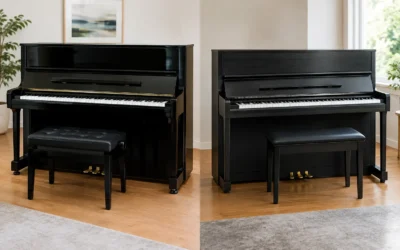
For many buyers, premium used uprights are the smartest place to start. They often deliver strong touch, musical depth, and visual presence at a lower price point than grands. For students, studios, and many homes, a quality upright can be the better purchase if it allows room in the budget for delivery, tuning, and future care.
Used baby grands and larger grands can also make sense, especially when they come from established brands and have been properly prepared. But this is where expertise matters. A lower sticker price on a neglected grand is rarely a bargain if the piano needs major work after delivery. Buyers with tighter financing terms usually benefit from choosing a piano with known condition and clear service support rather than chasing size or prestige alone.
In a market filled with uncertainty, a specialized retailer adds practical value. The confidence that comes from vetted inventory, professional preparation, and ownership services can outweigh a small price difference.
How to improve approval odds before you apply
A few simple steps can make a meaningful difference. First, know your real budget before shopping. That includes not only the payment, but also moving, tuning, climate control, and any bench or setup needs. Buyers who understand the full cost of ownership make cleaner decisions and avoid overreaching.
Second, gather your documentation early. Proof of income, identification, and current housing information can help speed up a financing review. If your credit has weak spots, strong documentation can provide useful context.
Third, consider a down payment if possible. Even a modest amount can improve the structure of the deal. It may lower the interest cost, open access to better inventory, or simply make the payment more comfortable month to month.
Finally, be realistic about the range you are shopping. There is no advantage in applying for more piano than your financial profile supports. A well-priced, high-quality instrument is a far better ownership experience than a luxury model financed on terms you resent.
Questions to ask before agreeing to financing
Before signing anything, ask what the full cost will be over the life of the financing, not just the monthly amount. Ask whether there is a prepayment penalty. Ask what happens if you want to pay the balance off early. Ask whether the approval is tied to a specific instrument or a maximum purchase amount.
You should also ask about delivery, setup, and post-sale service. A piano is not a boxed product left on the porch. It requires proper handling, placement, and care. If those details are separated from the financing conversation, buyers can underestimate the true cost.
This is especially important with premium and vintage pianos. The right instrument can serve a family or institution for decades, but only if the purchase includes practical support after the sale.
Why dealer expertise matters more with bad credit
When credit is strong, buyers can sometimes afford to make a few mistakes. When credit is challenged, every decision has to work harder. That makes dealer guidance far more important.
An experienced piano specialist can help narrow the field to instruments that deliver real musical value in the approved range. They can explain why one used Yamaha upright may be a safer purchase than a cheaper but less proven alternative, or why a restored vintage piano may justify its price through craftsmanship and performance. They can also help buyers avoid spending approval dollars on the wrong feature set.
For customers seeking premium used, vintage, and specialty instruments, this level of guidance is not a luxury. It is part of protecting the purchase. A440 Pianos, for example, operates as more than a showroom, with financing access, delivery, tuning, repair, and restoration services that support ownership beyond the initial transaction.
A better way to think about the purchase
The goal is not simply to get approved. The goal is to bring home a piano worthy of your space, your playing, and your investment without creating financial strain. Sometimes that means choosing a refined upright now and moving into a grand later. Sometimes it means making a larger down payment and buying once instead of trading up too quickly. Sometimes it means waiting a short time to strengthen your application and secure better terms.
There is nothing glamorous about forcing the numbers. The better move is to buy with clarity. A strong piano purchase feels confident from the bench and sensible on paper.
If your credit is less than perfect but your standards are still high, that does not put premium piano ownership out of reach. It simply means the smartest purchase is the one where quality, financing, and long-term care are all aligned from the start.


0 Comments