

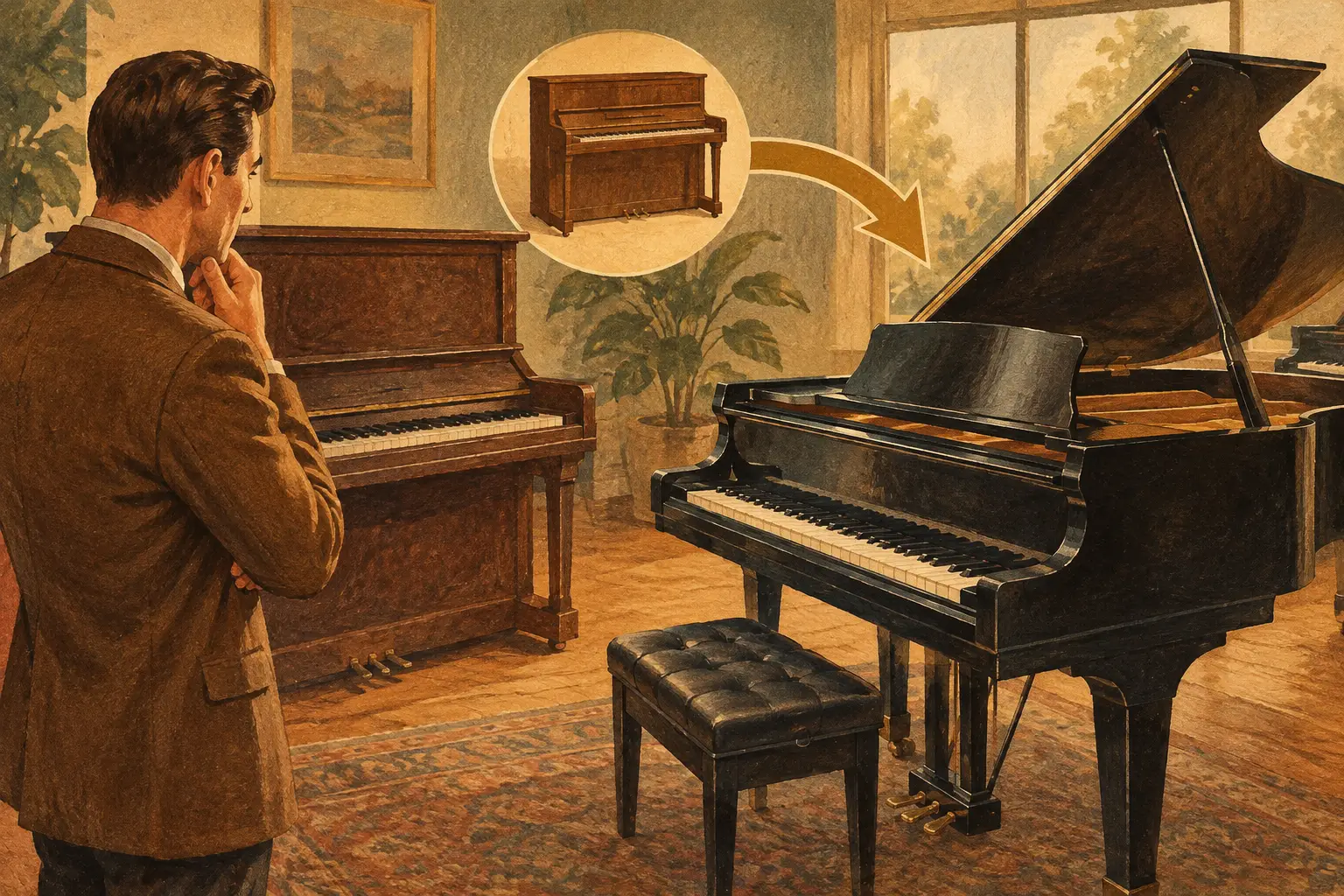
A piano upgrade should feel like a musical step forward, not a logistical burden. A thoughtful piano trade-in comparison gives you a clear view of what your current instrument contributes toward the piano you truly want – whether that is a responsive Yamaha grand, a restored Steinway, a refined Kawai, or an exceptional vintage instrument with character.
For many owners, the piano at home represents years of lessons, family gatherings, worship services, or professional work. Its value is not only sentimental. When evaluated accurately, it can become a meaningful part of the investment in a better instrument. The key is comparing trade-in options on more than the headline offer.
What a Piano Trade-In Actually Includes
A trade-in is not simply a dealer purchasing your piano at a discounted price. It is an exchange structured around your next purchase. The dealer evaluates your current piano, accounts for the cost and risk of preparing it for resale, and applies an agreed value toward another instrument in inventory.
That distinction matters. A private-sale price may look higher on paper, but it does not account for photography, advertising, buyer questions, tuning, repairs, moving arrangements, payment risk, and the time required to find the right buyer. A trade-in offers a more direct path: one appraisal, one delivery plan, and one transaction focused on your next piano.
The strongest offer is not always the highest number. It is the offer that gives you confidence in the piano you are acquiring, the condition of the instrument you are leaving behind, and the service supporting both sides of the exchange.
Piano Trade-In Comparison: The Factors That Matter
A serious comparison begins with the piano itself. Brand, age, condition, size, finish, location, and current market demand all influence value. Two pianos of the same model can have very different trade-in values if one has been maintained consistently and the other has major action, pinblock, soundboard, or cabinet issues.
Brand and model reputation
Recognized makers generally provide a stronger starting point because buyers know what to expect from their construction, tone, and long-term serviceability. Steinway, Yamaha, Kawai, Baldwin, Blüthner, Mason & Hamlin, and select European brands often retain greater demand than entry-level or obscure instruments.
Still, the badge alone does not determine value. An older premium piano with deferred maintenance may require substantial restoration. Conversely, a well-kept upright from a respected manufacturer may be an excellent trade-in candidate for a family moving into a larger home or a student progressing to advanced repertoire.
Musical and mechanical condition
A piano is a precision instrument with thousands of moving parts. The appraisal should consider tuning stability, hammer wear, key response, regulation, pedal function, strings, bridges, soundboard condition, and the integrity of the pinblock. Cosmetic condition also matters, particularly on polished ebony, mahogany, walnut, and specialty finishes.
Be realistic about repairs. A piano that needs tuning is not necessarily a concern. Nearly every piano should be tuned after moving. More significant work, such as replacing strings, repairing structural damage, rebuilding the action, or correcting severe humidity-related issues, affects what a dealer can responsibly offer.
Age, serial number, and provenance
Age should be viewed as context, not a verdict. Some vintage pianos were built to extraordinary standards and can become remarkable instruments after expert restoration. Others have reached a point where restoration costs exceed their market value.
The serial number helps identify the year of manufacture and original specifications. Documentation of previous restoration, regular service, climate-controlled ownership, or institutional history can strengthen an appraisal. If you have service records, include them. They help establish a more complete picture than photos alone.
Type, size, and buyer demand
Grand pianos tend to command more interest than uprights, but size and market fit remain important. A 5-foot to 6-foot grand may suit many private homes, while a 7-foot performance grand serves a more specialized buyer. Uprights vary widely as well: a quality studio upright may be highly practical for a teacher, church, school, or apartment, while a spinet often has a narrower resale market.
Demand changes by region and season. Black polished grands remain broadly desirable, while rare finishes and distinctive art-case instruments may appeal to a smaller but more specialized audience. A dealer with nationwide reach and a curated clientele may be better positioned to recognize the value of an unusual or luxury piano.
Trade-In Versus Private Sale
A private sale can make sense when you have time, storage flexibility, and a piano with strong consumer appeal. It may produce a higher gross price, particularly for a recent-model Yamaha or Kawai in excellent condition. It also places the work on you.
You will need to establish an asking price, screen buyers, coordinate viewings, negotiate, arrange secure payment, and manage professional moving. If a buyer raises concerns after delivery, you may still be drawn into the conversation. For many busy families and professionals, that process is not worth the additional effort.
A trade-in is usually the better choice when the priority is efficiency and certainty. It allows the old piano to leave as the new one arrives, minimizing disruption in the home. It also consolidates the transaction with a piano specialist who understands appraisal, transport, tuning, repair, and resale.
Questions to Ask Before Accepting an Offer
A transparent dealer should explain how the trade-in value was determined. Ask whether the appraisal is based on current photos, an in-person inspection, or both. Confirm whether the offer depends on the piano matching the stated condition when collected.
You should also understand what happens with moving costs. A low trade-in figure can still be competitive if it includes professional pickup of your existing piano, delivery of the replacement instrument, placement in the room, and coordination of the full exchange. Compare the complete transaction, not isolated line items.
Finally, focus on the piano you are purchasing. Is it professionally prepared? Has it been inspected, regulated, tuned, or restored as needed? Is the dealer equipped to support future tuning, repair, restoration, and moving? The trade-in value matters, but the quality and long-term enjoyment of the replacement piano matter more.
Preparing Your Piano for an Accurate Appraisal
You do not need to invest in a full restoration before requesting a trade-in evaluation. In fact, major work should be discussed with a specialist first, because it may not return its full cost in added value. What does help is providing clear, current information.
Send photos of the entire piano, the keyboard, pedals, interior, serial number, and any visible wear or damage. Include the make, model, approximate age, dimensions if known, service history, and your location. Mention issues honestly, including sticking keys, cracks, missing parts, water exposure, or prolonged time without tuning. Accurate disclosure prevents surprises and leads to a more dependable offer.
Keep the piano accessible for inspection and moving. Remove fragile items from its surface, clear a path through the home, and mention stairs, tight turns, elevators, or long carries. Professional piano movers plan for these details before the appointment, not after the instrument is already in motion.
Choosing an Upgrade Worth the Exchange
The best upgrade addresses a real limitation in your current piano. A serious student may need more tonal range, repetition, and dynamic control than an entry-level upright can provide. A teacher may need a dependable studio instrument that holds up to daily use. A collector may be seeking a particular era, finish, maker, or musical voice.
Play several instruments whenever possible. Listen for clarity in the treble, warmth through the tenor, and depth in the bass. Feel how the action responds at soft and fast dynamics. Cabinet style matters in a fine home, but it should complement – not replace – musical performance.
At A440 Pianos, a trade-in can be part of a premium, service-centered purchase experience, with curated instruments and professional support designed to make the transition practical as well as rewarding.
Your present piano has already carried music through an important chapter. A well-structured trade-in gives it a next home while making room for an instrument that better matches where your playing, family, studio, or collection is headed.

0 Comments