

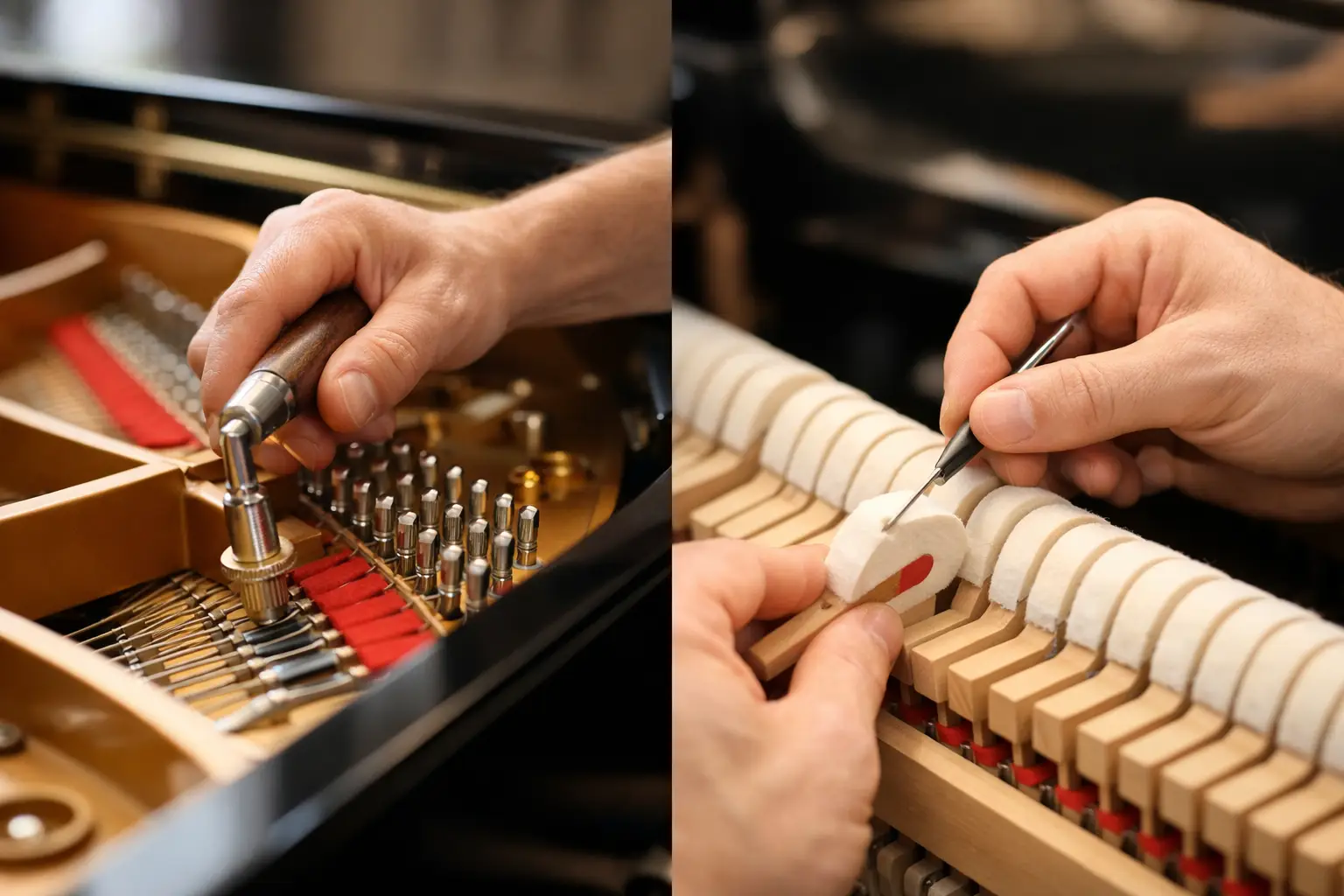
A piano can be perfectly in tune and still sound too bright, too dull, or uneven from one note to the next. That is why piano tuning versus voicing is more than a technical distinction. Tuning corrects the pitch of the strings; voicing shapes the character of the sound those strings produce. Both matter when you want an instrument that feels rewarding to play, whether it is a family upright, a Yamaha studio piano, or a concert-ready grand.
Piano Tuning Versus Voicing: The Essential Difference
Tuning brings each string back to its intended pitch and sets the proper relationship between notes across the keyboard. A piano has more than 200 strings under considerable tension, and even a well-built instrument gradually changes pitch as the seasons, humidity, temperature, and regular playing affect the strings and soundboard.
When a piano is out of tune, intervals that should sound clean begin to beat or clash. Chords lose their clarity, unisons sound unfocused, and a player may start compensating without realizing it. Tuning is the foundation of musical accuracy. No amount of beautiful tone can make an instrument satisfying if its notes do not agree with one another.
Voicing, sometimes called tone regulation, addresses a different question: what is the quality of the sound? It involves carefully adjusting the density and resilience of the hammer felt so the piano produces an even, musical response from the lowest bass notes through the high treble. A technician may use specialized needles to soften compacted hammer felt, reshape hammers when appropriate, or use controlled hardening techniques where more brilliance is needed.
In simple terms, tuning determines whether the piano is on pitch. Voicing determines whether its voice is warm, clear, brilliant, round, or harsh.
Why a Tuned Piano May Still Not Sound Its Best
Every hammer strikes thousands of times over its life. As the felt compresses, it becomes harder at the point of contact with the strings. This often creates a bright, metallic edge, especially in frequently played middle-register notes. A piano in a busy teaching studio, church, school, or active home can develop uneven tone more quickly than an instrument played occasionally.
The reverse can happen as well. Some pianos sound overly soft or lack definition, particularly after extensive needling or when hammer felt has become worn. In that case, a pianist may feel that fast passages blur together or that the instrument cannot project into a room. Good voicing is not simply making a piano mellow. It is about creating a balanced tonal palette that suits the instrument, the player, and the setting.
A bright Yamaha grand may be voiced differently for a conservatory-trained pianist than for a family room where a gentler sound is preferred. A vintage Steinway may need a sensitive approach that respects its age, original materials, and distinctive musical personality. The right result is never one-size-fits-all.
Tuning, Voicing, and Regulation Are Separate Services
Piano owners sometimes use these terms interchangeably, but they solve different problems. Regulation is a third service that affects how the action feels and performs. It adjusts the many mechanical relationships inside the piano so keys respond consistently, hammers strike accurately, and repetition works as intended.
If a key feels sluggish, plays too loudly with little effort, fails to repeat quickly, or sits lower than its neighboring keys, regulation may be part of the answer. Voicing cannot fix a sticking key, and tuning cannot correct an action that is out of adjustment. Likewise, regulation alone will not restore a harsh tone or bring a piano back to concert pitch.
These services often work best together. A technician may first address structural and action concerns, then tune the piano, regulate as needed, and voice it once the instrument is stable. The sequence depends on the condition of the piano and the work being performed. For example, extensive hammer reshaping or string replacement can make a final voicing especially valuable.
When Does Your Piano Need Tuning?
Most home pianos benefit from professional tuning at least twice a year. In homes with stable climate control and light use, once a year may be acceptable after the piano has settled at standard pitch. For pianos used daily by students, teachers, recording artists, or performers, more frequent service is often worthwhile.
New pianos need extra attention during their first year or two because fresh strings stretch and the instrument acclimates to its environment. A piano that has recently been moved, particularly across a significant change in climate, should also be allowed to settle before being evaluated for its ongoing maintenance schedule.
Call for tuning when the piano sounds noticeably sour, a single note has drifted away from its neighbors, or a singer or another instrument cannot comfortably perform with it. Even if the change is subtle, regular tuning protects the piano from falling far below pitch. Bringing a neglected piano back up gradually is safer and more predictable than forcing a large correction in a single visit.
Signs Voicing May Be the Better Answer
Voicing is worth discussing when the piano is on pitch but no longer inspires you. The sound may be painfully sharp at a normal playing volume, or certain notes may jump out with an aggressive tone. You may also notice that some areas sound muffled while others are thin and piercing.
Pay attention to changes in your own playing. If you find yourself avoiding a dynamic range because soft notes disappear or louder passages become unpleasant, the piano may need tonal attention. Professional players are often highly aware of this issue, but beginners and families notice it too. A piano should invite practice, not make every forte chord feel like a compromise.
Voicing is particularly useful after a piano has been played heavily, restored, restrung, or fitted with new hammers. It can also help refine a recently purchased piano to better fit its new room. Hard floors, large windows, high ceilings, rugs, and upholstered furniture all influence what you hear. The instrument’s tone should be assessed where it will be played, not only in a showroom or workshop.
What to Expect From a Professional Voicing Appointment
A thoughtful technician begins by listening. They will play across the keyboard at different dynamics, assess the hammers, and check whether uneven tone is actually caused by hammer condition or by a mechanical, string, or tuning issue. This diagnosis matters because voicing is precise work. Excessive or poorly placed needling can leave hammers weak and unfocused, while unnecessary hardening can create a brittle sound.
The process may include light hammer filing to remove deep string grooves, followed by careful voicing to restore evenness. The technician listens repeatedly as the work progresses. The goal is not to impose a generic sound, but to reveal the best voice already present in the piano.
For premium, vintage, and restored instruments, experience is especially valuable. These pianos can offer extraordinary color and depth, but their materials and prior service history require informed judgment. At A440 Pianos, ongoing care is approached as part of piano ownership, not as an afterthought following delivery.
Protecting Tone Between Appointments
Climate consistency does more for a piano than many owners expect. Keep the instrument away from direct sun, exterior doors, fireplaces, heat vents, and damp areas. Avoid placing drinks or plants on the piano, and leave the lid closed when it is not being played to reduce dust accumulation and accidental damage.
It also helps to schedule service before a piano becomes obviously problematic. Regular tuning gives a technician the chance to notice early signs of compacted hammers, action wear, loose hardware, or environmental stress. Small adjustments made at the right time are usually more effective and less disruptive than waiting for several concerns to build up.
When you sit down at your piano, listen for more than correct notes. Notice whether the sound feels balanced under your hands, whether the touch responds predictably, and whether you want to keep playing. Those details give a qualified technician the clearest starting point for helping your instrument sound like itself again.


0 Comments