

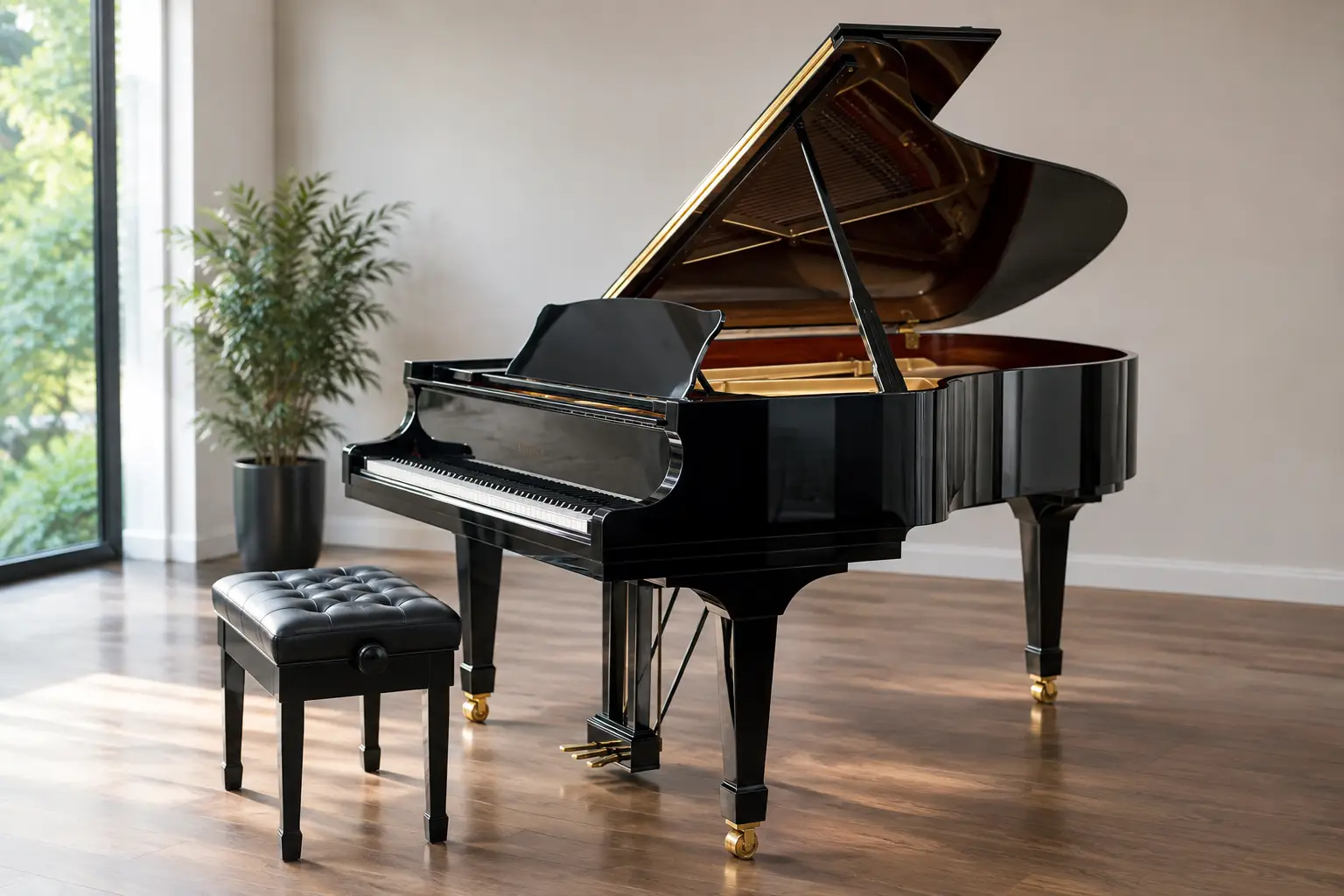
At 5’3″, the Yamaha GC1 occupies a particularly appealing place in the grand-piano market: it is compact enough for many homes, yet substantial enough to offer the response, tonal color, and presence players expect from a real grand. This Yamaha GC1 review looks beyond the familiar Yamaha name to explain what the instrument delivers, where it fits best, and what a prospective buyer should assess before making room for one.
Yamaha GC1 Review: The Short Answer
The Yamaha GC1 is an excellent entry into premium grand-piano ownership for advancing students, serious hobbyists, teachers, and families who want a musical instrument rather than a decorative baby grand. It offers a clear, controlled voice, dependable action, and the consistency that has made Yamaha a preferred choice in teaching studios and performance settings.
It is not intended to imitate a larger concert grand or a hand-built European instrument with a deeply individual tonal personality. Its strength is balance. The GC1 gives players a satisfying range of expression in a manageable footprint, with a scale design and cabinet quality that feel meaningfully more refined than many lower-priced small grands.
For many buyers, that balance is exactly the point. A piano should suit the room, the player, and the years of care it will receive. The GC1 does that exceptionally well when those priorities include reliability and musical growth.
Size That Works in Real Homes
The GC1 measures approximately 5’3″ long. That places it at the larger end of the baby-grand category, and its dimensions matter more than the label. Very small grands can look impressive while offering limited bass development and a compressed tonal range. At 5’3″, the GC1 has enough string length and soundboard area to produce a more convincing bass foundation and a fuller middle register.
It still needs thoughtful placement. Allow room for the bench, a fully opened lid, and a clear path around the instrument for tuning and service. In many living rooms, music rooms, churches, and private teaching studios, its footprint is more practical than a 6-foot grand while still making a strong visual statement.
The room itself will affect the result. Hardwood floors, glass, vaulted ceilings, and sparse furnishings can make any bright, clear piano sound more forward. Rugs, upholstered furniture, curtains, and careful lid positioning can bring welcome warmth and control. A qualified technician can also voice the hammers over time to suit the room and the player’s preferences.
Tone: Clear, Focused, and Versatile
The GC1 has the recognizable Yamaha character many players know well: a clean attack, focused sustain, and an even transition from bass to treble. The sound has enough brilliance to project clearly, which is useful for practice, teaching, and ensemble work. It also gives a player immediate feedback, making articulation and uneven fingerwork easier to hear.
The middle register is one of the piano’s most useful qualities. It remains present and organized rather than becoming muddy under chords, so melodies and inner voices can be shaped with confidence. The bass is impressive for the instrument’s length, although buyers should maintain realistic expectations. A 5’3″ grand cannot create the same low-register depth and resonance as a 6’1″ or 7-foot instrument.
Some pianists prefer a darker, more mellow sound with a wider sense of tonal haze around each note. Those players may be drawn toward certain European makes, select vintage instruments, or a larger grand with a different scale design. The Yamaha GC1 is best for someone who values definition, consistency, and a tone that can adapt to a broad range of repertoire.
Can the GC1 Be Voiced for a Warmer Sound?
Yes, within reason. A skilled technician can adjust hammer voicing to reduce excessive brightness, round off a sharp edge, and help the piano blend more comfortably with a particular room. Regulation and proper tuning also have a major influence on how refined an instrument feels.
Voicing should enhance the piano’s natural identity, not force it to become something it is not. A well-prepared GC1 can sound warm and sophisticated, but it will generally retain the clarity and directness that Yamaha players appreciate.
Touch and Action Feel
A grand piano action differs fundamentally from an upright action. Its horizontal design allows faster repetition and gives the player more detailed control over soft playing, repeated notes, and dynamic shading. The Yamaha GC1 makes that advantage accessible without requiring concert-hall space.
Its action is typically responsive, even, and moderately firm in a way that encourages good technique. Beginners can grow into it, while accomplished amateur and professional players will find enough control for nuanced work. Fast passages feel secure, and the piano responds predictably at both quiet and strong dynamic levels.
As with any acoustic piano, condition matters. A new GC1 that has been properly prepped will feel different from a used example that has seen years of heavy teaching-studio use without regulation. Before purchasing, play slowly at very soft levels, repeat notes in several registers, test the pedals, and listen for consistency across the keyboard. A piano may be structurally sound yet still benefit from tuning, regulation, or voicing.
Build Quality and Long-Term Ownership
Yamaha has earned its reputation through disciplined manufacturing, durable components, and dependable quality control. The GC1 reflects that approach. Its cabinet is polished and formal without being overly ornate, and its construction is designed for regular use rather than occasional playing.
For buyers, this reliability has practical value. A well-maintained Yamaha grand generally remains appealing to future buyers, teachers, and institutions because its character is familiar and its service needs are well understood by qualified technicians. That does not make maintenance optional. Every acoustic piano needs a stable environment, regular tuning, and periodic inspection.
Plan to tune a newly delivered piano after it has adjusted to the home, then maintain a regular schedule, often twice yearly. Keep the instrument away from direct sun, exterior doors, heating vents, fireplaces, and dramatic humidity changes. These habits protect tuning stability, action performance, finish condition, and long-term value.
Who Should Choose a Yamaha GC1?
The GC1 is particularly well suited to a family moving beyond an upright, an advancing student preparing more demanding repertoire, or an adult player who wants the true musical experience of a grand piano. It is also a strong choice for a teacher who needs an instrument with dependable action and enough tonal clarity to evaluate students accurately.
It can be an especially sensible purchase for buyers choosing between a new smaller grand and an older, larger piano. A vintage grand may offer more size for the money, but its condition can vary greatly. Pinblock integrity, soundboard condition, action wear, previous rebuilding work, and climate history all deserve careful evaluation. A newer GC1 offers greater predictability, while a thoroughly restored vintage piano may offer a different kind of musical value.
For a player with a large room, an appetite for deeper bass, or a goal of frequent advanced performance, it is worth comparing the GC1 with Yamaha’s larger models. More length usually means more tonal complexity, greater dynamic reserve, and a richer low end. The right choice depends on whether the extra musical scale serves the player enough to justify the additional cost and space.
What to Consider Before You Buy
A piano purchase should begin with playing, listening, and asking practical questions. Compare the GC1 in person against instruments in its price and size range. Play music you know, including quiet passages, wide chords, repeated notes, and material that reaches into the bass and high treble. The most useful comparison is not between brand names alone, but between specific pianos in their actual condition.
Confirm what preparation and after-sale support are included. Professional delivery is essential for a grand piano, both for safety and for protecting the instrument and the home. Ask about bench inclusion, warranty coverage, first tuning, service recommendations, and financing options if they affect the purchase decision.
At A440 Pianos, we encourage buyers to consider the complete ownership experience, from selecting an instrument that fits the room to arranging careful delivery and ongoing technical care. The best grand piano is one that invites regular playing and remains satisfying long after the first day it arrives.
For the right home or studio, the Yamaha GC1 is more than a step up from an upright. It is a practical, polished grand that gives developing musicians and experienced players a dependable place to make music every day.


0 Comments