

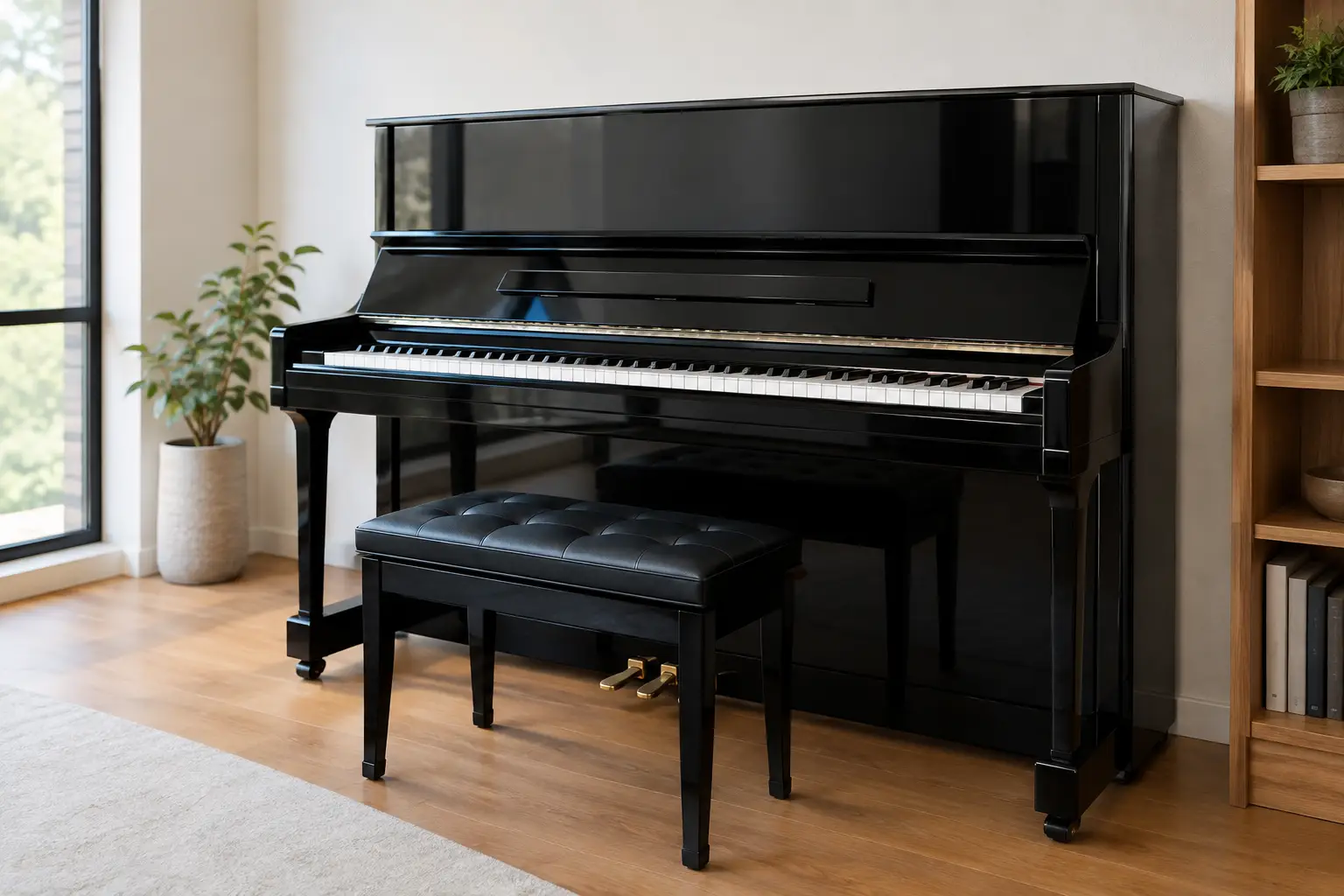
The Kawai K300 review begins with a practical question: can a 48-inch upright give a developing player enough musical range to grow for years without overwhelming a living room or budget? For many families, teachers, and advancing pianists, the answer is yes. The K300 sits in a particularly appealing part of the upright piano market – substantial enough to feel like a serious instrument, yet still suited to a home, teaching studio, or practice room.
It is not the least expensive upright Kawai makes, and it is not designed to imitate a concert grand. What it offers is a refined playing experience, strong build quality, and a clear path beyond the limitations of entry-level pianos. That combination is why it remains a model worth playing in person before making a final decision.
Kawai K300 Review: What Makes It Different
The Kawai K300 is a 48-inch professional upright built around the company’s Millennium III Upright Action. This action uses ABS-Carbon components in key areas rather than relying entirely on traditional wood parts. The material is designed to remain stable through changes in humidity and temperature, which can be helpful in homes where the climate is not perfectly controlled.
For the player, the result is a responsive, consistent touch. Repetition is quick, the keyboard has a controlled feel, and the action gives a pianist room to shape phrases rather than simply press notes. A beginner may not immediately describe those differences in technical terms, but they often notice that the piano feels easier to control. An experienced player is more likely to appreciate the evenness from bass to treble and the confidence the action provides during faster passages.
The K300 also has a solid spruce soundboard, a feature that matters because the soundboard is central to the piano’s ability to project and develop color. Its larger cabinet and longer strings give it more tonal foundation than smaller 42- or 44-inch uprights. That added scale does not turn it into a grand piano, but it makes a real difference in bass warmth, sustain, and overall presence.
Tone: Clear, Warm, and Controlled
Kawai’s tonal character is often described as warm and round, and the K300 generally follows that direction. The bass has satisfying weight for an upright of this size, while the middle register tends to be full without becoming muddy. The treble is clear and singing, particularly when the piano has been properly prepared and voiced.
That last point is worth emphasizing. Two K300s can sound noticeably different depending on their preparation, room acoustics, age, and maintenance history. A piano displayed in a hard, reflective showroom may seem brighter than it will in a carpeted home. Likewise, a newly delivered instrument may benefit from settling time and its first in-home tuning.
Players who prefer a brilliant, forward sound may find a Yamaha upright more immediately familiar. Those looking for a little more warmth and tonal cushion may be drawn to the Kawai. Neither approach is automatically better. The right choice depends on repertoire, touch, room, and personal taste.
For classical practice, the K300 has enough dynamic range to support careful work on voicing and phrasing. For jazz, pop, worship music, and accompaniment, it offers a pleasing blend that records and fills a room well. Its sound is polished rather than aggressively powerful, which makes it especially comfortable in residential settings.
How the K300 Feels Under the Fingers
The action is one of the strongest reasons to consider this model. The K300 does not have the longer key length or escapement mechanism of a grand piano, so a grand and upright should not be judged as identical experiences. Still, it gives players a remarkably capable upright action with good repetition and a dependable sense of control.
The touch is often perceived as moderately firm rather than excessively heavy. That can be a benefit for students building finger strength and control, but it should be evaluated personally. A player accustomed to a very light digital keyboard may need time to adjust. Conversely, someone moving up from an older spinet or console piano may immediately feel the added precision and stability.
Teachers frequently appreciate this kind of action because it does not hide uneven technique. The K300 responds to soft playing, controlled crescendos, and articulated staccato work. It also has enough resistance to encourage intentional playing rather than careless key strikes.
Size, Space, and Home Ownership
At roughly 48 inches tall, the K300 is a full-sized upright. It needs a thoughtful location, but it is far more practical for many homes than a grand piano. Its cabinet is elegant without being oversized, making it a strong fit for a living room, dedicated music room, school, or private studio.
Before purchasing, measure the wall space as well as the path into the home. Stairways, tight turns, flooring, and elevator access all affect delivery planning. A professional piano moving team should evaluate these details before moving any instrument. Upright pianos are heavy, top-weighted, and more vulnerable to damage when handled like ordinary furniture.
Once installed, place the K300 away from direct sunlight, heating vents, fireplaces, and exterior doors that bring sudden temperature changes. A stable environment protects tuning and helps preserve the action and soundboard over time. Most home pianos should be tuned at least twice a year, with additional service sometimes needed after a move or major seasonal change.
Is the Kawai K300 a Good Value?
The K300 is best understood as a long-term upright rather than a starter piano. Its price reflects its larger scale, better action design, and higher musical potential than entry-level models. For a serious student, a committed adult beginner, or a family that wants to avoid replacing a smaller piano after a few years, that investment can make sense.
It is also a compelling option for teachers who need a reliable studio instrument. A piano used daily by many students needs consistency, durability, and a tone that remains pleasant over long teaching hours. The K300 checks those boxes well when it is maintained properly.
However, value depends on the individual buyer. If space is limited, a smaller Kawai upright may be more sensible. If the priority is maximum projection and a more grand-like feel, stepping up to the taller Kawai K500 could be worthwhile. If silent practice with headphones is essential, a hybrid, digital, or acoustic piano with a factory-installed silent system may be the better fit.
A pre-owned K300 can also be attractive, but condition matters more than the name on the fallboard. Have the piano evaluated for action wear, tuning stability, pedal function, cabinet condition, soundboard health, and its service history. A well-cared-for used instrument can offer excellent value; a neglected one may require repairs that change the real cost of ownership.
Who Should Choose the K300?
The K300 is especially well suited to advancing students, dedicated adult players, teachers, churches with limited space, and families who want an acoustic piano with lasting musical credibility. It has enough depth for serious repertoire while remaining manageable in an average home.
It may be less ideal for the buyer who simply needs an inexpensive first keyboard, wants an extremely bright sound, or requires silent practice every evening. Those needs do not make the K300 a poor piano. They simply point toward a different kind of instrument.
The best next step is to sit down and play it with familiar music: soft passages, scales, chords across the keyboard, and something that asks for real dynamic control. At A440 Pianos, we encourage buyers to compare the touch and tone of a K300 against nearby alternatives in the same room. The right piano should not only fit the space and budget – it should make you want to return to the bench tomorrow.

0 Comments