

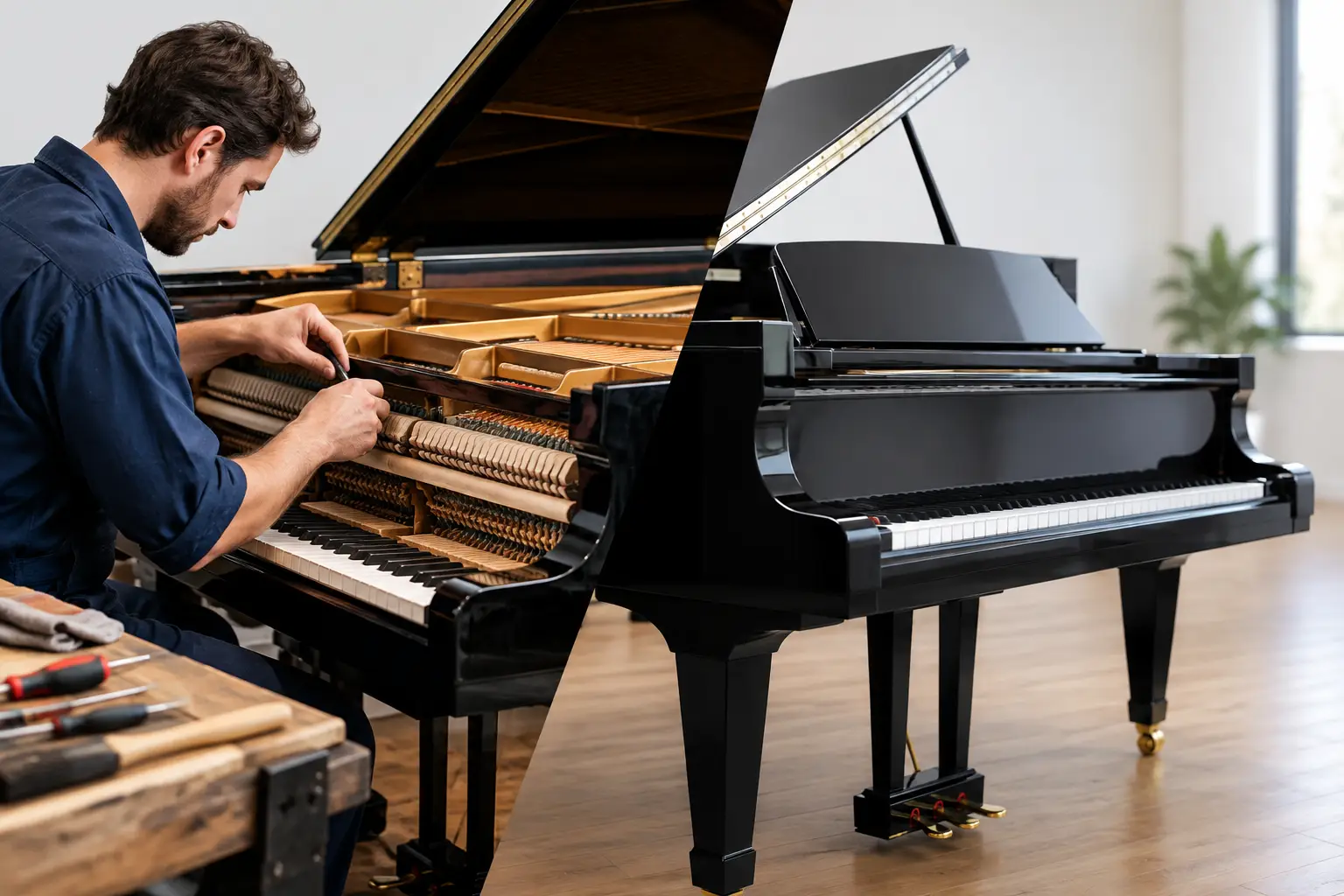
A piano that has begun to stick, rattle, drift out of tune, or feel uneven at the keyboard does not automatically need to be replaced. The real question behind piano repair versus replacement is whether the instrument still has a sound foundation worth preserving – and whether the work will serve the way you or your family want to play.
For some owners, a carefully restored vintage upright becomes the heart of a home for decades. For others, putting major funds into a worn, entry-level piano makes less sense than choosing a better instrument with a more responsive touch and richer voice. The right answer is rarely found by looking at age alone.
Start With the Piano’s Musical Potential
A piano is a complex acoustic instrument, not a piece of furniture with keys. Its value depends on the condition of the structure, the action, the strings, the soundboard, and the quality of the instrument when it was built. A respected piano that has been properly cared for may be an excellent restoration candidate after 40, 60, or even 100 years. A poorly built piano that has spent years in a humid garage may not be.
The first step is a hands-on inspection by a qualified piano technician. Cosmetic wear may look discouraging but be relatively straightforward to correct. Faded finish, chipped veneer, worn keytops, and dull brass hardware can often be addressed during restoration. Structural issues require much closer attention.
A technician will look for problems such as loose tuning pins, severe rust on strings, cracks in the pinblock, bridge damage, soundboard separation, water damage, insect activity, and signs of a compromised cast-iron plate. These concerns affect tuning stability, tone, safety, and the realistic cost of bringing the piano back to reliable playing condition.
The Brand and Build Quality Matter
The name on the fallboard is not everything, but it matters. Well-made instruments from makers such as Steinway & Sons, Yamaha, Blüthner, Kawai, and certain established American and European manufacturers often justify thoughtful repair or rebuilding when their core structure is sound.
That said, every piano must be evaluated individually. A Yamaha U3 that needs regulation, hammer work, and tuning may be a very sensible repair project. A lower-quality upright with a failing pinblock and extensive moisture damage may be better replaced, even if it has sentimental importance.
When Piano Repair Is the Better Choice
Repair is often the most practical route when the work is targeted and the piano has a healthy foundation. Many common concerns are maintenance issues rather than signs that the instrument is finished.
If keys are sluggish, sticking, clicking, or uneven, action regulation and minor repairs may restore a more controlled touch. If the piano sounds bright, thin, or harsh, hammer shaping and voicing can make a meaningful difference. If it has not been tuned in years but still holds pitch reasonably well, a technician may be able to return it to concert pitch over multiple tunings.
Repair can also be the right decision when the piano already meets your musical needs. A family may own a quality upright that fits its space beautifully and offers a warm, familiar sound. A teacher may have a dependable studio piano whose action simply needs regular attention. In these cases, replacing the instrument can cost more while solving problems that professional service could have addressed.
There is also a distinction between repair and full restoration. Repair addresses a specific condition: a broken string, noisy pedal system, worn hammer, or unstable key. Restoration is broader and may include refinishing, restringing, rebuilding the action, replacing pinblocks, and renewing other major components. A full restoration can be worthwhile for a piano of notable quality, but it should be chosen with clear expectations about cost, timeline, and future value.
When Replacement Makes More Sense
Replacement deserves serious consideration when repair costs approach or exceed the price of a better-suited piano. This is especially true for instruments with significant structural deterioration, limited musical potential, or a history of poor storage conditions.
A piano that cannot hold a stable tuning is difficult to enjoy, no matter how polished its cabinet may look. Likewise, an instrument with extensive internal corrosion, severe soundboard problems, damaged action parts, or major water exposure can require a level of work that is hard to justify economically.
Replacement can also be a musical upgrade rather than a response to damage. A beginning student may have outgrown a small spinet with a shallow, inconsistent action. A growing family may need a more substantial upright with stronger projection. A serious pianist may be ready for a grand piano with the tonal range, repetition, and expressive control required for advanced repertoire.
Digital and self-playing options may also change the equation. For a condominium, late-night practice space, or room where acoustic volume is a concern, an electric piano or hybrid solution may better match daily life. The goal is not to preserve an instrument at all costs. It is to make sure the piano in your home invites people to play.
Compare the Total Cost, Not Just the First Estimate
A repair estimate should be viewed in context. A modest service bill for tuning, regulation, and a few action repairs is very different from a complete rebuild. Ask what the proposed work will accomplish, what it will not accomplish, and how long you can reasonably expect the result to last.
It is equally important to include ownership costs when comparing a replacement. Delivery, professional piano moving, tuning after placement, humidity control, future maintenance, and any financing arrangements are all part of the decision. A piano that appears less expensive upfront may need immediate service before it performs at its best.
For many buyers, a professionally inspected used piano offers an appealing middle ground. It can provide a meaningful step up in tone and touch without the cost of a new premium instrument. A curated used or vintage piano should be evaluated for mechanical condition, tuning stability, cabinet condition, and the quality of any previous restoration work.
Sentimental Value Has a Place in the Decision
A piano passed down through generations may carry memories that cannot be assigned a market value. Restoring it can be deeply worthwhile, even when purchasing a different piano would be the more economical choice. The key is to separate emotional value from musical and financial expectations.
In some cases, families choose both paths: restore a cherished heirloom at an appropriate level while purchasing a more capable instrument for daily study and performance. There is no wrong choice when the priorities are clear.
Questions to Ask Before You Decide
Before authorizing major work or shopping for a replacement, ask the technician to explain the piano’s current condition in plain language. Find out whether it holds tune, whether the action can be regulated successfully, whether structural repairs are needed, and whether the piano has a realistic future as a satisfying musical instrument.
Then consider the player. Is this piano for a young beginner, an advancing student, a church, a teacher, a recording space, or an experienced pianist? How much room is available? Is a warm vintage voice desired, or would a more powerful, precise modern sound better suit the repertoire? These answers matter as much as the repair quote.
At A440 Pianos Inc, the most useful guidance begins with understanding both the instrument and the owner’s goals. An honest evaluation may point toward tuning and repair, comprehensive restoration, or a replacement that better fits the space, budget, and musical future of the household.
A piano should not become a source of uncertainty sitting silently in the corner. Have it assessed, listen to what it can still offer, and choose the path that gives music a lasting place in your home.

0 Comments