

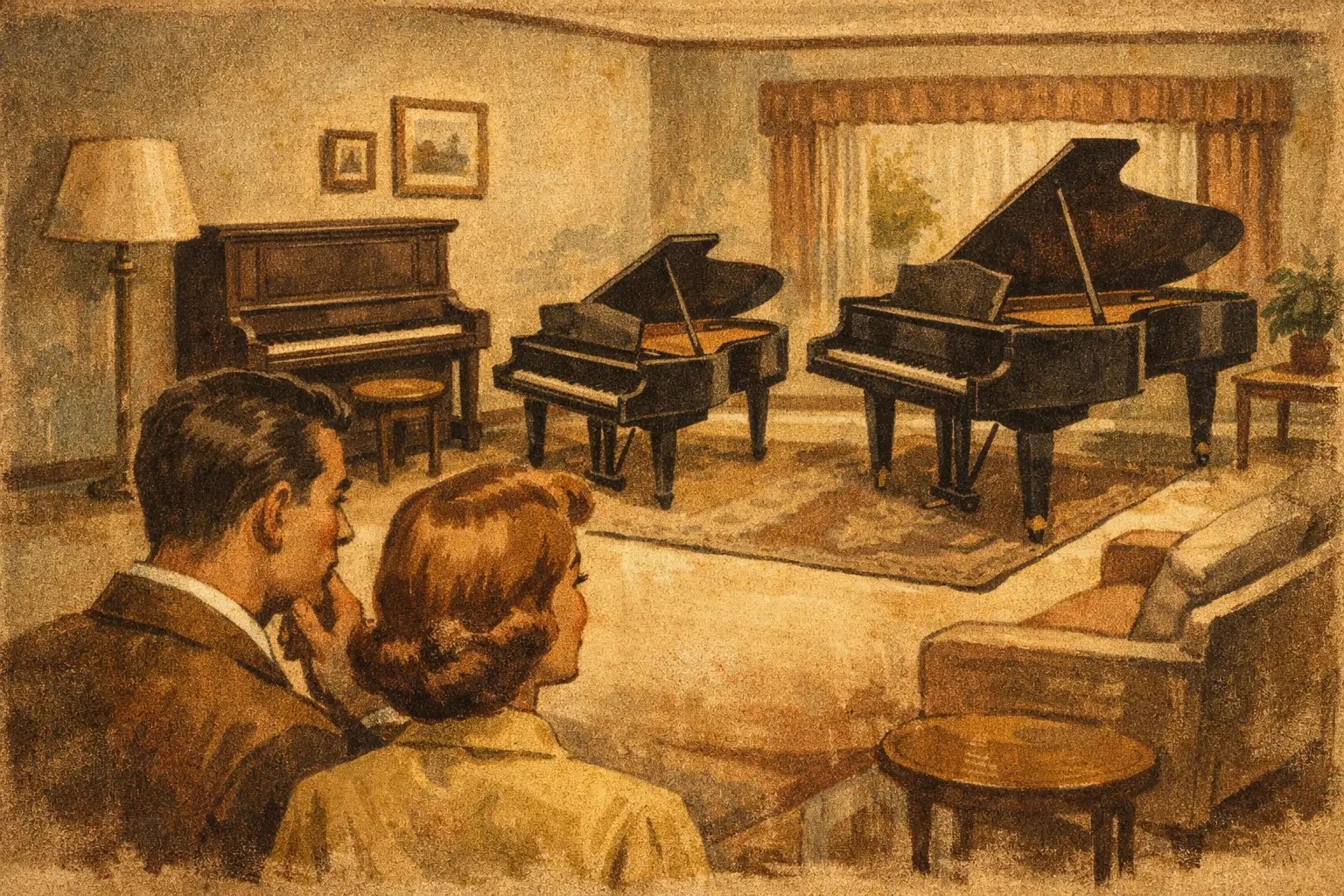
A piano can look perfect on a showroom floor and feel overwhelming once it enters a room. The question, “what piano size fits my room,” is about more than whether the instrument clears the doorway. The right choice must leave space for the bench, the player, proper delivery access, and the instrument’s sound to develop beautifully. A carefully selected piano should become a natural focal point in your home, studio, church, or teaching space, not an obstacle you learn to live around.
Start With the Piano’s Real Footprint
Piano dimensions are often discussed as if length alone tells the whole story. It does not. A grand piano’s length is measured from the keyboard to the tail, but its width is typically close to 5 feet. Once you add a bench, room for the lid to open, and a comfortable walking path, the usable footprint becomes substantially larger.
An upright piano uses less floor area, but it still needs breathing room. Most upright and vertical pianos are about 58 to 60 inches wide and 24 to 26 inches deep. The bench adds another 15 to 18 inches in front of the keyboard. A player also needs enough clearance to sit, rise, and move comfortably without backing into a wall, table, or doorway.
| Piano type | Typical dimensions | Best suited to | |—|—|—| | Spinet or console upright | 58 inches wide, 24 inches deep | Compact rooms and casual use | | Studio upright | 58 inches wide, 24 to 26 inches deep | Homes, schools, and teaching studios | | Full upright | 58 inches wide, 25 to 27 inches deep | Larger rooms needing a powerful vertical piano | | Baby grand | 4 feet 11 inches to 5 feet 6 inches long | Living rooms, music rooms, and apartments with adequate access | | Parlor or living room grand | 5 feet 7 inches to 6 feet 6 inches long | Dedicated music spaces and larger homes | | Semi-concert grand | 6 feet 7 inches to 7 feet 4 inches long | Studios, churches, and serious performance settings |
Dimensions vary by manufacturer and model, particularly among vintage and specialty instruments. Measure the specific piano before making a final placement decision.
What Piano Size Fits My Room? Measure the Usable Space
Begin with the room’s clear floor space, not its total square footage. A 16-by-20-foot living room may sound generous, but a fireplace, sectional sofa, built-in cabinetry, traffic lane, and windows can reduce the available piano area quickly.
For an upright, plan for a minimum depth of roughly 5 feet from the wall to the front of the bench. That allows for the instrument, bench, and a reasonable amount of player space. A room that is 10 by 12 feet can often accommodate a quality studio upright very comfortably, provided doors and pathways remain clear.
For a baby grand, a useful starting point is a room of at least 12 by 15 feet with a relatively open layout. This is not a hard rule. A 5-foot baby grand can work in a smaller room if it is the primary furnishing, while a larger room crowded with furniture may be a poor fit. A 6-foot grand generally feels most balanced in a 14-by-18-foot room or larger.
A grand piano needs a wider visual field around it. If the tail is pressed close to a sofa or the keyboard faces a narrow passage, even a technically successful installation can feel cramped. Leave room around the curved side and tail whenever possible. The piano should appear intentionally placed rather than squeezed into an available corner.
Do Not Forget the Bench and Walking Clearance
The bench is part of the piano’s footprint. Plan for 3 feet of clear space in front of the keyboard as a practical minimum, and more when the player is tall, the bench is adjustable, or the room is used for lessons. If parents, teachers, accompanists, or guests regularly gather around the instrument, provide a clear path that does not force people to pass directly behind the player.
Doorways and delivery routes deserve equal attention. Measure exterior doors, interior turns, stairways, elevator dimensions, and any narrow hallways. A premium piano requires professional handling, and a delivery assessment can prevent a beautiful purchase from becoming a complicated installation day.
Choose for Sound, Not Floor Plan Alone
A larger piano usually offers longer strings, a larger soundboard, and more tonal depth. That is why a 6-foot grand often gives an advanced player greater color, control, and sustain than a compact baby grand. Yet bigger is not always better in a reflective room with hardwood, glass, stone, and high ceilings.
Small rooms can magnify brightness and bass resonance. In those settings, a well-prepared upright or a smaller grand may be the more musical choice. Area rugs, upholstered furniture, drapery, and thoughtful placement can soften excessive reflections without making the room sound dull.
Conversely, a large open room can make a small piano feel visually and musically underpowered. A substantial upright may be a stronger choice than a small grand chosen only for appearance. For serious students and experienced players, touch, tonal range, and condition should carry more weight than the silhouette of the cabinet.
Place the Piano Where It Can Stay Healthy
A piano is built from wood, felt, metal, and precision action parts. Sudden changes in temperature and humidity affect tuning stability, regulation, and long-term condition. The best location is usually an interior wall away from direct sun, exterior doors, active HVAC vents, radiators, fireplaces, and damp areas.
An upright is traditionally positioned with its back near an interior wall, but avoid pressing it tightly against the surface. A few inches of clearance improves air circulation and makes routine service easier. If the room allows, consider angling it slightly so it feels integrated with the furniture rather than flat against a wall.
A grand piano gives more placement options. In many homes, the straight side sits near an interior wall, with the keyboard extending into the room. This makes the piano feel open and accessible while protecting the instrument from a high-traffic edge. The lid should have room to open without contacting walls, artwork, or lighting fixtures.
Avoid placing any acoustic piano directly beneath a sunny window or next to a supply vent. A striking view may be appealing, but ultraviolet light and forced air can damage finishes and create seasonal tuning problems. Consistent climate control is one of the most valuable protections an owner can provide.
When an Upright Is the Better Investment
A grand piano is not automatically the premium choice for every room or every player. A high-quality upright from Yamaha, Kawai, Steinway, Baldwin, or another respected maker can deliver exceptional musical value while preserving the room’s flexibility.
For a student practicing daily in a family home, a professional studio upright often provides the responsive action, full pedal system, and reliable tone needed for years of progress. It occupies a fraction of the floor space of a grand and is easier to position in an office, den, or dedicated lesson room.
An upright may also be the smarter choice when the room has a low ceiling, limited natural acoustic absorption, or a challenging delivery route. Choosing a fine instrument that fits properly is a better outcome than compromising the room and the piano’s condition to force in a larger model.
Use a Simple Pre-Purchase Room Test
Before selecting a piano, mark its proposed footprint on the floor with painter’s tape. Include the piano body, open bench position, and at least one walking path. Live with that outline for a few days. Open doors, move through the room at normal times, and imagine a lesson, holiday gathering, or evening practice session.
Also look upward. Chandeliers, low pendant lights, ceiling fans, and artwork can interfere with an open grand lid or make the arrangement feel compressed. Photograph the room from several angles with the taped outline visible. The images often reveal scale issues that are easy to miss while standing in the space.
For buyers considering a luxury grand, a professional consultation is worthwhile before making the final selection. A440 Pianos can help evaluate model dimensions, delivery requirements, placement, and the practical service needs that follow installation. That level of planning protects both the investment and the experience of owning it.
The best piano for your room is the one that leaves you eager to sit down and play. Give it enough space to sound alive, enough protection to remain stable, and enough presence to make music feel at home.


0 Comments