


A piano can have a beautiful cabinet, a familiar name on the fallboard, and a rich first impression, yet still be frustrating to play if its action is not working properly. Knowing how to assess piano action gives buyers a more reliable way to judge an instrument’s musical condition before committing to a purchase. You do not need to be a technician to notice meaningful clues. You simply need to play deliberately, listen closely, and know when a professional inspection is warranted.
For families purchasing a first piano, action condition affects whether a student can build good technique. For experienced players, it influences control, speed, repetition, and expression. On a vintage grand or a well-used studio upright, action evaluation can also reveal how much service may be needed after delivery.
What Piano Action Means for a Player
The action is the mechanical system that transfers the movement of a key to the hammer that strikes the strings. It includes keys, hammers, shanks, dampers, springs, felt, and many smaller parts working together. A grand piano and an upright use different action designs, but the questions for a buyer are similar: Does every key respond consistently? Does the instrument repeat notes properly? Can you control soft and loud playing without fighting the piano?
A piano action is not meant to feel identical from one model to another. A well-regulated Yamaha U3 may feel firm and direct, while a Steinway grand may have a lighter, more nuanced response depending on its model, age, and preparation. Personal preference matters. What should not vary dramatically is reliability from key to key.
Keep in mind that action problems are often repairable. Regulation, voicing, key bushing work, hammer reshaping, and replacement parts can restore a great deal of performance. The real question is whether the piano’s condition, price, and expected service needs make sense together.
How to Assess Piano Action at the Keyboard
Begin by sitting at the piano and playing every key from the lowest bass note to the highest treble note. You are not giving a recital. Slow, simple tests usually reveal more than a demanding piece played quickly.
Check Key Level and Key Travel
Look across the keyboard from the player’s bench. The white keys should form a reasonably even line, and the black keys should also be level with one another. A single slightly uneven key does not automatically signal a serious issue, especially on an older instrument. Several noticeably low, high, tilted, or sticking keys deserve closer attention.
Press keys slowly, one at a time. They should move smoothly downward and return promptly when released. Notice whether any key feels unusually loose, excessively heavy, sluggish, or noisy. A faint mechanical sound is normal, but clicking, scraping, knocking, or a key that remains down should be addressed.
Key depth should also feel consistent. Most acoustic pianos have a controlled amount of downward travel before the key reaches the keybed. If one section feels shallow while another feels deep, the action may need regulation. This is not necessarily a reason to walk away, but it is useful information when comparing instruments.
Test Soft Playing and Dynamic Control
Play a five-finger pattern or a simple scale very softly. Each note should speak at a quiet dynamic without requiring an exaggerated push. If notes fail to sound when played gently, the action may be poorly regulated, the hammers may be too close or too far from the strings, or the piano may need more extensive work.
Then play the same passage with more force. The sound should increase predictably as you press harder. A healthy action allows gradations between soft and loud rather than making every note feel either muted or suddenly aggressive.
Pay attention to whether certain notes are much brighter, duller, louder, or weaker than their neighbors. Tone differences can involve hammer wear and voicing rather than action alone, but uneven response often becomes most obvious when you test dynamics.
Check Repetition on a Grand Piano
One of the advantages of a grand piano is its repetition mechanism, which lets a note repeat before the key fully returns to its resting position. To test it, play a middle-register key repeatedly with a controlled, moderate touch. Then try repeating it while allowing the key to rise only partway between strikes.
A properly functioning grand should repeat cleanly and predictably. If the note fails to sound, double-strikes, hesitates, or needs the key to return all the way up before it will play again, the action may need regulation or repair. Some variation in repetition speed is normal across different instruments, but obvious inconsistency is not.
Do not judge repetition only by how fast you can tap a note. The goal is not to set a speed record. A pianist should feel that the instrument follows the hand without requiring compensation.
Evaluate Repetition Differently on an Upright
Upright pianos do not have the same repetition mechanism as grands, so they generally will not repeat as quickly when keys are only partially released. That is a design difference, not a defect.
Instead, check whether each upright key returns fully and reliably after normal playing. Repeatedly play neighboring notes in the middle register, then test bass and treble sections. A slow return, sticking key, weak note, or inconsistent touch may point to friction, worn components, humidity-related swelling, or a regulation need.
A quality upright can still offer a responsive, satisfying action. For homes, teaching studios, and space-conscious buyers, a well-maintained upright often provides excellent control and musical value.
Look for Signs of Wear Inside the Piano
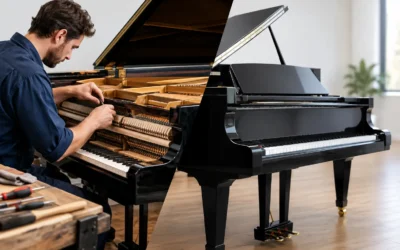
If the piano is open for viewing, examine the hammers. They should be aligned with the strings and show wear that is reasonably even across the keyboard. Deep grooves in the hammer felt, flattened hammer crowns, loose hammer parts, or visibly uneven alignment may indicate the need for service.
On a grand, look at the action only if you can do so without touching or disassembling anything. An experienced seller or technician can show you the hammers, dampers, and key mechanisms safely. On an upright, much of the action sits behind the front panel, where a quick visual inspection may reveal dust, moth damage, deteriorated felt, or evidence of past repairs.
Age alone does not tell the whole story. A carefully restored vintage piano may have a more dependable action than a newer piano that has received little maintenance. Likewise, an instrument that has spent years in unstable heat or humidity can develop action issues even if its exterior looks excellent.
Pedals and Dampers Matter Too
Action assessment should include the pedal system because pedals affect how the piano responds in actual playing. Test the sustain pedal by playing several notes and releasing the keys. The notes should continue ringing, then stop cleanly when the pedal is released. Dampers that lift unevenly or fail to stop strings consistently may need adjustment.
On grand pianos, test the soft pedal and observe whether the tonal change occurs smoothly. On uprights, the soft pedal usually moves the hammers closer to the strings rather than shifting the action sideways, so the effect may be subtler. The middle pedal varies by piano. It may operate a practice mute, a sostenuto function, or a bass sustain feature.
Pedal noise can be minor, but squeaks, rattles, and loose travel should be included in the condition discussion. A piano is a complete mechanical instrument, not just a keyboard with strings attached.
Compare Feel, Not Just Brand Names
Recognizable brands are a useful starting point, but every individual piano deserves its own evaluation. A well-cared-for Yamaha, Steinway & Sons, Blüthner, or other respected instrument can be a wonderful long-term choice. Still, the condition of its specific action matters more than the logo alone.
When comparing two pianos, play the same short passage on both. Try legato lines, repeated notes, soft chords, and a few stronger accents. Notice whether your hands relax into the keyboard or whether you begin adjusting your technique to overcome unevenness. The better piano is often the one that lets you focus on the music rather than the mechanism.
For beginners, an action that is even and predictable is usually more helpful than one that is unusually light. An overly light or poorly regulated keyboard can make it harder to develop finger strength and control. Advanced pianists may have more specific preferences, particularly around key weight, repetition, and tonal response.
When to Request a Professional Evaluation
A professional piano technician should inspect any instrument that represents a significant investment, particularly a used or vintage piano. This is especially true if you find sticking keys, poor repetition, uneven touch, excessive noise, visible hammer wear, or unclear service history.
A pre-purchase assessment can distinguish between routine regulation and a larger action rebuild. Routine work may be an expected part of preparing an older piano for its next owner. More extensive work can affect the overall value and should be reflected in the purchase decision.
At A440 Pianos, action condition is part of the larger conversation about matching an instrument to a player’s goals, home, and budget. Buyers should feel comfortable asking what service has been completed, what maintenance is recommended, and how the piano is expected to perform after delivery and tuning.
The best test is simple: play patiently, compare honestly, and trust what your hands tell you. A piano with an action that feels responsive and even invites you back to the bench, which is exactly what a fine instrument should do.
0 Comments