

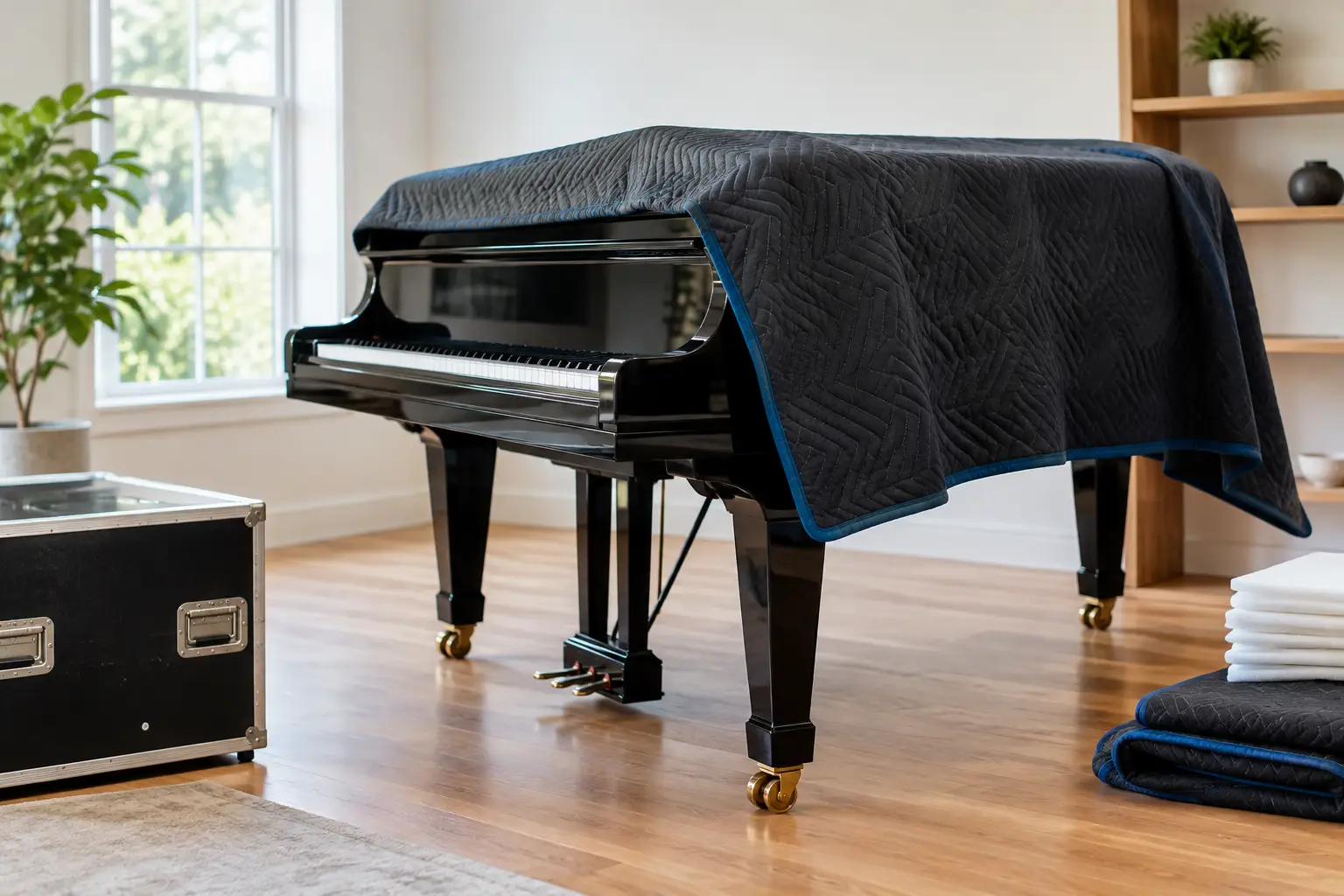
A piano can tolerate a quiet week in a carefully chosen room. It can suffer real damage after months in a damp garage, an unconditioned storage unit, or a home with dramatic swings in temperature and humidity. This piano storage guide explains what protects the instrument you value, whether it is a family upright, a Yamaha U3, a restored vintage piano, or a concert-worthy grand.
A piano is not only a substantial piece of furniture. Its sound and mechanical reliability depend on a precise relationship between wood, felt, strings, glue joints, metal hardware, and action parts. Proper storage protects that relationship, giving your instrument the best chance of returning to service in excellent condition.
Start With the Right Storage Environment
The best place to store an acoustic piano is inside a climate-controlled building that remains comfortable for people year-round. Aim for a stable temperature, generally around 68 to 72 degrees Fahrenheit, and relative humidity near 42 to 50 percent. Perfectly fixed conditions are unrealistic, but gradual, modest changes are far safer than repeated extremes.
Humidity is usually the greater concern. When air becomes too dry, the piano’s soundboard and pinblock can shrink. Tuning pins may lose holding power, wood joints can open, and the instrument may become harder to keep in tune. Excessive moisture causes the opposite problem: wood swells, action parts can become sluggish, strings may corrode, and mold can develop in felt and fabric components.
Avoid basements, attics, garages, sheds, porches, and standard self-storage units unless they provide genuine year-round climate control. A unit described as “indoor” is not necessarily climate controlled. Ask specifically whether temperature and humidity are managed in every season, including during power disruptions or extreme local weather.
For a piano that will remain in one home, placement matters just as much. Keep it away from exterior doors, sunny windows, fireplaces, HVAC vents, radiators, and kitchens. A grand piano needs breathing room from outside walls; an upright should not be pressed tightly against one. These locations expose the instrument to rapid environmental changes that can affect its tuning and regulation.
Piano Storage Guide: Prepare Before Moving
Preparation begins before the piano leaves its current room. A clean, documented instrument is easier to protect and easier to assess when it comes out of storage. Take clear photographs of the cabinet, pedal assembly, legs, lid, keys, and any existing finish marks. This is especially useful for a vintage piano or a high-value instrument with a polished finish.
Close and secure the keyboard lid. If your piano has a fallboard lock, use it, but keep the key in a safe and accessible place. Remove music, décor, lamps, and loose objects from the piano and bench. Do not tape the lid, pedals, or moving action parts directly to the finish. Adhesives can leave residue or damage lacquer, polyester, veneer, or delicate older finishes.
Before storage, arrange a professional evaluation if the piano has known concerns such as sticky keys, loose tuning pins, insect activity, water exposure, or cabinet damage. Storage will not correct an existing mechanical issue, and a minor problem can worsen when conditions change.
For the move itself, a professional piano crew should use equipment designed for the instrument’s weight, balance, and vulnerable components. That includes a properly fitted piano board for grands, padding that protects the cabinet without trapping unnecessary moisture, secure strapping, and a vehicle capable of keeping the piano stable in transit. A piano should never be moved on its own casters over distance, and a grand should never be lifted by its legs.
Choose the Right Cover and Position
A padded moving blanket is appropriate during loading, transport, and short-term staging. It is not always the right long-term cover. Thick blankets left on a piano for months can retain moisture and restrict airflow, particularly in a humid space.
In a dry, clean, climate-controlled room, the piano may need little more than a light, breathable cover to protect the finish from dust. A fitted fabric cover is preferable to plastic. Never wrap an acoustic piano tightly in plastic sheeting for long-term storage. Plastic can trap condensation against the cabinet and create conditions that encourage mildew, finish damage, or corrosion.
Store the piano on a level surface. If there is any risk of a damp floor, raise it carefully on sturdy supports chosen by a piano professional. Do not use improvised blocks, cardboard, or uneven pallets. An unstable base can stress the cabinet, affect leg hardware, and create a safety hazard.
A grand piano should be stored in its proper orientation, with the lid and pedal lyre protected according to professional moving practice. Upright pianos should remain upright. Laying an upright on its side or back for extended storage can place pressure on components not designed to carry the instrument’s full weight in that position.
Monitor the Space During Long-Term Storage
Long-term storage requires occasional oversight. A monthly visit is sensible if the piano is in a private storage room; for a unit, inspect it as frequently as access allows. Look for signs of water intrusion, musty odors, pests, rust on exposed metal, or a cover that feels damp.
A small hygrometer placed near the piano provides useful information about humidity conditions. If readings consistently fall outside the healthy range, correct the room rather than trying to solve the problem with a container of moisture absorbers beside the instrument. Depending on the climate, a humidifier, dehumidifier, or professionally selected piano climate-control system may help. The best solution depends on the size of the room, the instrument, and how consistently the building is conditioned.
Do not place food, cardboard boxes, cleaning chemicals, paint, or gasoline-powered equipment near the piano. These create pest risks, odors, and potential fume damage. Keep stored items several inches away from the cabinet so air can circulate and so you can inspect the piano without moving a crowded room around it.
If a piano will be stored for more than a season, do not expect it to remain perfectly in tune. Even excellent conditions cannot stop all pitch movement, especially after relocation. Tuning before storage may be worthwhile if the instrument will be played first, but the more useful appointment is usually after it has been placed in its new environment and allowed time to acclimate.
Bringing a Piano Back Into Service
Once the piano reaches its new home, give it time to settle before scheduling final tuning. The exact timeline depends on the distance moved, the season, and the difference between the old and new environments. A piano moved locally between two well-conditioned homes may adjust quickly. A piano that spent months in storage, crossed climates, or experienced humidity swings may need several weeks before it fully stabilizes.
Start with a careful visual check. Look for moisture marks, finish changes, loose hardware, or signs of pest activity. Then have a qualified piano technician evaluate the instrument. The service may include tuning, action regulation, pedal adjustment, minor repairs, and voicing if the tone has changed. A piano that has been in poor conditions may require more extensive work, which is why prevention is far more economical than restoration.
If you are unsure whether a particular storage situation is safe, ask before the move is scheduled. At A440 Pianos, professional moving and ongoing piano care are part of helping owners protect instruments well beyond delivery day. The right plan will vary for an upright in a condominium, a baby grand awaiting a renovation, or a collectible grand moving across state lines.
A good storage decision is ultimately a musical decision. Give the piano a stable room, experienced handling, and time to acclimate afterward, and it will be ready to welcome players back with the response, tone, and reliability that made it worth keeping.

0 Comments